
Two federal judges have issued conflicting rulings over the Trump administration’s use of a federal immigration database to help states check voter rolls for potentially illegal voters, creating a legal clash over whether purported privacy concerns can override state access to federal citizenship records.
The fight centers on the Systematic Alien Verification for Entitlements database, known as SAVE, which Republican-led states have sought to use to verify whether registered voters are U.S. citizens.
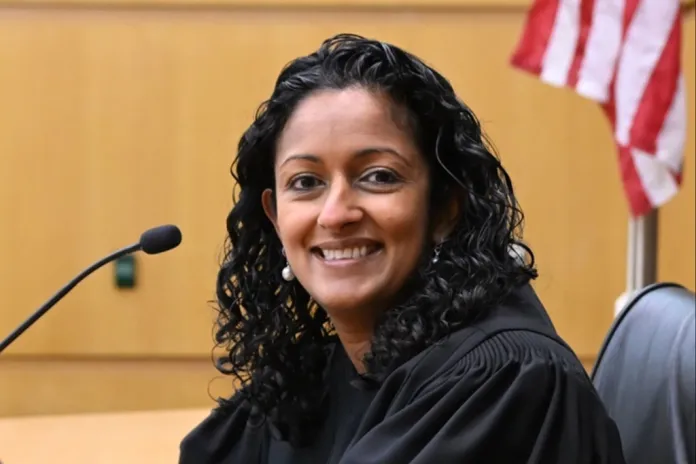
U.S. District Judge Sparkle Sooknanan, an appointee of former President Joe Biden in Washington, D.C., blocked the modified SAVE system nationwide on June 22 after voting rights and privacy groups argued the overhaul unlawfully exposed Social Security information and risked wrongly flagging eligible voters as noncitizens.
But U.S. District Judge T. Kent Wetherell II, an appointee of President Donald Trump in Pensacola, Florida, ordered the Department of Homeland Security on Tuesday to restore access for Florida, Ohio, Iowa, and Indiana, finding that DHS violated a settlement agreement with those states when it disabled key SAVE features to comply with Sooknanan’s ruling.
“The fact that Defendants disabled those features to comply with Judge Sooknanan’s order does not change the fact that they violated the agreement,” Wetherell wrote.
The Florida case began when Florida sued the Biden-era DHS in 2024, accusing the department of failing to respond adequately to state requests for citizenship verification. After Trump returned to office, DHS settled with Florida and three other Republican-led states, agreeing to maintain improved SAVE features, including bulk searches and Social Security number-based checks.
The Washington, D.C., case was brought separately by voting rights and privacy advocates challenging those same SAVE changes under the Privacy Act, the Social Security Act, and the Administrative Procedure Act.
Abhishek Kambli, a partner with Holtzman Vogel who recently departed the Justice Department‘s Civil Rights Division, argued that sequence is critical because Sooknanan’s decision came after the Florida settlement had already been entered.
Kambli noted that Sooknanan’s remedy was vacatur under the APA, meaning the agency action was set aside, rather than a permanent injunction directly barring DHS from operating SAVE. He argued that her ruling could not wipe out the Florida settlement agreement, which Wetherell has now ordered DHS to enforce. Other conservative critics accused Sooknanan of overstepping her authority by attempting to stop the federal government from using its databases.
“So if the vacatur was technically satisfied and there’s no permanent injunction in place, I think there’s a strong likelihood the Florida case wins out,” Kambli posted on X.
That distinction may explain why DHS is now caught between two courts. It shut down the disputed SAVE features after Sooknanan’s order, but Wetherell said that move still breached the settlement and ordered the features restored.
“One of the orders has to give,” Wetherell wrote, adding that he was “not persuaded” his should be the one to yield.
Sooknanan rejected the Trump administration’s request Wednesday to pause her ruling while it appeals. She also criticized Wetherell’s decision, saying he “erred in significant ways” and had no authority to make merits determinations about SAVE’s legality.
Critics of Sooknanan’s ruling say her decision also failed to account for federal statutes that support state access to citizenship information.
Hans von Spakovsky, senior legal fellow at the Edwin Meese III Institute for the Rule of Law at Advancing American Freedom, told the Washington Examiner that 8 U.S.C. 1373 is central to the dispute because the law bars restrictions on state and local officials obtaining citizenship information from federal immigration authorities.
“That statute is the key statute in this entire matter, as well as that Help America Vote Act provision that she fails to deal with, and it basically says that the order she issued is wrong,” Spakovsky said.
He also said Sooknanan ignored the Help America Vote Act, which requires voter registration applicants to provide either a driver’s license number or the last four digits of a Social Security number and directs states to work with the Social Security Administration to verify that information.
“Well, that’s exactly what the SAVE system is doing,” Spakovsky said.
Voting rights groups have argued SAVE can contain outdated immigration information, meaning naturalized citizens could be wrongly flagged as noncitizens and removed from voter rolls.
Sooknanan’s decision endorsed this argument, agreeing with parties who challenged the policy that it “knowingly trampled on the privacy rights of U.S. citizens in a manner that threatens the sacred right to vote.”
She also wrote, “Simply put, Section 1373(a) does not on its own authorize the establishment of the SAVE modified system — it is merely a prohibition on conduct.”
ABE HAMADEH BEGINS DRAFTING IMPEACHMENT ARTICLES AGAINST BIDEN JUDGE WHO BLOCKED VOTER DATABASE
The dueling decisions have turned the SAVE fight into a broader test of how far one district judge can go in blocking a federal election-related system when another court has already approved a settlement requiring the government to maintain it for several states.
Since Sooknanan’s ruling, she has faced threats of impeachment by a Republican congressman and even a complaint filed with the District of Columbia Court of Appeals’s Office of Disciplinary Counsel, accusing her of “dishonesty, fraud, deceit, or misrepresentation” related to her work at the DOJ under the Biden administration.