
The truest acts of moral courage are rarely about defending our own — they’re about defending someone else’s freedom. That is why American singer-songwriter John Ondrasik’s Independence Day performance alongside former Israeli hostage Alon Ohel aboard the USS Nimitz was far more than a moving musical moment. It was a reminder that America’s greatest strength has never been measured solely by its military might or global influence, but by its willingness to defend the dignity and freedom of others.
We hear a great deal about allyship today. Too often, however, it is defined by shared politics, shared experiences, or shared identity. Genuine allyship asks something harder: to stand beside people whose stories are not our own simply because it is the right thing to do.
Ondrasik had no personal reason to become one of the loudest artistic voices advocating for the Israeli hostages. He isn’t Jewish. He isn’t Israeli. He had never met Ohel before Oct. 7, 2023. His advocacy wasn’t born from identity. It was born from principle. In an era when Americans are increasingly encouraged to see the world through the lens of identity, Ondrasik reminds us that the strongest acts of moral leadership transcend faith, nationality, and politics. His example challenges all of us to ask a simple question: Are we willing to stand up for another person’s humanity, even when their story is not our own?
I’ve spent years interviewing ambassadors, military leaders, hostage families, survivors, and policymakers. Those conversations have reinforced one lesson above all others: history changes when ordinary people decide another person’s freedom matters as much as their own.
Long before the world watched the two musicians perform together, Ondrasik released “Superman for Alon and the Hostages” with one hope: that one day Ohel would accompany him on the piano.
“We all hoped and prayed,” he told me. “Though our hearts were full, in our minds we thought that was a very unlikely reality due to the evil that is Hamas.”
Still, he never let go of that promise. When Ohel was finally released and the two sat side by side at the piano, it wasn’t simply the fulfillment of a promise. It was proof that stories worth telling don’t end when the headlines fade. Sometimes they are only beginning.
When I asked Ondrasik what music can communicate that words often cannot, his answer was immediate: “Music is the only medium that can transcend cultures, borders, and reach our kids. Without the arts as soft power in this war for civilization, we will lose.” Whether or not one believes music is unique in that respect, it undeniably possesses an extraordinary ability to humanize people long after the news cycle has moved on. Music reaches places arguments often cannot. It reminds us that behind every headline is a human being, behind every statistic is a family, and behind every former hostage is someone with dreams waiting to be reclaimed.
Ondrasik also offered perhaps the clearest explanation for why he felt compelled to become involved in the first place. “If Hamas is not evil,” he told me, “nothing is evil.” Regardless of where one stands on the broader politics of the Middle East, his conviction was rooted in something much simpler than politics: innocent civilians deserve our humanity.
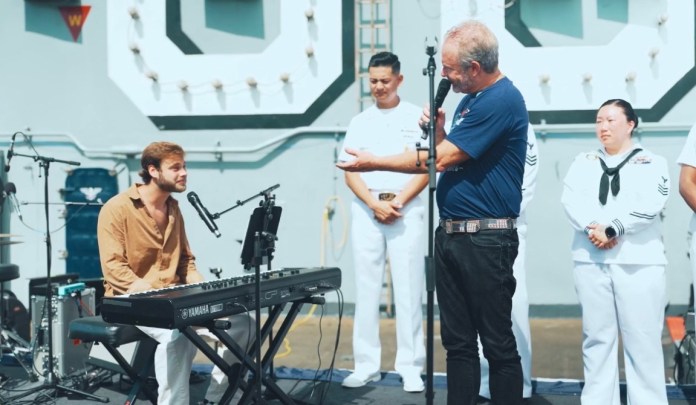
Watching Ondrasik and Ohel perform together, it became impossible to see only geopolitics. We saw resilience. Gratitude. Friendship. Hope. We saw freedom. For a few minutes, politics gave way to humanity. There was something profoundly fitting about this moment unfolding aboard the USS Nimitz. An American aircraft carrier became the stage for a timeless reminder that our country’s greatest strength is measured not only by the power it projects, but by the values it chooses to defend.
You don’t have to share someone’s identity to share their humanity.
Perhaps that’s why this performance resonated far beyond those who have followed the hostage story from the beginning. It wasn’t simply about Israel. It wasn’t simply about one former hostage. It was about the timeless belief that another person’s freedom should never become someone else’s inconvenience.
‘NO DEFENSE, ONLY OFFENSE’: AMERICA’S GROWING ANTISEMITISM PROBLEM REQUIRES MORE THAN SILENCE
When I asked Ondrasik what message he would have wanted Ohel to hear while he was still in captivity, his answer came without hesitation: “You are not alone.” Then I asked what message now unites two people from different faiths, different countries, and different backgrounds. Again, his answer was strikingly simple: “Do the right thing.”
Perhaps that is the lesson this performance leaves us with. It wasn’t simply about music. It wasn’t simply about Israel. It wasn’t simply about America. It was about a timeless truth: Freedom survives when ordinary people decide another person’s liberty matters as much as their own. Ondrasik stood beside Ohel because he understood a truth that should unite all of us: You don’t have to share someone’s identity to share their humanity. America needs more of that kind of allyship.
Ariella Noveck is a journalist specializing in antisemitism and Middle East affairs, with extensive experience covering Jewish communities worldwide.