
A new think tank report claimed that the total casualties in the Russia-Ukraine war have risen to over 2 million, including up to 600,000 deaths, but the confirmed total remains elusive.
The report from the Center for Strategic and International Studies, released on Wednesday, gave the think tank’s latest input on the grinding war that has now lasted longer than World War I. The study authors claimed that Russian casualties have reached 1.4 million, including between 400,000 and 450,000 deaths, and that Ukraine suffered between 525,000 and 625,000 casualties, including between 125,000 and 150,000 deaths.
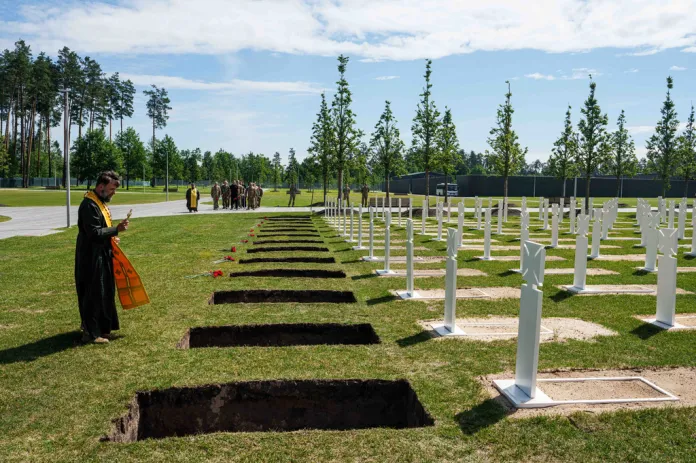
Even worse in the report’s telling, the casualty ratio for the first half of 2026 was 8:1 in Ukraine’s favor, compared with 2:1 or 3:1 previously.
Much of the study proceeded from these estimates, arguing that it illustrates a losing calculus for Moscow.
As for how the casualty estimates were quantified, the report said they came from “CSIS estimates; UK Ministry of Defense; analysis of data collected by Russian news outlet Mediazona and the BBC Russian Service; and interviews with U.S., European, and other government officials.”
Notably, the CSIS estimate of Russian casualties is the same number as that claimed by Ukraine’s Ministry of Defense.
The sourcing of the study faces the same issues as previous casualty estimates, which have become notoriously difficult to quantify due to Ukraine and its allies and Russia and its allies’ vested interest in downplaying their own casualties while inflating the enemy’s.
The Washington Examiner reached out to the author of the report for further clarification.
Difficulties with casualty estimates
The Russia-Ukraine war has become in many ways a PR war, as Russia seeks to keep the war effort going while avoiding public dissent over its own casualties, while Ukraine seeks to gain Western arms and support by downplaying its own losses and boosting those of Russia.
The only certainty of casualties from each side is a floor, which is provided by open-source analysis confirming individual deaths. The floor of Russian casualties comes from Mediazona and BBC Russia, which have a guaranteed number of Russian dead through analyses of social media posts, obituaries, and posts from regional authorities.
The latest confirmed number of Russians killed, calculated up to the week ending on June 18, stands at 227,734. The outlets also include an extrapolation to estimate the true number of casualties by taking into account the bureaucratic lag and number of missing, which they put at roughly 352,000 killed.
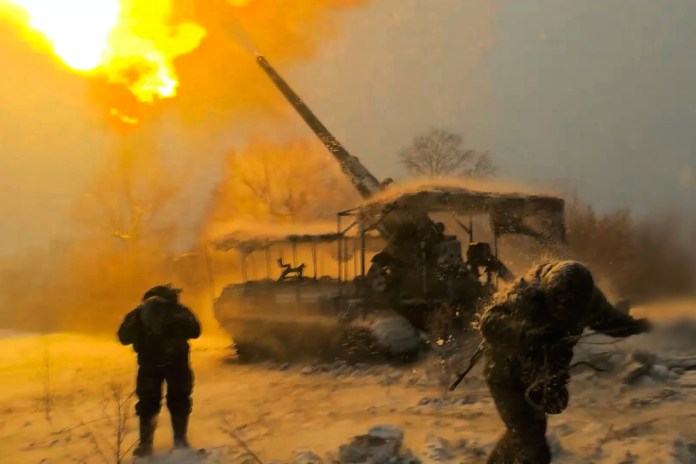
Ukraine’s floor comes from UAlosses.org, a Ukrainian open source intelligence project which tracks Ukrainian deaths through similar means, using announcements by local authorities and media, social media posts, and monuments to the dead. It acknowledges the true total is much higher, as available data is scarce for “large cities, Transcarpathia, and most localities in the east and south,” making the count “likely only a fraction of the real toll. Large cities and localities in the east are likely to have disproportionately higher numbers of casualties.
The confirmed number of Ukrainian military deaths since Feb. 24, 2022, is given as 103,418. However, it separately includes the number of missing, with many, if not most of these likely dead: 97,938. Another 11,618 were counted as prisoners. Adding together the number of dead and missing, the total is 201,356.
Russia’s death total is actually easier to quantify due to the accessibility of its non-classified but restricted national probate system, a non-military-related bureaucratic system used for settling inheritance cases. Mediazona uses this database to give a rough estimate of the true death toll — it tracks the rate of cases opened for military-aged men against women of the same cohort. Since the vast majority of soldiers killed are men, it can compare the spikes in cases to prewar rates, and attribute new male deaths in excess of this to the war.
Ukraine has been more vigilant about restricting all demographic data to prevent Russia from properly estimating the attrition it is inflicting against Kyiv. Whether for the interest of state secrecy or a lack of interest from journalists, Ukraine’s national probate registry isn’t readily accessible to provide a proper extrapolation.
A rough estimated range of Ukrainian dead can be given using the extrapolation from the confirmed Russian dead to the national probate registry total. The biggest variable is how many of those missing are dead. A joint Mediazona and Meduza investigation into leaked records from Russia’s 1st Guards Tank Army found that about 50% of those missing ended up being dead, a figure that provides a convenient floor for the proportion of Ukrainian missing that are dead. Given that Russia has mostly been the advancing side throughout the war, it can be reasonably assumed that Ukraine suffers a higher proportion of dead counted as missing than Russia, as it has greater difficulty recovering bodies from seized territory.
Estimating the number of missing Ukrainian soldiers who are dead at 50% to 100%, Ukraine’s extrapolated total of war dead can be roughly placed at 246,000 to 325,000. Given the lack of data from large cities and eastern regions, the true total is likely higher.
The last CSIS report on Russia-Ukraine war casualties in January received measured criticism from Meduza, a premier pro-Ukraine/Russian opposition outlet. It questioned the methodology of the casualty statistics, pointing out that while assuming 50% to 60% of Russian dead don’t make it onto named lists, it assumed nearly all Ukrainian dead were on named lists. More telling is a statistic suggesting rough casualty parity.
“Second, officer casualties on both sides are almost identical: 6,534 for Ukraine, 6,168 for Russia,” the outlet wrote. “That’s hard to reconcile with a 2–2.5 to 1 ratio overall, as the report claims.”
The outlet also cautioned against claims of casualties altogether, as counting wounded is much more difficult given a lack of concrete records.
Altogether, the most accurate death counts have Russia and Ukraine experiencing a much closer casualty ratio than suggested in the CSIS study.
The claim of an 8:1 casualty ratio for the first half of 2026, one of the study’s biggest claims, is likely to attract the most criticism. The war’s two major shifts over the past half year have been Ukraine stepping up its long-range drone campaign against Russian oil infrastructure and its short and medium-range drone campaign against Russian logistics, using artificial intelligence-assisted drones. Both of these developments cause economic and logistical issues, but don’t cause any notable personnel casualties in and of themselves.
Russia has also been doing the same to Ukraine at a much greater scale for the past few years.
Aside from Ukraine’s expanded strategic drone campaigns against energy infrastructure and logistics, the past half year hasn’t seen a major change in tactics. Russia continues to rely on small assault squads, only two- or three-men strong, to infiltrate through Ukrainian positions, something outlined in the CSIS study. Many Russian casualties come from FPV drones hunting these small groups individually.
Ukraine and Russia have both invested heavily in FPV drone production, but Russia’s established defense industrial base likely gives it a quantitative advantage. Qualitatively, the two are almost evenly matched, with investment in elite drone teams on both sides.
Historical comparisons
Whatever the true casualties, the floor of deaths makes the Russia-Ukraine war the bloodiest fought by a major power since World War II. The scale of casualties is hardly surprising given the unique nature of the conflict, however; the war represents the first time two large, developed, near-peer rivals of roughly equal technological capabilities have engaged each other in all-out battles using most of their combat potential since 1945.
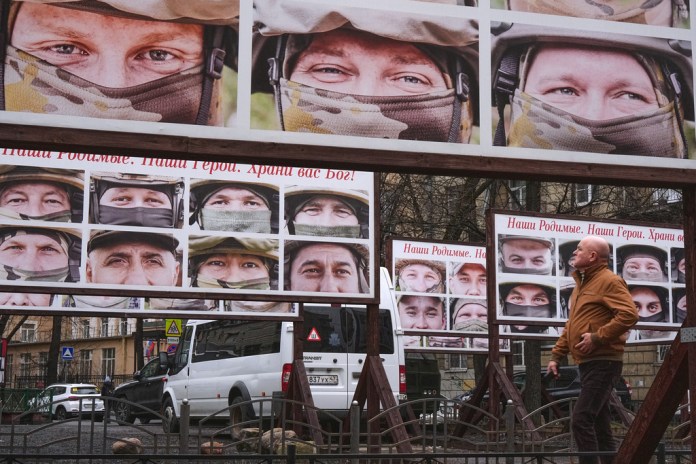
Most conventional wars of recent history have been between technologically or quantitatively mismatched foes, with casualties likewise heavily skewed in favor of the superior side. The U.S.-Israeli war against Iran made history of its own by being the most lopsided in terms of casualties, amounting to nearly 375 Iranian military personnel killed for every single U.S. and Israeli soldier. Russia’s wars before Ukraine were also against inferior foes, resulting in relatively low casualties. Even given the most conservative estimates, the war in Ukraine has killed more Russian soldiers than all of its wars after World War II combined.
The death toll also surpasses every U.S. soldier killed across wars in Korea, Vietnam, and the Middle East combined. Whether it has surpassed the number of U.S. dead in World War II, a number totaling around 415,000, depends on which estimate is used.
The closest equivalent to the Russia-Ukraine war is the 2020 Nagorno-Karabakh war between Armenia and Azerbaijan. While most of their military hardware was comparable, Azerbaijan possessed air supremacy through its clear superiority in drone technology, a preview of the unparalleled role drones would play in Ukraine two years later. Accounts are split as to the final death count, but the smaller size of the two and the relatively short duration of the war, 44 days, capped the total number of deaths at around 10,000.
Russia and Ukraine are many times larger than both Armenia and Azerbaijan, and they are backed by the world’s leading economies. The war has taken place across a much larger area as well.
Despite the unparalleled carnage, the Russia-Ukraine war still falls short of claiming the title of the deadliest post-World War II war, a title that belongs to the Second Congo War fought from 1998 to 2003, which killed anywhere from about 3 million to 5.4 million people.