
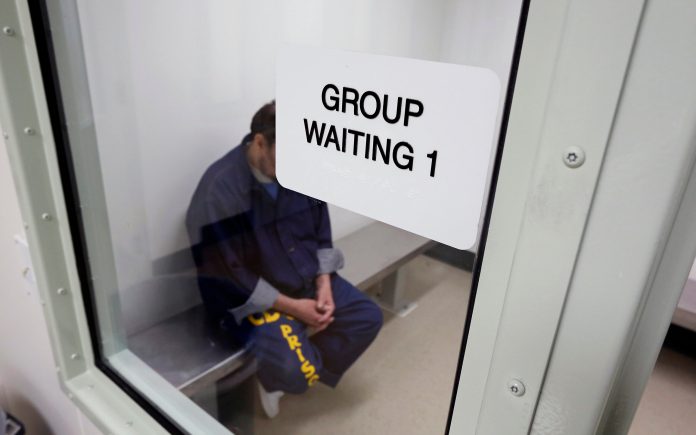
Last month, a new state-run psychiatric hospital opened in Dallas, one of the first built in several decades. The Texas Behavioral Health Center is part of a multi-year, multibillion-dollar investment by the state to rebuild and modernize its state hospital system. No other state has made a dedicated investment of this kind, despite a nationwide shortage of psych beds.
Texas’s investment represents a needed shift. While states have poured tens of billions of dollars into unaccountable generic mental health efforts, serious mental illness has remained chronically undertreated. States need a strategy for serious mental illness. Texas is providing a framework for that.
Serious mental illness, best represented by schizophrenia, is distinct from common anxiety, depression, and ordinary distress. It warrants special attention. Serious mental illness causes functional impairment and often involves psychotic symptoms. Although it affects only about 5% of Americans, it accounts for a disproportionate share of the street homeless and incarcerated. Neglected by the mental health system, these hardest cases put other public systems under strain: social services, courts, and emergency departments.
Inpatient care is often medically necessary at some point for the seriously mentally ill. But America has too few psych hospital beds. Decades of deinstitutionalization and financial incentives that favor outpatient services have left state hospital bed capacity reduced by 97% from its 1955 peak.
Bed shortages are exacerbated by community mental health primarily serving the “worried well.” Public funding has expanded access indiscriminately regardless of need, acuity, severity, or risk of violence. Services go to those who show up first, which works poorly for nearly half of the seriously mentally ill who won’t voluntarily self-refer.
Broad mental health efforts are billed as prevention for serious conditions. But almost no one with a generic distressing problem — such as bad grades, teen angst, divorce, or job dissatisfaction — will ever develop a disabling psychiatric condition.
Lack of targeting and accountability is the problem, not a lack of funding. States spent over $61 billion on community mental health in 2024, excluding tens of billions spent by the federal government. What’s been the return on investment? Mass mental health for the worried well has not reduced the prevalence of serious mental illness, nor their rates of homelessness, arrests, or incarceration. Wellness outcomes haven’t improved for the broader public, either.
For greater accountability, states should establish an explicit initiative on serious mental illness — a narrowly-focused program that has a formal agenda and stated goals, not just rhetoric about ambiguously improving mental health. For first steps, look to Texas.
A serious mental illness initiative must commit to state hospitals. Investment in state beds is the clearest signal of focused resources, because hospitals exist to serve the hardest cases. Inpatient care is often framed as antithetical to community mental health, but an effective community-based system depends on inpatient beds. Without sufficient institutional capacity, community programs have no partner to send patients to during acute decompensation when they can’t handle themselves. Collaborative efforts among providers, social services, and law enforcement should include state hospitals for this reason.
A serious mental illness initiative must also define goals and outcome metrics. This agenda guides resource allocation, since even the best-funded programs will never meet all demand. Key metrics should be reducing violence from untreated serious mental illness and improving continuity of care. Texas’s current legislative priorities reflect this: the state is considering how to prioritize its most acute populations to reduce public safety threats.
Such a program also needs clear ownership. Accountability is easier when responsibility for outcomes sits with someone specific, rather than diffused across agencies pursuing separate efforts. Texas illustrates this gap: state hospital construction, forensic competency restoration beds, and jail diversion programs are all underway, yet it’s not organized under a single, explicit initiative on serious mental illness. Making the most of related investments will include naming an owner and consolidating efforts into one cohesive program.
RESTORING AMERICA: DECLINING OBAMACARE ENROLLMENT ISN’T THE CRISIS CRITICS CLAIM
Past that initiative, the bar for public mental health funding must be higher than universal programs, which have the clearest evidence of no benefit and documented harm. Mental health education, awareness campaigns, and widespread screening are prime examples. Often delivered through schools, these programs misallocate resources away from serious mental illness and drive overmedicalization by pathologizing normal distress.
Texas is rightly reviewing its Texas Child Mental Health Care Consortium, which includes universal programs like “TCHATT” that deliver mental health education, awareness training, and student tele-mental-health services. The consortium reports delivering around 130,000 school-based services to 27,332 students through TCHATT. But nothing is known about whether students needed the services they got, were helped or harmed, or were served with confirmed parental consent. Nearly half were referred to community treatment, and 15% received medication management; without more information, these metrics could represent overmedicalization, not success.
Carolyn D. Gorman is a fellow at the Manhattan Institute.