
When a priest of the Catholic Church is being consecrated as a bishop, the prelate elevating him is required to ask for the Apostolic Mandate — the formal approval of the pope for his new office — to be read aloud by a notary for all those in attendance.
But when the Society of St. Pius X defied the Holy See and consecrated four new bishops in a meadow of Écône, Switzerland, on Wednesday, Bishop Alfonso de Galarreta’s notary didn’t have an Apostolic Mandate to read. Instead, observers listened to a bizarre and mealy-mouthed statement about the “necessity” of the occasion, despite unambiguous orders from Pope Leo XIV not to proceed.
“It is the Catholic and Roman church, always faithful to the traditions received from the apostles, who in entirely exceptional circumstances demands that we provide for the upholding of these traditions, that is the deposit of faith and that we take the means necessary to transmit them faithfully to all men for the salvation of their souls,” the consecrating bishop’s notary said in place of an actual mandate. “From Vatican Council II up to the present day, the authorities in the Church have been animated by a spirit that is contrary to that of the faith and have been acting against holy tradition. They will no longer endure sound doctrine, turning their hearing away from the truth and turning toward fables.”
All the clerics involved are now excommunicated from the Catholic Church. No paperwork was necessary. According to Catholic doctrine, illicitly consecrating a bishop without the approval of Rome, or receiving such an illicit consecration, activates the automatic and immediate penalty upon one’s soul.
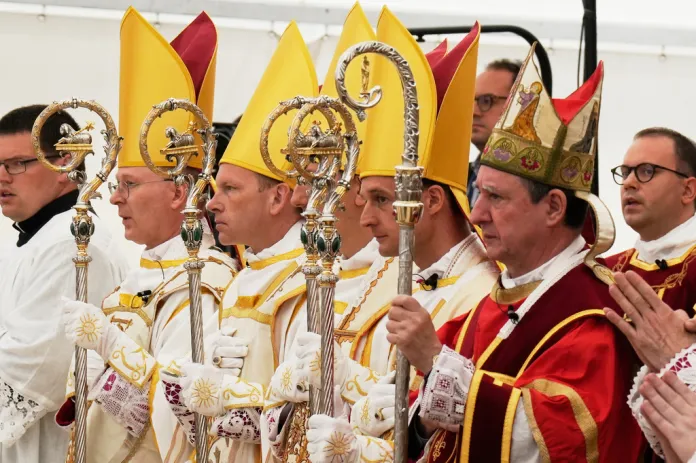
It is a remarkable collapse in relations between the Catholic Church and what used to be its preeminent internal critics. Now, these clerics have moved from the extreme fringe of the Church to a space unambiguously outside it.
The Society of St. Pius X is a traditionalist Catholic community that has, for decades, drifted in and out of communion with the greater Catholic Church. The priestly fraternity, named in honor of the anti-modernist Pope St. Pius X, was founded in 1970 by Archbishop Marcel Lefebvre in response to liturgical reforms issued by the Second Vatican Council (also known as Vatican II).
SSPX priests only celebrate the “Traditional Latin Mass,” an all-Latin liturgy codified in 1570, and claim the “New Mass” as formalized in Vatican II is inferior and insufficiently reverent. The group also laments a perceived drift within the Church toward the error of “modernism.” SSPX leadership has always maintained that they are not schismatic, only committed to tradition and opposed to theological errors they claim have plagued the church since Vatican II. They acknowledge the papacy as legitimate but decline to bind themselves to its authority.
The society, finding itself in recent years without young bishops who will be able to validly shepherd the community after this generation of geriatric prelates dies off, first announced its intentions to consecrate four new bishops in February. The Holy See immediately issued an order to suspend the consecrations and invited SSPX representatives to participate in a discussion about their theological hang-ups.
Instead, SSPX leadership repeatedly pressed the Vatican for a personal meeting with Pope Leo. These requests were ignored. The society published an open letter to the pontiff and his cardinals earlier this month with an attached “Profession of Catholic Faith,” which reaffirmed their disputes with the Holy See and their intention to consecrate.
The Vatican was largely silent in the run-up to the ceremony, though stray comments from cardinals showed the impending schism was on their minds.
Leo, in an unexpected gesture, issued his own letter to SSPX Superior General Fr. Davide Pagliarani on Tuesday, the day before the consecrations, urging him toward “dialogue and understanding” instead of schism.
“Filled with Christian affection, I plead with you and ask you with all my heart: please turn back! I urge you to consider carefully the spiritual good of the faithful, because the schismatic act you are about to undertake would deprive them of the licit and, in some cases, even valid reception of the Sacraments, which they love and seek for their sanctification,” the pontiff wrote.
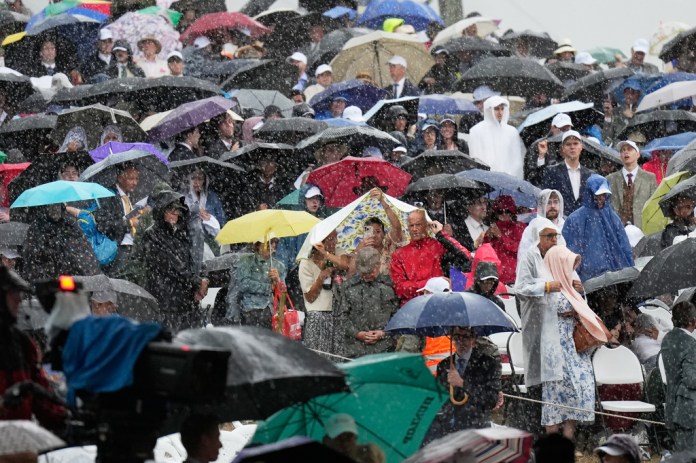
Pagliarani published a reply to the pope the same day, stating that the consecrations would go on as planned but asking the Holy See to suspend the penalty and embrace SSPX as faithful Catholics in full communion.
“Far be it from us to separate ourselves from the Roman Church. We desire, on the contrary, to serve her by means that are extraordinary, as one would assist a mother in distress who requires particular help, even if such help is not understood by everyone,” the superior general wrote back. “The Holy See has shown itself capable of understanding very complex situations and of allowing time for discernment. May I therefore filially ask Your Holiness to take the time necessary for that discernment.”
TRUMP’S BIG-TENT RELIGIOUS APPEAL DOESN’T CARE ABOUT CREED OR DENOMINATION
Cardinal Víctor Manuel Fernandez, Prefect of the Dicastery for the Doctrine of the Faith, offered a surprisingly gentle statement following the episcopal consecrations.
“They didn’t consider useful the dialogue we’ve proposed. But we hope in future, thanks to the action of the Holy Spirit, it’ll be possible,” the Vatican doctrinal chief told the Catholic Herald on Wednesday. “I’m sure, but we’ll need time.”
The SSPX does not seem to be particularly concerned about the idea that its actions have excommunicated its clerics, though a later statement on Wednesday said: “The Society sincerely regrets that, owing to exceptional circumstances, these consecrations had to be conferred without the authorization of the Holy Father.”
The excommunication from society can only be lifted by the pope, who has not publicly commented on the situation since his letter on Tuesday was ignored.