
Despite the doom and gloom of America’s naysayers, passion for American values runs far past our shores. Over the past few weeks, social media feeds have been filled with stories of the world visiting the United States for the World Cup — most notably, the exploits of Scottish fans visiting Boston. A match made in heaven: no beers were spared, boats were rented to avoid Boston’s seemingly archaic drinking laws by Scottish standards, and most heartwarming of all may have been the Scots singing the “Flower of Scotland” following the national anthem at a Red Sox game.
The Scottish-American relationship is deeper than a love of beer or the passionate singing of our own national anthems. In fact, it finds its roots in philosophy.
The Tartan Army’s appreciation for American values and hospitality is rooted in the invaluable impact that was left on this country by a former Scot’s teachings. Scottish philosopher and economist Adam Smith’s The Wealth of Nations shares its 250th birthday with our Declaration of Independence.
This is no mere coincidence. Smith’s theories are what shaped America’s free market, helping foster a society built on opportunity, individual initiative, and the freedom to pursue one’s own success. Those principles have long attracted admiration from visitors around the world and remain a cornerstone of the American character that so warmly welcomed Scotland’s supporters.
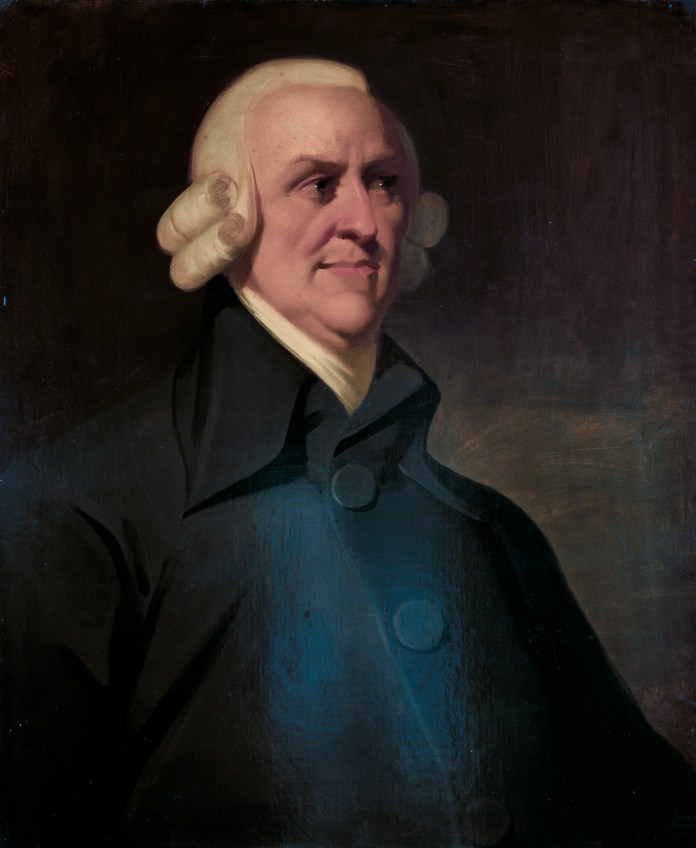
The founders considered numerous historical texts when drafting the Constitution and outlining the purpose of the American government, taking inspiration from Montesquieu, Cicero, John Locke, William Blackstone, and the Magna Carta. Smith’s ideas were already circulating among the founders as they built a new government, and his fingerprints are visible throughout. Those contributions are evident in the Constitution and its protections for property, its restraint on government power over commerce, and its implicit faith that a free people could organize their own affairs better than a distant authority could.
Smith’s most famous concept was the “invisible hand,” which hypothesized that individuals pursuing their own interest, within a framework of law and free exchange, would produce more prosperity than any monarch or government directing the economy from above. He attacked the prevailing belief of mercantilism — that nations grew rich by hoarding gold and restricting trade — and instead argued for open markets, the division of labor, and limited government interference in commerce. Freedom of movement and choices, not control, was the source of wealth.
Smith’s ideas made their mark on many of the founders. Alexander Hamilton, despite his reputation as a champion of a strong central government, leaned on Smith’s analysis of commerce and capital in shaping his economic vision for the new republic, even while disagreeing with him on the merits of manufacturing subsidies. James Madison engaged seriously with Smith’s writing on factions and self-interest, ideas that fed directly into Federalist No. 10’s argument that a well-structured government could channel competing interests toward the public good.
Smith similarly argued markets could turn private ambition into collective benefit. Thomas Jefferson kept The Wealth of Nations on his personal reading list and praised it as the best book on political economy available. Benjamin Franklin reportedly knew Smith personally in London and discussed early drafts of the book with him.
RESTORING AMERICA: AMERICA-HATERS WON NEW YORK. GLOBAL SOCCER FANS LOVE AMERICA ANYWAY
Smith’s greatest impact on America may not necessarily be limited to the Constitution, but more broadly on the instincts it instilled in the average American worker. Those beliefs of hustle and self-reliance are virtues that still dominate dialogue around work and opportunity. That success earned through effort is worth admiring rather than resenting. The government’s job is mostly to stay out of the way and let people strive to innovate. Those beliefs live on in the cultural respect for small businesses and self-made entrepreneurs. Few Americans have read The Wealth of Nations, but most have absorbed its premise without even knowing. Freedom to pursue your own interests, far from being selfish, is what makes a free society work.
So when Scottish voices rose over Fenway Park this summer, singing with the same unrestrained pride Americans bring to their own anthem, it seemed altogether fitting. Two nations built, in part, on the same notion that free people can build even greater things than a ruler ever could. Yet even the invisible hand couldn’t prepare Boston for the onslaught of Scots.
Marc Wheat is general counsel of Advancing American Freedom.
Connor Bolster is an intern at Advancing American Freedom.