
The following is an installment of “On This Day,” a series celebrating America’s 250th anniversary by following the actions of Gen. George Washington, the Continental Congress, and the men and women whose bravery and sacrifice led up to the signing of the Declaration of Independence.
June 28-29th 1776
Two of the most breathtaking, high-stakes days of the American Revolution.
The American experiment is on the line. In a span of 24 hours, the fledgling nation faces a massive foreign invasion, a dark internal betrayal, a desperate coastal bombardment, and the birth of its founding document.
On the morning of June 28, 1776, 45 enemy ships sailed into view, dropping anchor at Sandy Hook. Behind them, dozens more sails broke the horizon line.
Gen. George Washington received the frantic dispatches at his Manhattan headquarters. It was the vanguard of the largest British amphibious invasion force in history, carrying thousands of seasoned redcoats and Hessian mercenaries.
Washington’s defenses were dangerously porous. The local militia was arriving agonizingly slowly. Sensing the supreme urgency of the hour, Washington spent his evening penning a desperate letter to New Jersey political leader William Livingston, pleading that “not a moments time” be lost in sending men forward to New York. The war had arrived at their doorstep.
While British ships crowded the harbor, Washington had to confront an enemy already inside his gates.
Just days earlier, a terrifying Loyalist conspiracy had been uncovered: a plot to mutiny, sabotage New York’s defenses, and potentially assassinate Washington himself. Most horrifying of all, the plotters had infiltrated Washington’s elite personal bodyguard, the Commander-in-Chief’s Guard. The ringleader in the ranks was Thomas Hickey.
Washington knew that a divided city and a nervous army could not afford mercy.
By Washington’s explicit General Orders of June 28, 1776, Hickey was marched to a field near Richmond Hill. Upwards of 20,000 spectators, including every military brigade not on vital duty, stood in stunned silence. Hickey was swung from the gallows. The message Washington sent to his troops and the watching world was unmistakable: betrayal ends at the gallows.
Hundreds of miles to the south, a completely different drama was exploding in Charleston Harbor, South Carolina.
A formidable British naval squadron, commanded by Commodore Peter Parker, unleashed a merciless, hourslong bombardment on a tiny, unfinished fortress on Sullivan’s Island.
The British expected the fort to crumble within minutes. What they didn’t account for was the native architecture. The fort’s walls were packed with soft, spongy palmetto logs.
Instead of shattering the wood and sending lethal splinters flying through the air, the British cannonballs simply buried themselves harmlessly into the resilient wood.
The patriot defenders, though heavily outgunned, stood their ground and fired back with lethal precision. By sunset, the British fleet was badly battered and forced to slip away, delivering the Americans a stunning, miraculous victory that saved Charleston from occupation for years to come.
While blood was spilled in the South and gallows were being raised in the North, five men walked into the Pennsylvania State House in Philadelphia.
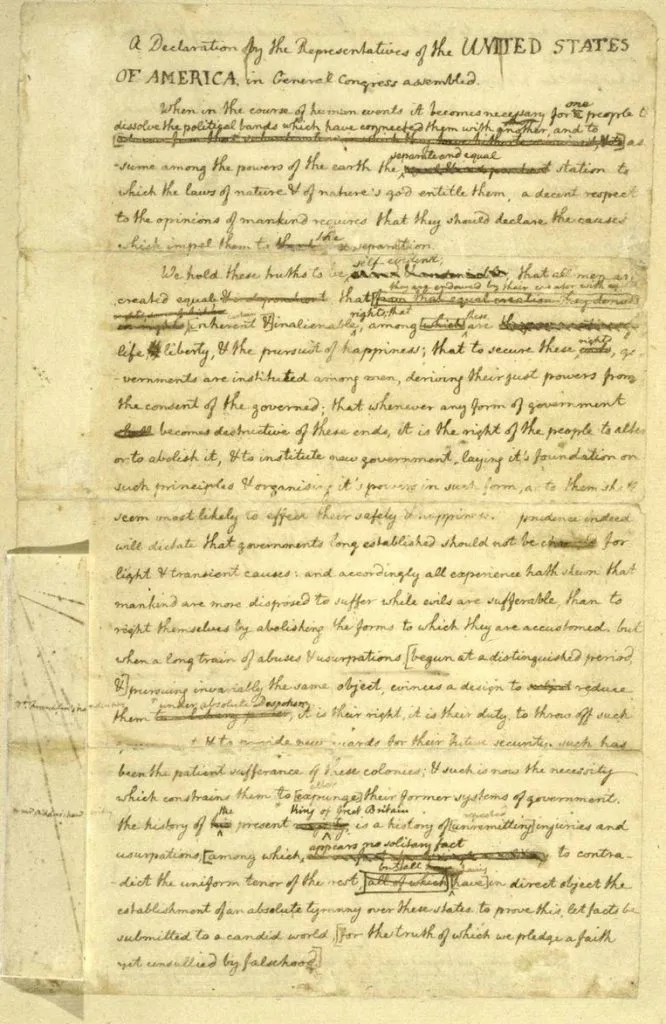
Thomas Jefferson, John Adams, Benjamin Franklin, Roger Sherman, and Robert Livingston — collectively known as the Committee of Five — had spent weeks wrestling with words. On June 28, they walked to the center of the Continental Congress and presented their draft of the Declaration of Independence.
As the clerk read Jefferson’s revolutionary words aloud, the delegates knew that agreeing to them would mean signing their own death warrants if the revolution failed. Yet, surrounded by the literal smoke of war from New York to South Carolina, they resolved to push forward.
ON THIS DAY: WASHINGTON’S SUPPLY NIGHTMARE
These two days proved to the colonists that they could survive a British naval onslaught, that their army would hold the line against treason, and that their leaders had the courage to put a vision of freedom on paper.
Less than a week later, that very draft would be adopted, changing the shape of human history forever.