
This is the age of the YOLO candidate. Are you a terrible person with a clear record of awfulness? You would be perfect for the U.S. Senate! Democrats have found just that sort of guy in Maine; Republicans have found one in Texas. Both would be perfect additions to the large and growing cast of bloviators, morons, and preening hacks that constitute what was once known as the world’s most deliberative body.
Both sides justify these candidates along similar lines: “[Institution or policy] has failed [interest or faction that sees its demands as indistinguishable from the national interest]. Our only response is to elect [person of bad character that we like]. And anyway, the other side has done worse!”
These arguments often have a ring of partial truth to them. Lots of policies are not working, our system of government stubbornly resists change, and people are unhappy about the status quo. Still, a little perspective is called for. Our current state of the union could certainly be better, but it is not like it is 1929, or 1941, or even 1968, for that matter. Inflation is still running a little hot. Education and healthcare in particular are too expensive. But the wheels are not coming off.
And even if they were, do we the people really have the right to elect any random jackass to office? Sure, we have the power, in the sense that our system of government is premised on the principle of majority rule. If half plus one of Maine voters elect the guy with the Nazi tattoo to the Senate, he gets to go. But we the people have a duty to at least try to elect good people to government.
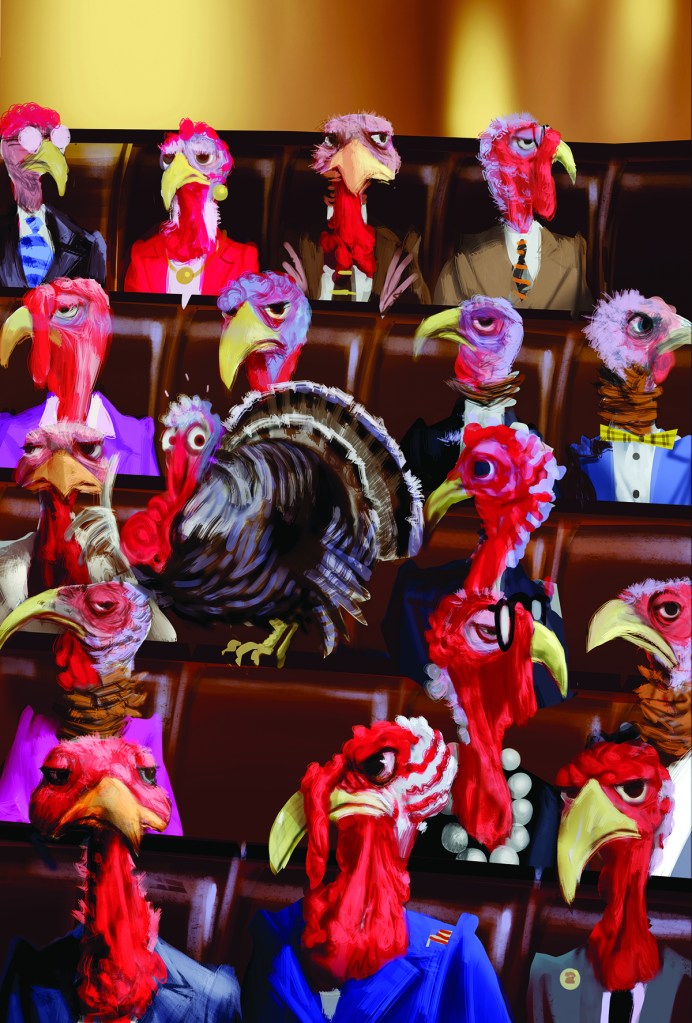
That point often gets missed in our hyper-democratic age. Politicians always speak reverently of the American people — never in error, always legitimate in its demands, perpetually wise. But our system of government is a republic that seeks to temper the majoritarian impulse, as it can often be unwise. This is why our system has features like separation of powers, bicameralism, and checks and balances. The point of all this is to empower the people to rule but reduce the chance they misrule.
And while the founders did not believe the people would possess civic virtue to a heroic level, they did anticipate at least a minimal threshold of wisdom. As James Madison wrote in Federalist 55, “As there is a degree of depravity in mankind which requires a certain degree of circumspection and distrust, so there are other qualities in human nature which justify a certain portion of esteem and confidence. Republican government presupposes the existence of these qualities in a higher degree than any other form.” And in Federalist 57, Madison talks about the need “to obtain for rulers men who possess most wisdom to discern, and most virtue to pursue, the common good of the society.”
These two points about virtue are related. The founders did not expect the average American to always and everywhere perceive what the common good is. That is beyond the reach of most people at most times. But what they did expect was that the average American would be able to figure out which prospective leaders had that capacity. That was one of the great advantages of representative government. Not only does it make it feasible to extend republicanism across something greater than a New England town or Greek city-state, which are limited by the logistics of direct democratic participation, but it is also a way for the people to elevate the best among themselves. Again to quote Madison, this time from Federalist 10, representative government can “refine and enlarge the public views, by passing them through the medium of a chosen body of citizens, whose wisdom may best discern the true interest of their country, and whose patriotism and love of justice will be least likely to sacrifice it to temporary or partial considerations.”
But all this has to start with we the people. If average Americans are not insisting on wise and prudent leaders to go into government, the whole process of representation malfunctions. The government stops reflecting our best virtues and instead represents our worst impulses. That means we should be supporting candidates that are not just principled, but also exhibit some of the qualities leaders should possess. Do they understand how our government actually works? Can they grasp the complicated details of public policy? Do they have an open mind? Are they willing to compromise when opportunities for common ground appear? Do they have a good temperament? Have they conducted themselves honorably in their personal lives? Not everybody is going to be a George Washington. But he should still be the standard by which we measure our leaders.
When the Constitutional Convention adjourned, Benjamin Franklin was famously asked, “Well, Doctor, what have we got, a republic or a monarchy?” His famous response was, “A republic, if you can keep it.” Franklin’s response captures the essence of the Constitution. Despite all its various instruments to prevent the abuse of power, the government it creates is a republic only if we ourselves do our part. Are we really doing that in 2026? A quick glance at the members of the U.S. Congress suggests the answer is: not as well as we could. No doubt, there are many quality people in our legislature, but the number of disreputable characters is large, and looks to keep growing.
And we the people have no excuse. In the 19th century, we could blame the party machines for foisting bad candidates upon us, forcing us to pick among terrible options. But in the age of party primaries, the power to select from an array of potential options now rests with the people alone. We could choose to elevate literally anybody to public office. If bad people are being elevated, that is our fault, not some cabal of insiders.
WHAT THE SUPREME COURT’S TARIFFS RULING SAYS ABOUT JUDICIAL POWER
As we approach the 250th anniversary of the Declaration of Independence, it is worth remembering that we are now the legatees of a great tradition of republican self-government. Indeed, ours is the greatest tradition — for we proved to the world, at that point universally in one form of tyranny or another, that the people can govern themselves.
Today, we do not just get to enjoy the benefits of what our forefathers had done. We must continue in that tradition. That means taking the job of citizen more seriously than we do. It is not just a matter of government responding to our demands, but also making sure that we are electing fit characters to do the work. We’re not doing that nearly as well as we could be.
Jay Cost (@jaycost) is the Gerald R. Ford senior nonresident fellow at the American Enterprise Institute.