
President Donald Trump’s media company and video-sharing platform and Rumble are escalating a closely watched legal battle against the Brazilian government, arguing that a top Brazilian judge attempted to censor U.S. users and regulate speech through secret overseas court orders.
The lawsuit filed by the companies in February names Brazilian Supreme Federal Court Justice Alexandre de Moraes, who has become a target of criticism after he ordered social media platforms to suspend accounts accused of spreading disinformation, among other past orders targeting U.S.-based social media platforms like Elon Musk’s X. The parent company over Trump’s Truth Social media platform and Rumble argued Moraes’s orders against their companies reached beyond Brazil’s borders and unlawfully targeted speech protected by the First Amendment.
What the plaintiffs ultimately seek is a judgment that makes clear that no foreign official may use secret orders to regulate speech inside the United States, compel U.S. platforms to censor U.S. users, or obtain private data of U.S. users while bypassing U.S. law and U.S. legal process.
The companies moved last week in Florida federal court for a clerk’s entry of default against the Brazilian judge after alleging Moraes failed to appear or respond to the lawsuit by a June 15 deadline, despite being served through a court-authorized email process. According to court records, plaintiffs’ attorneys successfully delivered the lawsuit materials to one of the email addresses approved by presiding U.S. District Judge Mary Scriven after traditional service efforts under the Hague Convention proved unsuccessful.
Moraes ultimately did not respond before the deadline, prompting Trump Media and Rumble to seek a default judgment in favor of their side.
“Defendant has neither appeared, responded, requested additional time, nor otherwise defended this action,” the plaintiffs wrote in a June 18 filing. They further argued that lawyers representing the Federative Republic of Brazil, which moved to intervene on the final day before the deadline for Moraes, “do not represent” the judge and therefore cannot cure his failure to appear.
The case has evolved into a broader clash between U.S. free speech protections and Brazil’s efforts to police online content within its own borders.
Brazil has asked to intervene and dismiss the lawsuit, arguing it is the real party in interest and that Moraes is entitled to immunity because the challenged actions were taken as part of his judicial duties.
Scriven, an appointee of former President George W. Bush, permitted Brazil to intervene but deferred ruling on its motion to dismiss the lawsuit against Moraes until Trump Media and Rumble have a chance to respond.
Attorneys for Trump Media and Rumble maintain the case is not an appeal of Brazilian court rulings. Instead, they argue it presents a novel question about whether a foreign official can direct censorship orders into the U.S. against U.S. users, U.S.-based companies, and speech protected by the Constitution without using U.S. legal channels.
Proponents of the plaintiffs’ legal theory have pointed to long-standing Supreme Court precedent that has long understood that foreign judgments and governmental actions do not automatically receive domestic legal effect merely because they originate from a foreign sovereign.
Conversely, Brazil argued in its motion to intervene that the case against Moraes warrants dismissal “for lack of subject matter jurisdiction under the Foreign Sovereign Immunities Act,” citing the federal statute that generally shields foreign sovereigns and their officials from litigation in U.S. courts.
The lawsuit alleges Moraes issued a series of sealed orders requiring platforms to remove accounts belonging to journalists, lawmakers, commentators, and supporters of former Brazilian President Jair Bolsonaro, a longtime Trump ally. According to the complaint, nearly 150 accounts have been suspended since 2022 under Moraes’s directives.
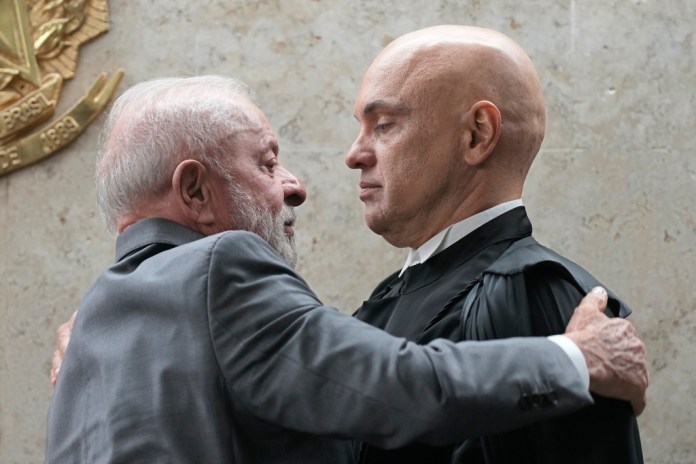
The litigation has attracted attention because it pits a U.S.-based media company linked to Trump against a foreign government that conservatives frequently accuse of suppressing political dissent. The dispute also comes amid broader tensions between Washington and Brazil over free speech, online regulation, and digital sovereignty.
Trump Media and Rumble’s case echoes Moraes’s other high-profile clash with Elon Musk’s X platform in 2024. The Brazilian justice ordered the suspension of accounts tied to Bolsonaro supporters and ultimately blocked X throughout Brazil after the company refused to comply with court directives. Musk at the time accused Moraes of censorship and authoritarianism, while Brazilian officials defended the orders as necessary to combat disinformation and threats against democratic institutions. X was later restored in Brazil after the company complied with court requirements.
SUPREME COURT DENIES RASTAFARIAN’S LAWSUIT AGAINST PRISON OFFICIALS FOR CUTTING HIS DREADLOCKS
While the court has not yet entered the default judgment requested by the plaintiffs, the fight could shape the limits of whether foreign officials may seek to enforce censorship-related orders against U.S.-based platforms, users located in the U.S., and data stored under U.S. legal protections.
If ultimately successful, Trump Media and Rumble are expected to seek declaratory and injunctive relief barring enforcement of the Brazilian orders against U.S. platforms, users, and data.