
As British Prime Minister Keir Starmer announced his resignation from office, a faction within his own political party was already planning to coronate a successor who was elected back to Parliament less than a week ago.
Andy Burnham, the new member of Parliament for Makerfield, is currently the only horse in the race to fill Starmer’s shoes as leader of the Labour Party and head of the incumbent Labour government. He offered Starmer a brief farewell message on Monday that immediately pivoted to talks of a “political change” with him at the center.
“Keir has given huge service to our country and I want to thank him for his leadership and dedication during such a challenging period,” Burnham said. “His decision marks the beginning of a transition and it is important that this process is conducted in an orderly and responsible way. I will put myself forward as part of this process.”
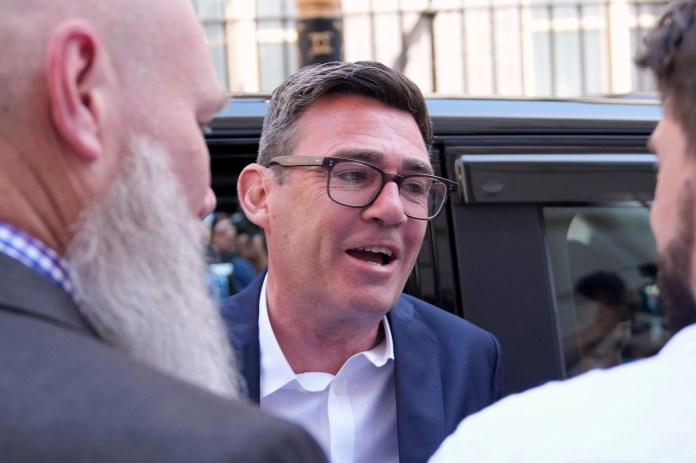
The use of the word “transition” might suggest that Burnham is hoping to take leadership of Labour unopposed. He dramatically began a journey by train to London the same day, ceremonially changing out of his casual t-shirt and into a blazer before arriving at Euston station and grabbing a taxi to the Parliament — greeting and speaking with supporters on the way.
Burnham only just won a special election in Makerfield on Thursday, winning against Reform UK candidate Rob Kenyon with 24,927 votes to Kenyon’s 15,696. His campaign always characterized Makerfield as a jumping-off point for upheaving the Westminster status quo. “This result will bring about a country that works fairly for everywhere and for everybody,” he said in his victory speech.
It may be the most exciting moment of the soft-left socialist’s career. A member of Parliament beginning in 2001, he tried and failed twice to become head of the Labour Party, once in 2010 and again in 2015. He quit Parliament in 2017 to successfully run for mayor of Greater Manchester, a role in which he found the most impact. After three successful election victories and a strong Labour cult forming around his leadership, he began to be informally recognized as the party’s “King of the North.”
It is a trajectory strikingly similar to that of former Prime Minister Boris Johnson, who similarly left Parliament in 2008 to become the first-ever Conservative mayor of London. Johnson returned to Parliament in 2016 and became prime minister in 2019, having built up a powerful political brand while running the city that he translated into a national campaign.
Burnham’s political philosophy and policy agenda, sometimes referred to as “Manchesterism,” centers on mixing private investment with government funding and emphasizes “public control” of common utilities and services. He described the ideology as a “modern and functional response to the high-inequality, low-growth trap that came from the 1980s drive to over-centralize political power in the Treasury and privatize economic power.”
“As we move forward, our priority must be to work together to get the country back to where we all want it to be. People want to see progress on economic growth, cost of living, public services, housing and opportunities for the next generation,” Burnham said on Monday. “Political change should never distract from the responsibility to improve people’s lives.”
Nominations to replace Starmer are expected to open on July 9 and close by the middle of the month. If other candidates emerge to challenge Burnham’s run, the contest would be expected to wrap by September, with the winner taking office immediately.
But those candidates are, so far, nowhere to be found.
Wes Streeting — who served as Starmer’s health minister until May, when he explosively left the government — was widely considered one of the few Labour MPs with the institutional backing necessary to mount a challenge for Labour leadership and 10 Downing Street.
But age-old wisdom in British politics says that he who knifes the leader does not get to wear the crown. Since it was Streeting’s scorching condemnation of Starmer in his resignation letter that pushed the collapse of the prime minister into irreversible decline, it is unsurprising that the former health minister opted to back Burnham.
Streeting suggested that spending weeks “exaggerating small differences” between candidates would only hurt Labour in the long run and that he is confident that the Makerfield MP would be receptive to his visions for “progressive capitalism” and a “change” to the “culture of our Party” that makes it “more inclusive and open to ideas.”
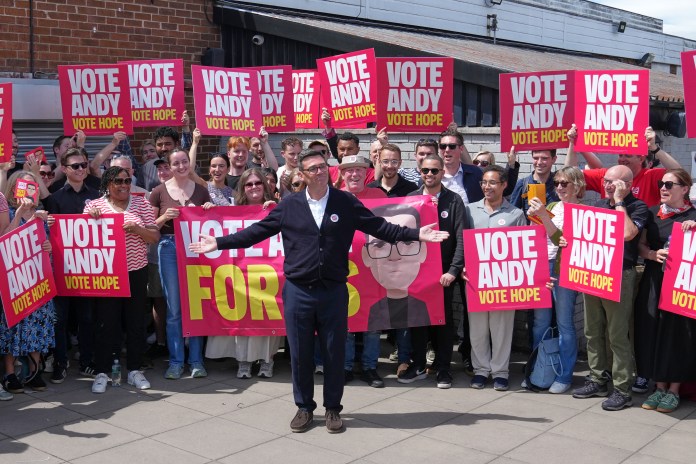
“Having spoken at length with Andy in recent days, I’m convinced that there is a place for those ideas under his leadership; that he is committed to building an inclusive party that draws on the best of our political traditions; and that he can win the fight of our lives against the forces of nationalism,” Streeting said.
The former minister told the press on Monday that Burnham “has not offered me any jobs” in a hypothetical future government.
Reform UK, the surging right-wing party that has eclipsed the Conservative Party as Labour’s primary adversary, is demanding that the British government call an early general election.
“The man who now presumes to be our Prime Minister based on less than 25,000 votes,” party leader Nigel Farage said of Burnham and the prospect of an unopposed transition. “That is why I am calling for a General Election at the soonest possible date. … I happen to believe that a mandate from the British people matters.”
There is precedent for party leaders who took the job between elections to wait for a beneficial bounce in the polls and call voters to the ballot box to demonstrate their own mandate to govern. But there is no obligation for the next prime minister to call a general election until August 2029.