
If you are a single person living alone and you make $46,000 a year, then you are a solidly middle-class American. Unless you live in Orange County, where you can make double that amount and still be considered poor.
The California Department of Housing and Community Development released its “Official State Income Limits” for the state’s low-income housing programs last month, and individuals making up to $104,200 now qualify as “low income” in Orange County, up from $94,750 last year.
“It just feels so crazy to me,” 23-year-old actuary Megan Junanto told LAist. “I felt like one of the most well off compared to people in my age group, and I am near low income, and last year I was low income,” Junanto said.
Being “low income” does not guarantee anyone will be able to find affordable housing in Orange County, nor does it qualify them for Section 8 housing payments. It does allow them to rent rent-controlled units set aside by developers who received some form of public benefit, such as a tax credit, zoning allowance, or state funding. Jurisdictions such as Orange County often heavily restrict where developers can build and how many units they can build unless they first agree to set aside a certain number of units as “affordable” housing.
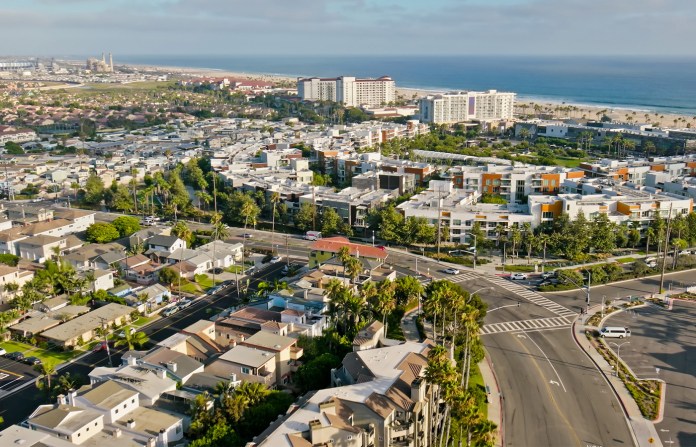
Housing costs in Orange County are punishingly high. According to the California Association of Realtors, only about 16% of Orange County households earn the $350,400 minimum annual income needed to afford the county’s $1,442,930 median-priced home. The same is true for much of California’s metropolitan areas, including Los Angeles, Marin, San Francisco, San Mateo, Santa Barbara, Santa Clara, and Santa Cruz counties.
California’s housing costs are high for many reasons, including the fact that its coastal cities support thousands of high-paying jobs that drive up housing demand and the weather is perfect 12 months out of the year. But California has also made a number of policy choices that have driven up housing costs as well.
Chief among them are California’s environmental laws. The California Environmental Quality Act has long allowed housing opponents to delay or kill new projects through years of lawsuits and environmental review, even in already developed neighborhoods. The state’s vehicle-miles-traveled rules, adopted in the name of fighting climate change, can force builders to pay for costly mitigation or abandon projects that regulators decide will generate too much driving. And along the coast, the California Coastal Act and Coastal Commission add another layer of approval that can block, shrink, or slow new housing in some of the most desirable and job-rich parts of the state. Each rule may have been sold as a way to protect the environment, but together they have helped make housing scarcer and more expensive.
THE REAL SCANDAL IN CALIFORNIA ELECTIONS IS WHAT IS LEGAL
And then there are the affordable housing mandates as well. By forcing developers to set aside a certain number of units as “affordable” every time they build, California politicians only further constrain the supply of housing, driving up housing prices, thus making more Californians housing “poor.”
If California policymakers really wanted to make its citizens wealthy, they would just scrap all their environmental and affordable housing regulations and let developers build again.