
Federal Communications Committee Chairman Brendan Carr’s clampdown on TV stations has a surprising antecedent. Sixty-five years ago, another activist FCC chief, Newton N. Minow, also read the riot act to TV networks.
Minow, an appointee of President John F. Kennedy, came from a very different political philosophy than Carr, who was selected by President Donald Trump. But both chairmen alarmed First Amendment champions who saw their actions as government meddling.
In April, Carr launched a review of eight local ABC licenses, including big-city affiliates in Chicago, New York, Los Angeles, and Philadelphia. The FCC ordered ABC to file its license renewals by May 28, more than two years ahead of schedule, citing “possible violations of the Communications Act of 1934 and the FCC’s rules, including the agency’s prohibition on unlawful discrimination.” That echoed a move by Minow, who threatened to yank TV stations’ licenses.
ABC, which is owned by Disney, filed the renewal requests as mandated, but essentially did so under protest, writing on behalf of WABC-TV in New York that the renewal order was “unlawful, arbitrary and unconstitutional.”
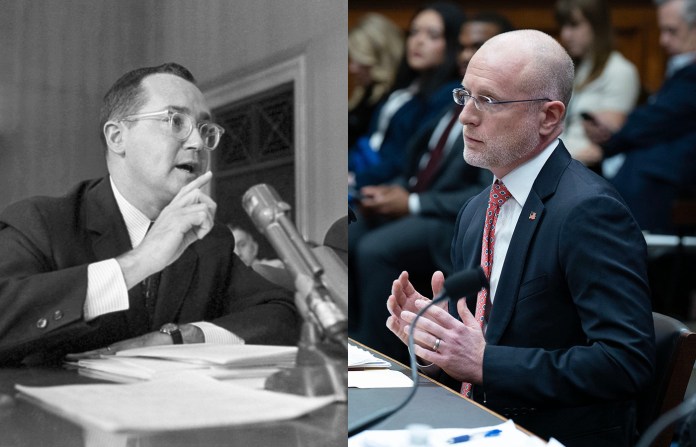
“The Order is inconsistent with a legitimate exercise of investigative authority and is plainly incompatible with the First Amendment,” the network added. “Worse, the Order opens the door to an assault on the Station’s license, while the Commission searches for a legal pretext to achieve its desired goal.”
In his May 1961 speech to the National Association of Broadcasters, Minow famously derided the quality of TV programming as a “vast wasteland.”
In a twist, both Carr and Minow flagged the TV networks on their “diversity,” but meant the word in far different ways. Carr’s inquiry of ABC focuses on diversity, equity, and inclusion practices at ABC stations — a juicy target for Trump and his conservative allies.
“No company is above the law – not even Disney. If Disney engaged in illegal DEI discrimination, if it failed to operate broadcast stations in the public interest, it will be held accountable,” Carr said in a May 28 X post.
Minow, by contrast, gave the broadcasters this directive: “You must provide a wider range of choices, more diversity, more alternatives.”
“There is nothing permanent or sacred about a broadcast license,” he warned the 2,000 broadcast executives, reminding them the FCC could revoke them for irresponsible performance.
Minow, at the time a 35-year-old lawyer, challenged them to watch TV for a day.
“I can assure you that you will observe a vast wasteland,” he said, scolding the industry for “a procession of game shows, violence, audience participation shows, formula comedies about totally unbelievable families, blood and thunder, mayhem, violence, sadism, murder, Western badmen, Western goodmen, private eyes, gangsters, more violence, and cartoons. And, endlessly, commercials – many screaming, cajoling and offending. And most of all, boredom.”
“And if you think I exaggerate,” he added, “try it.”
Minow’s tone was almost that of a disappointed parent who knew his kid could do better.
“When television is good, nothing — not the theater, not the magazines or newspapers — nothing is better,” he said. “But when television is bad, nothing is worse.”
Minow’s description of TV’s potential almost sounds like a description of the so-called Golden Age of TV, the modern era marked by shows such as The Sopranos and Breaking Bad.
But the TV selection in 1961 would be practically unrecognizable to viewers of today. Decades before streaming services, HBO, or even Fox, most original programming stemmed from the three major networks of ABC, CBS, and NBC. And it was all in black-and-white.
And yet, even by the early ‘60s, TV’s impact on society had grown enormously over the past decade. In 1950, less than one in 10 households in the United States even had a TV set. By 1960, televisions had saturated 90 percent of households, and millions of Americans had seen the first televised presidential debate, between Kennedy, a Democrat, and his Republican opponent, Vice President Richard Nixon.
Minow called out the TV industry for chasing the highest ratings, which he said was detrimental to children (who are now today’s aging baby boomers).
“I believe in the people’s good sense and good taste, and I am not convinced that the people’s taste is as low as some of you assume,” he said. “If parents, teachers and ministers conducted their responsibilities by following the ratings, children would have a steady diet of ice cream, school holidays and no Sunday school. What about your responsibilities? Is there no room on television to teach, to inform, to uplift, to stretch, to enlarge the capacities of our children?”
“There are some fine children’s shows,” he added, “but they are drowned out in the massive doses of cartoons, violence and more violence. Must these be your trademarks?”
That year, Minow might have alarmed TV executives, but Associated Press editors recognized him for his impact. He beat out the likes of Gary Cooper and Elizabeth Taylor to win “top newsmaker” of 1961.
And as the New York Times observed in a 2023 obituary for Minow, who died at the age of 97, Minow continued to pressure TV networks to up their game — and TV violence did appear to decrease while educational programming increased.
But in a cheeky bit of revenge, TV producer Sherwood Schwartz named the stranded boat on his ‘60s sitcom Gilligan’s Island, a show that would certainly have earned Minow’s contempt, “S.S. Minnow.”
“He didn’t like that speech at all,” Minow told NPR in 2006. “And he decided that he would get even with me by naming a boat the S.S. Minnow.”
In response to both Minow and Carr, critics claimed the FCC was violating the First Amendment; some network executives compared Minow’s actions to censorship out of the Soviet Union playbook.
The timing of Carr’s April review of ABC, which came one day after Trump and first lady Melania Trump said ABC should fire late-night host Jimmy Kimmel over his joke that she looked like an “expectant widow,” prompted a letter of protest from a dozen Democratic senators.
“The FCC order, sent under your leadership, appears to be a blatant effort to punish Disney for its editorial decision-making, notably its refusal to fire Kimmel over a recent joke,” wrote the senators, including Senate Minority Leader Chuck Schumer (D-NY); Sen. Maria Cantwell (D-WA), the ranking member of the Commerce, Science and Transportation Committee; and another committee member, Sen. Ed Markey (D-MA).
“Although the FCC has the authority to ensure broadcasters operate in the public interest, it cannot serve as President Trump’s roving censor, threatening to revoke licenses against broadcasters whose editorial content – including a comedian’s jokes – displeases the President,” they added.
But it’s not just Democrats. As Semafor has reported, several Republicans and conservatives criticized Carr’s review when it was announced in April.
“I do not believe the FCC should operate as the speech police,” Sen. Ted Cruz (R-TX), the Senate Commerce Committee chairman, told Punchbowl. While Rep. James Comer (R-KY), chairman of the House Oversight Committee, offered this advice in an interview with NewsNation: “I would hope that if my friend Brendan Carr is looking at something on ABC, it has more to do than with a few tasteless jokes.”
Minow, meanwhile, had a sense of humor about his most enduring line, telling NPR in 2006 that his kids had selected his epitaph: “On to a vaster wasteland.”
Frederic J. Frommer (@ffrommer), a sports and politics historian who has written for the Washington Post, the New York Times, the Atlantic, and other national publications, is working on a book on ‘70s baseball.