
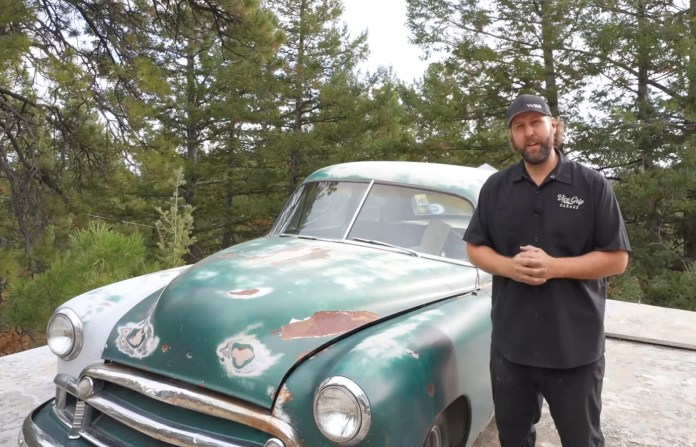
“Well, a guy is on a mountain in southwest Colorado, where I bought this 1950 Chevrolet sight unseen. It doesn’t run, and it’s been off the road for 20 years. I am going to try to get it fired up and drive it 1,400 miles back home.”
That is Derek Bieri of the YouTube channel Vice Grip Garage, and “home” is south-central Tennessee. The “revival” theme is prevalent throughout Bieri’s channel, where more than 2.5 million subscribers tune in every Friday to see his latest project.
The setup, as Bieri tells viewers at the start of every video, which begins with a tongue-in-cheek, “I’m an idiot,” is not necessarily educational. It is, however, deeply familiar to anyone who has ever pulled a tarp off something rusty and wondered whether it could be made to run again. Bieri buys old cars and trucks he has never seen in person, flies one-way to wherever they are sitting, and tries to nurse them back to life with a cheap set of tools and whatever he can grab at the nearest parts store. It’s the theme of “Will it run and drive?” He is often successful, but sometimes it does not work out at first. The Chevy on the Colorado mountain did not make it home under its own power. The transmission gave out halfway home, and the car finished the trip on a U-Haul trailer. The journey home and the repairs along the way are a significant part of the show.
Bieri is one of the most-watched figures in what has quietly become one of the most interesting corners of YouTube: a loose fraternity of mechanically inclined men, and a smaller number of women, who buy old, non-running, and sometimes abandoned vehicles for next to nothing and put them back on the road. Not restored. “Restoration” implies a finished, showroom-quality object that could sell for tens of thousands at auction. This is about saving vehicles typically headed for a scrapyard and making them drivable again.
Kevin Brown, a former Army aviation mechanic from Iowa, runs Junkyard Digs under the tagline “Real cars. Real people. Real content.” More than 1.3 million subscribers watch as he, along with a rotating cast of sidekicks, pulls cars out of barns and fields, gets them running, and puts them back on the street. In one episode, on an abandoned farm with no electricity, he and several others pulled a junk diesel engine from a 1979 Chevy C10 and replaced it with a 455 big-block they pulled from a non-running early-’70s Oldsmobile Delta 88 on the same property. The best part is that viewers are not passive consumers of content. The comment sections of these channels read like the back room of an old-fashioned parts counter or workshop. People swap stories about their own projects, argue about carburetors, and ask each other for help while offering assistance to the hosts, who don’t pretend to know everything.
Tony Angelo, a former champion drift racer who runs the Stay Tuned channel, sits somewhere on the boundary between the revivalists and the builders. One project involved installing a turbocharged engine in a 1988 Dodge Caravan. In a video from late last year, Angelo won an auction, bagging a 1953 Studebaker Commander. After doing a deep dive, he and his crew determined that the car had not turned a wheel under its own power in more than 60 years. They got it running and driving, and he wound up trading it to a viewer who recognized the car from an episode. That kind of connection within the community is what makes it so enjoyable to watch.
Adjacent to the revivalists is a wing of car YouTube devoted to ambitious fabrication and improbable engineering. Westen Champlin, working under the banner of “Redneck Science,” in Kansas, builds “couch trucks” and trucks that drive in reverse. He has been known to swap a Cummins diesel into a Rolls-Royce. The Fab Rats gang, based out of southwest Utah, fabricates off-road rigs from what they purchase, new parts, and whatever the field of vehicles they own yields that week. The work demands serious mechanical chops, engineering knowledge, fabrication skills, and a willingness to take risks that most professional shops would never countenance. It belongs to the same broader culture as Bieri, Brown, and Angelo: people who own their tools, trust their own hands, and assume that, with enough ingenuity, the problem in front of them is solvable.
What they all share is something close to a civic argument: They are keeping old American machinery in service at a moment when the economics and the regulatory environment are stacked against anyone trying to do exactly that.
The average new vehicle in the United States sold for $49,461 in April, according to Kelley Blue Book. Full-size pickups now cost above $66,000. For a family that needs a truck to haul a trailer or get to a job site, a running 1996 Ford F-150 with three previous owners and a fresh set of plugs starts to look less like nostalgia and more like a serious financial decision.
The trouble is that fixing any vehicle built in the last 10-20 years is harder than it used to be. Automakers have steadily restricted the diagnostic software, proprietary tools, and replacement parts needed for independent repair. The clearest illustration is not in the car business at all but in agriculture: John Deere spent years in court defending its practice of locking farmers and independent mechanics out of the diagnostic software needed to fix the tractors and combines they already own. In April, the company agreed to pay $99 million to settle a class-action lawsuit brought by farmers who said they were forced to use authorized Deere dealers for repairs that, a generation ago, they could have done themselves.
What John Deere has done to farmers, automakers are gradually doing to drivers. Several manufacturers now offer optional subscription services for factory-installed features: remote start, heated seats, navigation, and performance upgrades. So far, most of these programs are optional, and most can be ignored. The industry’s interest in the model, however, is clear. The direction of travel is toward a car that the buyer owns but does not entirely control.
NO ONE IS ENTITLED TO A JOB AT CBS OR ANYWHERE ELSE
Even the right to keep an older car on the road is contested terrain. In California, “Leno’s Law” would have exempted collector vehicles 35 model years and older from the state’s biennial smog check. Jay Leno testified personally in Sacramento. The bill passed the state Senate before the Assembly Appropriations Committee killed it in August 2025, without a public reason. Supporters are working to revive it, and a Republican win in the November governor’s race could change the political math.
None of this is what Bieri talks about on a Friday night. He talks about “sparkalators” and “lightning cubes,” his words for spark plugs and batteries, and “fuel-make-it-happeners,” his term for carburetors. He looks under the hood in the “power barn,” the engine bay, of a 50-year-old vehicle in a field, hundreds of miles from home, and tries to convince it to start. Politics is the backdrop against which Bieri doesn’t opine. For him, it is all about the tools in his hands, the rig he is working on, and the family in Tennessee waiting to see whether he makes it back. Two and a half million people, give or take, think it’s worth showing up for every week. The number is growing. So is the case for what they are watching.
Jay Caruso (@JayCaruso) is a writer living in Florida.