
Senate Republicans are openly venting over President Donald Trump’s Iran deal. But Sen. Ted Cruz (R-TX) is making a higher-profile — and perhaps more calculated — bet with his criticism.
Cruz, considered a possible 2028 presidential candidate, is publicly breaking with the administration on the memorandum, positioning himself as more hawkish than the White House as Republicans fear an end to the conflict that ultimately rewards Iran.
“History demonstrates that sending billions of dollars to theocratic lunatics who want to murder us is a very bad idea, and I think the president is receiving very, very poor advice on this deal,” Cruz told reporters Thursday. “I hope we don’t send a single penny to the ayatollah.”
Cruz, a third-term senator, was already at odds with Trump on the campaign trail over which GOP candidates to back in the 2026 elections. His decision to split with the president creates further daylight on one of the most politically risky choices of Trump’s second term and could help bolster his reputation with conservatives who fear a repeat of the Obama-era nuclear deal.
The two men repaired their relationship after a bruising run for president in 2016, in which Cruz fought tooth and nail to keep Trump from the Republican nomination. And so far, he’s generally been an ally of the administration and its policies.
Still, Cruz had already begun making waves with his decision to oppose Trump-backed candidates for governor in South Carolina and Georgia, and his latest moves have sparked criticism from those in Trump’s orbit.
Donald Trump Jr., his eldest son, accused Cruz of “lying thru his teeth” about Trump’s memorandum of understanding with Iran and of “using fake news about the peace deal to undermine” the president. He called it “the opposite of MAGA.”
Trump Jr. took particular issue with Cruz’s determination that the deal’s terms were akin to giving “billions of dollars to Iran” that “will be used to murder Americans.”
Under the memorandum, the United States will lift economic sanctions, unfreeze Iranian assets, issue oil export waivers, and develop a $300 billion international reconstruction fund, although the administration won’t contribute to the fund and White House officials have stressed that the terms of the deal are “performance-based.” In exchange, Iran will commit to yet-to-be-named guardrails on its nuclear program and drop its blockade of the Strait of Hormuz.
Trump used a Truth Social post Thursday to lash out at the GOP “fools” who’ve spoken out against his deal, painting them as “either jealous, bad people, or stupid.” Vice President JD Vance, another potential 2028 hopeful, has been enlisted to sell the deal publicly and negotiate its details with Tehran over the next two months.
Cruz treaded carefully between praise and criticism, saying Trump’s attacks on Iran’s leaders and its military infrastructure were successful but offered the caveat that he does “not believe that we should now be rebuilding the military we destroyed.” He echoed language used by other Republicans who’ve been critical, such as retiring Sen. Thom Tillis (R-NC), to say the president has received “poor advice.”
As for Trump Jr.’s accusation Cruz was “lying thru his teeth,” the senator told the Washington Examiner: “My views are clear.”
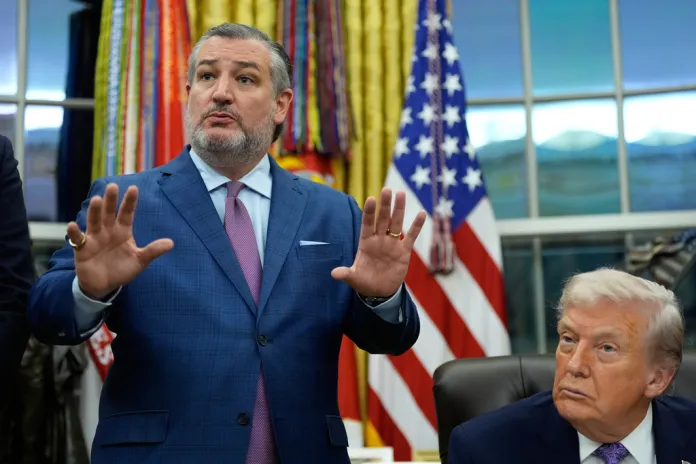
The strategic disagreements have extended into at least one race where Cruz has opposed a Trump-backed candidate. In the June 23 runoff for South Carolina governor, Trump-endorsed Lt. Gov. Pamela Evette is using comments from Cruz against Alan Wilson, saying Wilson should shun the senator’s support or embrace the “Never Trump that he truly is.” Cruz is backing Wilson in the primary.
Senate Republicans across the conference’s ideological spectrum, from centrist Sen. Lisa Murkowski (R-AK) to Armed Services Committee Chairman Roger Wicker (R-MS), have also rebuked the agreement that proponents counter is the solution to long-term peace.
In a scathing rebuke, Wicker said Thursday that the agreement “negotiates away the victories” over the last several months of war and that the $300 billion reconstruction fund, “though not funded by U.S. taxpayers, would make Iran’s payoff under President Obama’s 2015 deal look like a pittance by comparison.”