
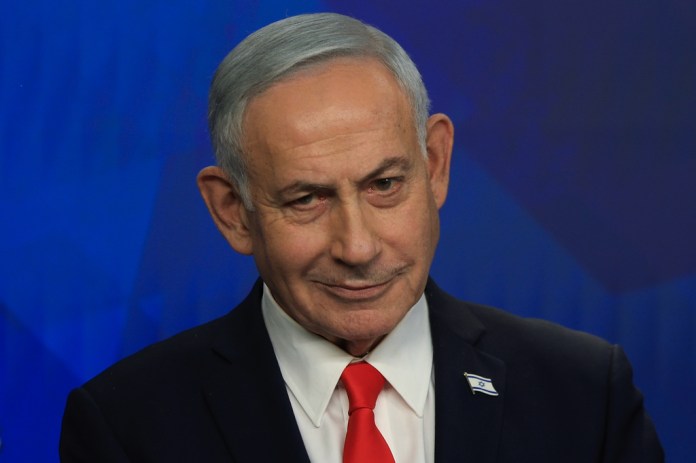
Israeli Prime Minister Benjamin Netanyahu was years ago nicknamed “The Magician” for his ability to win seemingly unwinnable elections and marshal governing coalitions out of parliamentary chaos.
He will need those magical powers in this year’s national vote as he plans to stand for reelection — the first time he will be judged at the voting box since the outbreak of violence and destruction in Gaza. A collapsing relationship with President Donald Trump, an Israeli public increasingly negative toward the White House, and a possible end to his foreign operations have scrambled his strategy.
Netanyahu’s party, Likud, is down in the polls to a prospective 24 seats in the Knesset if the election were held today, according to a survey published by Zman Yisrael. Likud is facing significant challenges from the centrist Yashar party and the center-right Together alliance — both of which are polling evenly at 21 seats apiece.
Most concerningly for the prime minister, the oppositional bloc is currently projected to secure 60 seats of the 120-member parliament, compared to his coalition, which is projected to hold 50, according to the Zmall survey.
A Channel 12 poll earlier this month similarly found the anti-Netanyahu bloc sitting at 59 prospective seats, compared to the pro-Netanyahu bloc’s 51.
The prime minister had planned to run a campaign that focused heavily on his close ties with the White House, according to outlet i24 news. But recent disagreements about the future of operations against Iran and Hezbollah have soured that friendship.
Trump called Netanyahu “f***ing crazy” on a phone call earlier this month when Israel refused to deescalate its campaign against Hezbollah in Lebanon. Iran has made clear any possible peace deal with the United States will require Israel to cease offensive strikes against the terrorist group. Earlier this week, the U.S. president revealed to Axios that he told Netanyahu he had “no f***ing judgement” following Israeli strikes on environs of the Lebanese capital of Beirut.
“Without us, without the United States, there would be no Israel,” Trump said Tuesday during a bilateral meeting with Emir Sheikh Tamim Bin Hamad Al Thani of Qatar. “Without me, there would be no Israel, because no other president was willing to do what I did. I’ve had a great relationship with Bibi, but now Bibi has to be more responsible with respect to Lebanon.”
The president is now suggesting that Israel leave the dismantling of Hezbollah to the Lebanese government — an arrangement that has historically failed to curb the terrorist group. Netanyahu has tried to keep the matter cordial, saying in a Monday address: “Many times [Trump and I] see eye-to-eye, and there are also cases in which we see less eye-to-eye. I am responsible for Israel’s security interests. I stand up for them.”
Israeli attitudes have soured in tandem with Trump’s frustrations. A poll released by Israel Hayom on Tuesday shows that approval of the U.S. president in Israel has flipped in less than a month.
Three weeks ago, approximately 58% of Israelis polled said they had a positive assessment of Trump, compared to 35% negative. Now, just 38% report positive feelings compared to 61% who see him negatively.
Critics and opposition leaders have seized on this upheaval — characterizing Netanyahu as a weak leader, having failed to follow through on his goal of dismantling Hezbollah and getting dog-walked by Trump’s peace deal.
Yashar party leader Gadi Eisenkot said the prime minister ought to have “admitted he made empty declarations” about the ultimate goals of intervention in Lebanon.
“It would have been better for him to say, ‘I erred, I set false goals that I wasn’t able to achieve,’” Eisenkot said. “This would have given Netanyahu much more credit and respect from the people.”
IRAN MOU HIGHLIGHTS TRUMP’S DIVISIONS WITH BENJAMIN NETANYAHU
Yair Lapid, leader of Yesh Atid and the broader Together alliance, said there has “never, ever, been a more absolute failure than Netanyahu’s diplomatic failure on the Iranian front.”
He added that Israelis must “recognize the fact that Netanyahu simply cannot do it anymore,” asserting that the “American president [is] openly and publicly telling the prime minister of Israel: ‘I am your boss, and you will do what you are told.’”
Natan Sachs, senior fellow at the Middle East Institute, told the Washington Examiner that a pending ceasefire between the U.S. and Iran “does little or nothing on the questions of funding for Iran’s proxies or its ability to threaten its neighbors or Israel,” which he characterized as a “major blow” to Netanyahu’s reputation.
He added that domestically, Netanyahu’s coalition is vulnerable, but said the Israeli prime minister is a “master of polarized politics.”
“He will likely move back to an anti ‘left’ campaign, trying to portray his rivals, such as the right-wing Bennett, as ‘lefty’ and diverting away from his responsibility for the catastrophe of October 7 and the inconclusive-at-best results of the long war since then,” he said. “The odds are not necessarily stacked against him. He’s an underdog to win outright, but he can hope to bring the elections to an inconclusive result, leading to a series of repeated elections, as he did prior to the last elections.”