
President Donald Trump is already planning his next “focus” after his administration formalizes its peace deal with Iran later this week, revisiting one of his most aggravating goals.
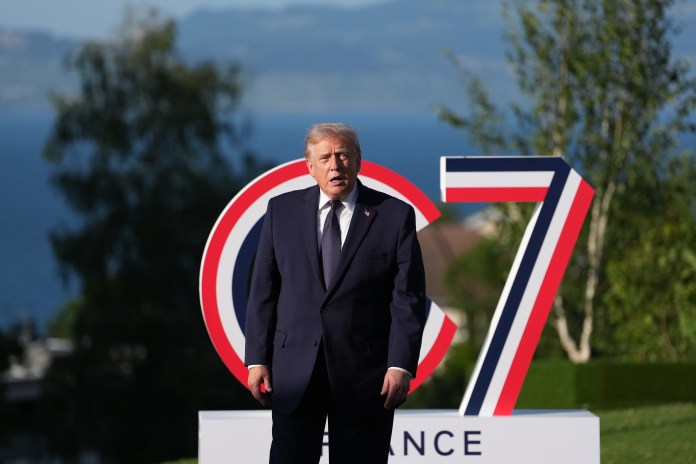
The president, who is expected to finalize his memorandum of understanding with Tehran on Friday, said Monday that ending the Russian invasion of Ukraine will be his next project. He made the remark during a sit-down with President Emmanuel Macron at the G7 summit in France.
“We had a very good conversation yesterday with President [Volodymyr] Zelensky and President [Vladimir] Putin, and I see maybe we can do something — I really do,” Trump told reporters. “I think they’re both open to it.”
The president indicated that he has spoken independently with the two world leaders and found greater openness to a compromise than during previous attempts at peace.
“Now that this [Iran campaign] is finished, we’re going to be focusing on that — see if we can get that one done,” Trump said. “Twenty-five thousand people a month are dying, mostly soldiers, and that shouldn’t happen. I had two very good conversations yesterday. We’ll be talking about it.”
Negotiations between the two Eastern European countries have been at a gridlock for over a year at this point, as Russian territorial gains have slowed to a bloody crawl. The front lines have turned into a proverbial meat grinder of cutting-edge drone warfare and precision strikes. Ukrainian casualties have been markedly lower than its adversaries, but the smaller population has required mass mobilization of all military-aged men.
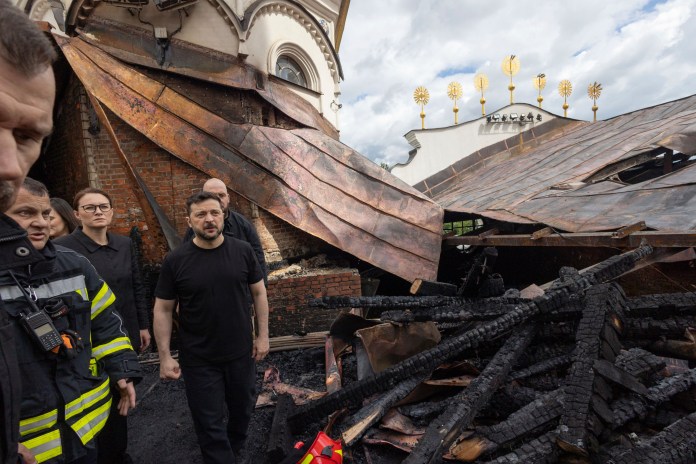
Additionally, Russia has ramped up attacks on civilian centers usually considered off-limits in wartime, such as a 1,000-year-old cathedral and monastery complex in Kyiv that was bombed Sunday night, killing three people. Firefighters struggled to contain the blaze, and Zelensky decried the attack as “one of Russia’s most serious crimes against Christian culture to date.”
Zelensky, who has repeatedly offered Putin to “meet anywhere where real decisions to end the war could be made,” said Monday he previously approached the United States and France about the possibility of meeting the Russian president at the G7. The Kremlin was not interested.
“Yesterday, we discussed with President Trump that such a meeting could be organized in the U.S. — in a format where Putin would find it much harder to refuse at least to President Trump,” the Ukrainian leader said Monday. “We will see what comes of it. If Russia refuses this chance as well, additional pressure will be needed.”
Putin adviser Yuri Ushakov said the Russian president told Trump he was “certain that together we could truly give Russian-American relations a new quality, and also do much to ensure security and stability on the world stage.”
Putin lavished Trump with praise during the nearly hourlong conversation, calling him a “bright, remarkable person and politician,” according to Russian news outlets. He additionally celebrated the “mutual understanding between us, which allows us to discuss … even the most complex issues on the bilateral and international agenda openly and frankly.”
ZELENSKY LAMENTS RUSSIAN ATTACK THAT DAMAGED 1,000-YEAR-OLD CHURCH
Russia’s list of demands for a hypothetical end to the war is long and filled with nonnegotiables for Zelensky and his government. The Kremlin demands total control over the Donetsk, Kherson, Luhansk, and Zaporizhzhia regions of Ukraine, as well as limits on the size of the Ukrainian military.
Additionally, it demands Kyiv adopt a position of total neutrality — abandoning attempts to join the European Union and NATO.
Secretary of State Marco Rubio admitted at a House Foreign Affairs Committee hearing earlier this month that “the prospects don’t look great that either side is prepared to make the concessions necessary in order to reach an agreement.
“Neither side has been willing to make concessions — particularly on the Russian side — necessary in order to bring peace about,” Rubio told lawmakers. “We remain ready to play any role we can in that context of bringing a peace about, because we think the war in Ukraine — devastating war — has no military solution. It can only be solved through a diplomatic route, and it’s been unfruitful.”