
The Great Fair of 1876, or the Centennial International Exhibition, was a celebration of 100 years of American achievement. Nearly 10 million visitors traveled to Philadelphia to view intricate exhibits related to agriculture, art, machinery, mining and metallurgy, and more. America’s past, present, and future were all celebrated and on display for the entire world to see.
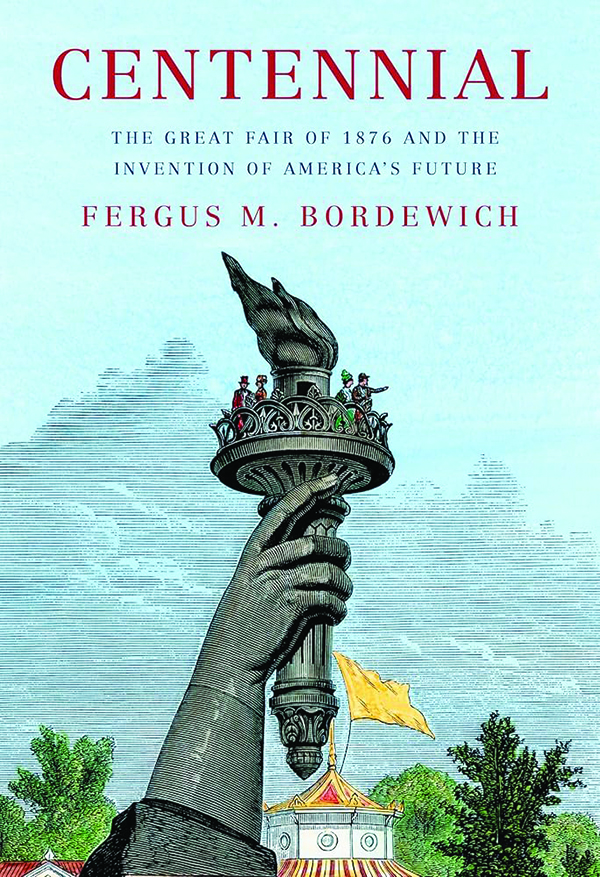
“The Centennial Exhibition …was the most ambitious public event in the nation’s history up to then,” historian Fergus M. Bordewich writes in Centennial: The Great Fair of 1876 and the Invention of America’s Future. “It marked the country’s first century with an epic celebration of its past and the promise of its future.” There were many fascinating inventions and exhibits at the centennial, including locomotives, works of art, horticulture, the Corliss Engine that was surely “the most powerful piece of machinery in the world,” and several inventions by Thomas Edison, including the “electric pen” and “quadruplex telegraph.”
Curious visitors could also pay 50 cents to climb a massive arm holding a torch. It would later become a defining piece of what we now know as the Statue of Liberty, designed by French sculptor Frederic Auguste Bartholdi.
Who attended the Great Fair? A proverbial melting pot of Americans from all walks of life, for one thing. “There were ordinary Americans of all kinds, war veterans from both North and South, presidential candidates, celebrities ranging from P.T. Barnum to Henry Wadsworth Longfellow and Mark Twain.” There was a distinctive international flavor, too. “Foreign visitors numbered in the hundreds of thousands,” Bordewich writes, “most famous among them Emperor Don Pedro II of Brazil, the first foreign head of state ever to visit the United States, who loved the Exposition so much that he often wandered among the crowds in disguise.”
Not everyone had a glorious time at the centennial. The American poet and essayist Walt Whitman was “notably omitted” from the festivities in spite of writing a “soaring ode” he hoped would be read at the opening ceremony, “Song of the Exposition.” His desire to gain more respectability (and money) was shot down and he ended up in the role of spectator, largely unnoticed in the throng of enthusiastic visitors to the world’s fair. Whitman is brilliantly depicted by Bordewich as a “kind of one-man subtext to the Centennial, a sharer in its thrilled celebration of the nation’s history and future, and also a lonely retort to its chest-thumping self-confidence.”
At the same time, there was an additional backdrop to this American celebration that served a dramatically different purpose. “If triumphalism was the Centennial’s dominant idiom, beneath its glittering surface it served as a giant kaleidoscopic lens that revealed much about America at one of its most transformative moments.” Bordewich points to black Americans who “struggled to exercise their hard-won freedom,” the feminist movement that “demanded rights for women,” and Native American tribes that “went to war to repel advancing settlement in the West” as examples.
These murky political waters were perceived through the eyes of four notable Americans in history. They all symbolized different stages of a nation caught in the crossroads between obvious greatness and gradual acceptance of societal change.
First was Alexander Graham Bell, who invented the telephone, worked with the deaf community, and had “long evinced a profound curiosity about the mechanics of language.” There was Edmonia Lewis, a talented black artist widely praised for her magnificent sculpture, The Death of Cleopatra, at the centennial, who was viewed as “an avatar of a new and promising future that growing numbers of African Americans shared.” There is also the incredible story of Thomas A. Scott, who started life as a mostly uneducated orphan, “essentially invented himself through a combination of charm, tireless work, and a genius for mathematics,” and rose to the positions of president of the Pennsylvania Railroad and U.S. assistant secretary of war under President Abraham Lincoln. And we can’t forget Rutherford B. Hayes, in the midst of a contentious presidential election that he ultimately won. He supported abolitionism and “always professed sincere commitment to the rights of the freed people,” but, like many other Civil War-era Republicans, begrudgingly accepted that “use of the military to protect Black Southerners was no longer politically possible.”
MAGAZINE: FRANKLIN’S FAILED CONQUEST
Bordewich’s skills as a historian, writer, and storyteller help weave an important tale of a century-old nation beginning to find itself. “History was treated as a gilded chamber of mirrors that flattered and reassured,” he writes, “reflecting back to Americans what they most wished to be true about themselves, assuring them that they lived in an ever-triumphant nation, not a deeply fissured one.” Nevertheless, there was still much work to do: the political battles between Republicans and Democrats in the post-Civil War era, where tensions still ran high; free black people and former slaves struggling to gain greater acceptance and equality, aided by abolitionist Republican politicians like Hayes, James G. Blaine, and Roscoe Conkling who “pledged to defend Black Americans’ rights”; Susan B. Anthony and the growth of the women’s suffrage movement; and even the rise of labor and the Irish-dominated “Molly Maguires” that fought for coal miners’ rights.
The grandeur of America’s Great Fair, therefore, occurred simultaneously with the reality of America’s great awakening. This is part of the compelling account that Bordewich’s Centennial depicts page after page, chapter after chapter. The book evokes a time in U.S. history that remains interesting, illuminating, and, in the end, inspiring.
Michael Taube, a columnist for the National Post, Troy Media, and Loonie Politics, was a speechwriter for former Canadian Prime Minister Stephen Harper.