
SACRAMENTO, California — Rep. Kevin Kiley (I-CA) is fighting a political battle on two fronts: one, in Congress and the other, in his West Coast home state.
On Capitol Hill, Kiley has emerged as one of the loudest critics of California’s mid-decade congressional remap, accusing Democrats of redrawing the map to weaken GOP incumbents. He has also voiced frustration with House leadership — including Speaker Mike Johnson (R-LA) and Minority Leader Hakeem Jeffries (D-NY) — for failing to advance federal legislation to curb partisan redistricting.
After months of being ignored, a frustrated Kiley is now forcing the House to confront his proposal to prohibit mid-decade congressional redistricting, deploying a discharge petition to bypass leadership and bring the measure directly to the floor. The maneuver, though rarely successful in Congress, reflects growing concern among lawmakers over increasingly aggressive partisan mapmaking. He’s disappointed in Johnson but frustrated by Jeffries, he told the Washington Examiner.
“I want to take him at his word,” he said of Jeffries. “He said just last week, or I guess it’s two weeks ago now, he said that the only reason he’s going on this gerrymandering spree is that there isn’t a national standard for redistricting. He said we’re going to keep doing this until there’s a national standard for the mid-decade re-instruction. So I said, I’ll take your word. Here’s your opportunity, right now, to make good on that, and to establish a national standard to end mid-decade redistricting. All he has to do is endorse the proposal. Several members of his caucus have already done so, but if the minority leader gives it his blessing, then we’ll quickly get the signatures that are needed to bring it to the floor.”
Kiley warned that allowing states to redraw districts outside the normal census cycle risks turning redistricting into a perpetual political weapon, with parties constantly reshaping boundaries for short-term electoral gain. He argued the trend would erode public trust, intensify polarization on Capitol Hill, and undermine stable representation for voters.
At the same time, Kiley is confronting the political fallout from Proposition 50, a Gov. Gavin Newsom (D-CA)-backed measure that carved up five Republican districts, including his, to favor Democrats.
Kiley, a former high school English teacher, had represented California’s 3rd District, a conservative-leaning area that is also the state’s most geographically diverse. It had spanned most of the California-Nevada border, including Sierra, Nevada, Placer, Alpine, Mono, Unyo, parts of El Dorado, Yuba, and a few outer Sacramento counties. The district also included Lake Tahoe, Death Valley National Park, and five national forests, making it one of the most rural areas in the state. The new 3rd District was split into six factions, and Kiley has said he would not run in it. Instead, he’s running Tuesday in the redrawn 6th Congressional District, centered in the Sacramento area, which now leans Democratic. It’s forced Kiley into a far more competitive race. Instead of seeking safer Republican territory, he chose to stay in his district and re-register as “No Party Preference” while continuing to caucus with Republicans in Congress.
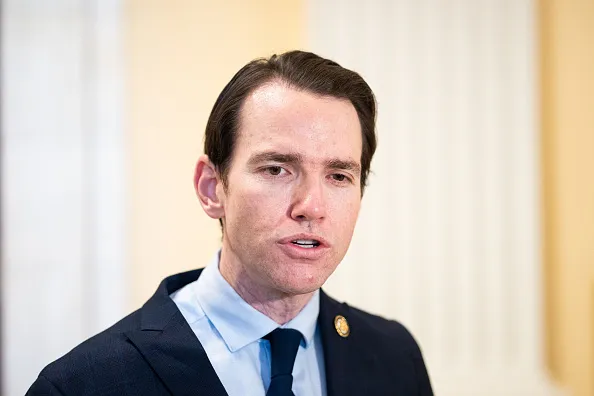
The shift underscores both the political pressure facing California Republicans and the stakes of the state’s redistricting fight. Democrats view the 6th District as a top pickup opportunity, with the DCCC already investing in the race ahead of the primary.
Heading into Tuesday, Kiley is hopeful and refuses to call his district left-leaning.
“I would actually call it an independent-minded district,” he said. “The district has voted for candidates of all political stripes, and I think that that reflects the way that I’ve always approached my role as a representative. I’ve always put my district first and answered to my constituents, not party leaders in Sacramento or Washington, D.C., and I’ve been fortunate to get a significant number of votes from Democrats, Republicans, and independents in prior elections, and so you know, I think that we’re very well positioned to advance in the primary to win the general election and to be able to deliver effective independent leadership for this newly drawn district.”
Eager to stop him are six candidates, five of whom have reported raising more than $100,000, according to the Federal Election Commission filings. Richard Pan, a pediatrician and former state lawmaker, known nationally for spearheading the state’s push to eliminate religious exemptions for school vaccine requirements, wants to hold Kiley accountable for supporting President Donald Trump’s One Big Beautiful Bill Act.
“We see a federal government that seems to be intentionally attacking healthcare, whether it’s taking away people’s health insurance, undermining public health to allow disease to spread, or cutting research for things like cancer treatments,” Pan said.
Pan, who was born in New York and raised in Pittsburgh by parents who immigrated from Taiwan, graduated with his Master of Public Health degree from Harvard in 1998 and moved to Sacramento to accept a faculty position at the University of California, Davis Health.
He is known for writing some of California’s toughest vaccine mandates and said it was Health and Human Services Secretary Robert F. Kennedy Jr.’s recommendation to loosen those mandates that pushed him to jump into the congressional race.
Then there’s Sacramento District Attorney Thien Ho, who has said he supports tax credits to encourage affordable housing, particularly near transit.
“We need to, first of all, provide tax credits to different organizations to go ahead and make sure that they promote affordable housing, especially around transit,” Ho said.
He also pointed to his record as Sacramento County’s top prosecutor, saying, “As a district attorney in Sacramento County, my office has repeatedly gone after corporations that have polluted our environment.”
SPENCER PRATT SAYS HE’S SURGING WITH MOMS USING STROLLERS ‘AROUND NAKED DRUG ADDICT ZOMBIES’
Kiley told the Washington Examiner that if elected, he would tackle the cost of living in California, from high housing costs to skyrocketing gas prices.
“The cost of living is the biggest challenge in California,” he said. “We have the highest cost of living in the country. So, the biggest thing I can do, and have been doing, to try to help with that, is counteract some of these extreme policies. So, we’ve had some victories there on trying to do more by getting them to, for example, suspend their gas tax, but there’s things we need to be doing in Congress as well. There’s a bipartisan housing bill that’s going to come to the floor soon, and certainly healthcare costs and energy costs. We’ve done some good things. There’s more we can do, so across every policy domain, I think that needs to be the No. 1 focus of our attention.”