
When George Orwell published Animal Farm, his biting critique of the Russian Revolution and the totalitarian communist regime that followed, in 1945, the novel was denounced as anti-communist propaganda and immediately banned in the Soviet Union.
Director Andy Serkis, who appears to share at least some of the Soviets’ aversion to political mockery and rebuke of leftism, has decided to go one better. His new animated adaptation of Orwell’s tome is a distortion so brazen it would have made Andrei Zhdanov, Joseph Stalin’s propagandist-in-chief, weep with admiration — before confiscating Serkis’s $18 million net worth and shipping him off to a labor camp.
The film opens with solemn narration from Woody Harrelson, who also voices Boxer, the hardworking horse. For the animals, he explains, “just one thing stood in the way of freedom and our dream of animals running the farm and working together.” That obstacle, naturally, was man — greedy, avaricious, and forever standing between the oppressed beasts and paradise. Soon enough, the animals unite in rebellion, overthrow the humans, and establish their seven commandments like “four legs good, two legs bad.” Under the tender leadership of Snowball, voiced by Laverne Cox and serving, as in Orwell, as the allegorical stand-in for Leon Trotsky, they begin their cooperative experiment in socialism.
Having laid the foundations of Orwell’s story, Serkis then proceeds to distort and bastardize its central meaning. At least the Soviet Union had the decency to ban Animal Farm outright. Stalin recognized Orwell’s fable as a repudiation and a challenge to his communist tyranny and treated it accordingly. Serkis and screenwriter Nicholas Stoller do something more insidious. They preserve the shell of the story while rewriting its moral logic from within. Just as “four legs good, two legs bad” becomes “four legs good, two legs better,” Orwell’s warning about the corruption of revolutionary power is revised into something resembling a liberal arts school catchphrase. Capitalism is the root of all evil.
Perennial pothead Seth Rogen portrays Napoleon, Orwell’s effigy for Stalin himself, as a bumbling buffoon and schoolyard bully rather than the fierce and cunning boar from the novel. But the bigger sin is that Napoleon is not even the chief antagonist of this contorted Animal Farm. Here, Napoleon is a manipulated cog in the larger workings of capitalism. The much graver evil, manifested in some post-apocalypse tech CEO, an Elon Musk-themed reimagining of Pilkington, who drives a Cybertruck.
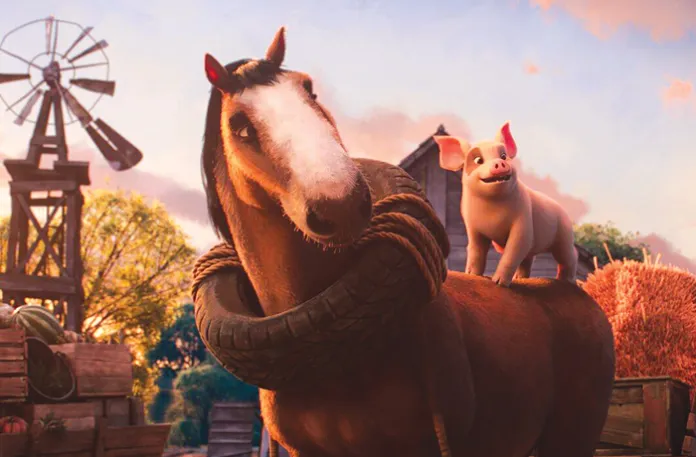
It is the cliché excuse of socialists everywhere — the “no true socialist” fallacy, insisting every example of a failed socialist state wasn’t real socialism. We are meant to believe that the animals’ experiment in this evil ideology faltered not because power naturally corrupts, as Orwell conveyed in his narrative, but because their socialist exercise was derailed and hijacked by this tech billionaire who, for reasons unexplained, needs to own this negligible parcel of land — capitalist, land-coveting greed has no boundaries after all — but, seeing how impressive Napoleon is at ruling over the animals, decides instead to manipulate Napoleon by showering him with iPhones and flashy cars, turning him into a materialist de facto human.
NETFLIX DOCUMENTARY EXPOSES TOXIC ‘MANOSPHERE’ INFLUENCERS
This would be foolish enough in an adult satire. It is more concerning in an animated adaptation aimed at children, and stranger still coming from Angel Studios, an openly conservative media company. Serkis’s Animal Farm manages, against all odds, to make some of Disney’s recent output look like Atlas Shrugged cartoons by comparison.
In that sense, Serkis’s Animal Farm is, ironically, among the most Orwellian things I have seen in recent years, though not in the way Serkis intended. For his next feature, Serkis might consider Solzhenitsyn’s The Gulag Archipelago as a teenage romance set in the idyllic resorts of northeastern Siberia.
Harry Khachatrian (@Harry1T6) is a film critic for the Washington Examiner. He is a software engineer, holds a master’s degree from the University of Toronto, and writes about wine at BetweenBottles.com.