
Pope Leo XIV on Thursday expressed concern over the increasing use of artificial intelligence in warfare, arguing that the technology sets up a moral dilemma for humanity.
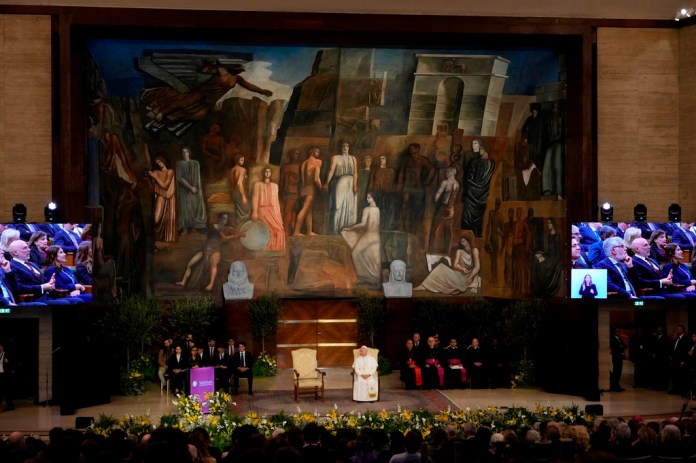
The pontiff’s warning came during a speech at Rome’s La Sapienza University, in which he called for expanded oversight over AI being developed and used in the military “so that it does not absolve humans of responsibility for their choices and does not exacerbate the tragedy of conflicts.” Leo, the first American pontiff, is expected to issue a similar admonition in his first encyclical set to be released on Friday, according to Axios.
“What is happening in Ukraine, in Gaza and the Palestinian territories, in Lebanon, and in Iran illustrates the inhuman evolution of the relationship between war and new technologies in a spiral of annihilation,” he said, voicing unease that investments in AI and high-tech weaponry are fueling conflicts across the world.
The pontiff’s address at Europe’s largest university follows some public squabbles with the Trump administration. Secretary of State Marco Rubio’s visit with Leo in Rome earlier this month appeared to smooth over some tensions, with the State Department later touting “the strong relationship between the United States and the Holy See and their shared commitment to promoting peace and human dignity.”
RUBIO AFFIRMS ‘ENDURING PARTNERSHIP’ WITH HOLY SEE AS HE MEETS WITH POPE LEO XIV
The pontiff’s move to weigh in on AI-directed warfare comes as global leaders, from President Donald Trump to Ukrainian President Volodymyr Zelensky, are increasingly turning to the technology to win conflicts.
Ukraine announced last month that it used an all-robot force to capture a Russian enemy position, marking the first time in the war that such an operation has been successfully executed. At the time, Zelensky said the technology was life-saving.
“Lives were saved more than 22,000 times when a robot went into the most dangerous areas instead of a warrior,” he said. “This is about high technology protecting the highest value — human life.”
The U.S. is battling to win the AI arms race, including by heavily investing in a strategy to team soldiers with autonomous drones on the battlefield, particularly during dangerous breaching exercises, marking a major cultural shift for the Pentagon.
“We’re not putting soldiers as the first line,” Army Chief Technology Officer Alex Miller told the Washington Times’ Threat Status podcast in February. “We’re trading blood for steel, and it’s steel on our side and blood on their side.”
THE AGE OF AI IS HERE — HOW SHOULD IT BE REGULATED?
Skydio drones, which operate with the help of “narrow AI,” are used for tracking objectives. The Department of War secured a record-breaking $52 million contract with the drone manufacturing company in March. Months later, the Pentagon announced on May 1 that it had reached deals with six of the world’s leading AI companies to use their software in the War Department’s classified work.
“Access to a diverse suite of AI capabilities from across the resilient American technology stack will give warfighters the tools they need to act with confidence and safeguard the nation against any threat,” the Pentagon said.