
Admittedly, as a conservative-leaning listener, it is difficult to tune into National Public Radio and not support the 2025 Republican-led recission of its federal funding. On any given day, story selection will likely lean into niche liberal issues such as transgender rights or abortion access, or, more recently, the Iran war understood through its impact on gas prices — keywords “skyrocket,” “highest point,” and “effect on America’s wallet.” What former NPR editor Uri Berliner wrote in 2024 apparently remains true: “An open-minded spirit no longer exists within NPR, and now, predictably, we don’t have an audience that reflects America.”
But that doesn’t mean that NPR, absent federal funding, is going away. In fact, it may well thrive. Last week, it received the largest gift from a living donor in its history, an $80 million donation from Connie Ballmer, wife of former Microsoft co-CEO Steve Ballmer and a member of the Obama Foundation board of directors, whose Ballmer Group supports left-of-center causes, including action against systemic racism.
In announcing the gift, NPR emphasized its support for a seemingly politically neutral “digital strategy” build-out for its system. But Ballmer herself gave away the game: She believes in NPR content.
“I support NPR because an informed public is the bedrock of our society, and democracy requires strong, independent journalism,” she said.
In other words, federal defunding has made NPR a powerfully attractive progressive cause. The Ballmer gift was complemented by a $33 million anonymous donation. It would not take many more similar gifts to make up for the modest $12 million in direct federal annual operating funds it had received, supplemented by indirect federal dollars provided by individual member station dues.
The Republican Congress may have cut public media funding — but it could not roll back the key advantage NPR has over private broadcasters: its federal nonprofit status that makes it eligible for tax-deductible charitable gifts, such as that of Ballmer. That’s not going away any time soon or ever. A gerrymander-style push for the IRS to strip it of tax-exempt status would soon enough lead to a Democratic push to do the same for right-leaning think tanks and foundations.
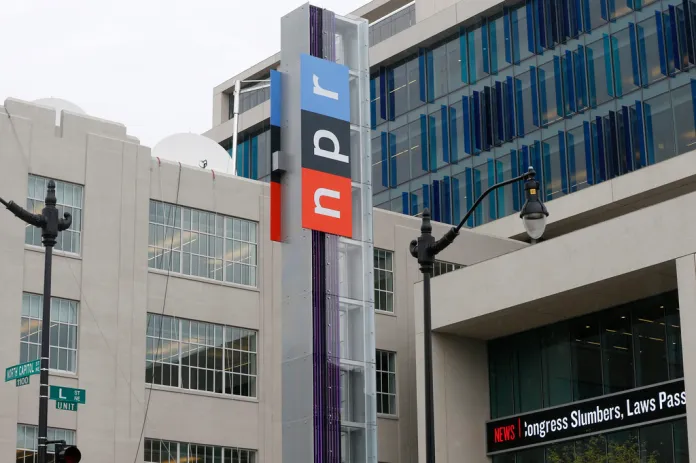
Nor will NPR lose access to public radio stations across the country that own telecommunications spectrum space granted to them originally by President Harry Truman’s administration.
The Ballmer gift reinforces the progressive foundation support that has been a financial bedrock for NPR. In the wake of the congressional budget cut, key progressive foundations — Ford, Knight, and MacArthur — pledged $37 million in public media support. It is no coincidence that there’s an overlap between NPR’s story selection, such as its climate desk, and the interest of MacArthur in a “just and verdant world,” as per its NPR on-air mission statement.
All this was true, to be sure, prior to the budget recission. But something important has changed that Republicans should regret. Absent federal funding, there will be no more support for progressive media, but there will also no longer be any congressional hearings at which NPR CEO Katherine Maher is called to account for her anti-Trump posts, and at which the “national” network is called to account for its narrow, upscale blue-state audience. Per Pew Research Center: “Consistent liberals are more than twice as likely as web-using adults overall to name NPR … as their top source for political news.”
Federal funding for NPR and PBS is not coming back, nor should it. But conservatives need to think about how to compensate for the left-leaning support for a publicly created media network that is not going away. In theory, conservative foundations could make their own gifts — for support of free-market economics or religious life, for instance. But these are not likely to influence NPR story bias. One would hope that, in search of non-federal financial support, NPR, and PBS NewsHour, would critique their biases and seek to expand their donor bases. This, too, seems unlikely.
NPR AND PBS FEDERAL FUNDING HALTED AS GOP IGNORES DEMOCRATS’ SHUTDOWN DEMANDS
The best that conservatives can do is to focus locally, on their own communities’ public radio and television stations. These are used to receiving the lion’s share of federal funding through “community service grants” and are now more likely to be struggling. They also tend to be sources of local news in an era in which newspapers are dying off at a rapid rate. They have local community boards that can influence the character of their news coverage. Local leaders and community foundations should take note.
Cutting off federal funds for NPR and PBS was no doubt a feel-good vote for the Freedom Caucus. But neither is going away.
Howard Husock is a senior fellow in domestic policy studies at the American Enterprise Institute and was formerly a member of the board of directors of the Corporation for Public Broadcasting.