
EXCLUSIVE — Several law firms have secured outside counsel contracts across multiple states while directing the vast majority of their political contributions to Democrat candidates and committees, according to a new report tracking private sector influence. Those arrangements can create conflicts of interest, particularly when Republican-led states are paying significant sums to firms that turn around and fund Democrats.
The report, released Tuesday by the conservative Alliance for Consumers, found that the eight firms, which the group dubbed the “Shady Eight,” collectively steered nearly $26 million in federal political donations between 2017 and 2025, with roughly 99% going to Democrats and allied groups, according to an early review of the report by the Washington Examiner.
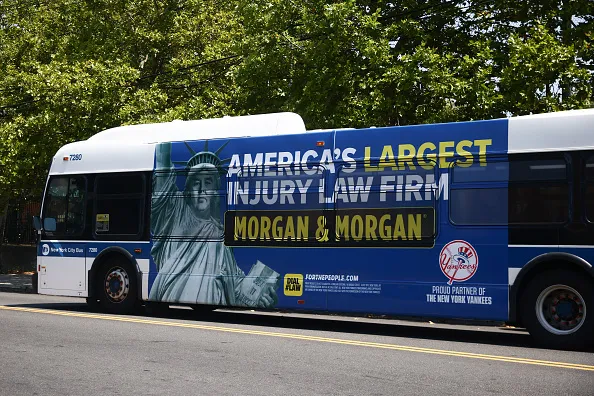
Among the top list of firms identified in the Alliance for Consumers’ self-described “Shady Eight” report include Morgan & Morgan, Motley Rice, Lieff Cabraser, Baron & Budd, Grant & Eisenhofer, Berger Montague, Cohen Milstein, and Simmons Hanly Conroy — all of which have benefited from government-backed litigation work with state and local officials, including in states such as Alaska, Iowa, Kansas, Montana, and Utah.
Those arrangements, known as outside counsel contracts, allow state governments to hire private law firms to handle major lawsuits on their behalf, often in exchange for a share of any financial recovery rather than up-front payment.
In a letter sent to attorneys general alongside the report, the Alliance for Consumers is urging officials, particularly in Republican-led states, to take a fresh look at those relationships.
“The contracts that states have with these firms make some sense if the goal is funding left-wing political campaigns, but, for many reasons, they are exactly the wrong way to protect consumers and your states,” wrote Alliance for Consumers Executive Director O.H. Skinner.
The report also details where that political money is going. Among the top recipients of contributions from the firms were Democratic Senate candidates and incumbents, including Sen. Jon Ossoff (D-GA), former North Carolina Gov. Roy Cooper (D) in his Senate bid, Sen. Cory Booker (D-NJ), and Sen. Tammy Duckworth (D-IL).
More than half of the firms’ political giving last year went not just to individual candidates but to Democratic Party committees and affiliated political organizations, with the Democratic Congressional Campaign Committee emerging as the largest single recipient. Notably, the share of giving to Republicans at the firms stood at around just $230,000 in 2017 and has dropped to just $33,000 among the firm’s contributions as of last year.
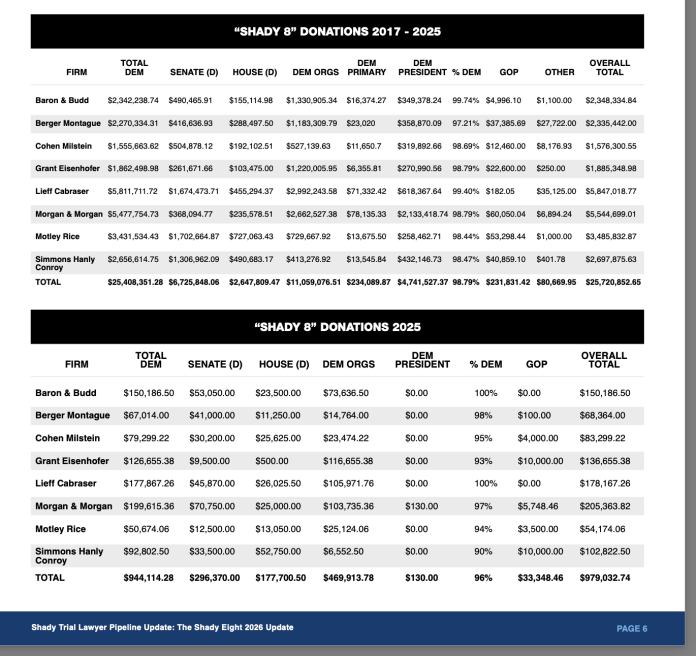
The report frames those donation patterns as part of a broader “pipeline,” in which firms that receive lucrative public litigation work later direct political contributions toward candidates and committees aligned with their political priorities.
Skinner told the Washington Examiner the concern is not simply partisan giving but a disconnect between the interests of state clients and the firms they hire.
“The key problem is just the misalignment,” Skinner said. “You want a lawyer that is loyal to the client and aligned with their interests.”
The accompanying letter points to actions already taken by some Republican state attorneys general. Officials in states including Alaska and Utah have already ended relationships with firms cited in the report, including Motley Rice and Baron & Budd, which have handled states’ cases, including matters related to opioid litigation and chemical contamination disputes, respectively.
Alliance for Consumers also raised concerns about the structure of some of these contracts. According to the report, certain agreements lacked basic safeguards, such as clear rules on conflicts of interest or provisions allowing states to easily terminate the relationship.
“These types of weak, under-protective, giveaway-style contracts make some sense if the goal is to fund left-wing campaigns … but they make no sense if your goal is to help consumers and protect taxpayers,” the report states.
Supporters of using outside law firms say states often rely on them for expertise and resources in complex cases they may not be able to handle alone. Skinner acknowledged that role, but said states should still ensure those partnerships are structured to avoid conflicts.
DNC CASH CRUNCH PERSISTS DESPITE MOMENTUM HEADING INTO 2026
“Every conservative official should be revisiting their contracts,” he said, noting that many officials may have inherited agreements from prior administrations.
The Washington Examiner contacted the eight firms but did not immediately receive a response.