
The Supreme Court’s rollback of the Voting Rights Act is already throwing the 2026 midterm elections into flux, as states weigh last-minute changes to their congressional maps, while preparing for a much broader redistricting battle in the years beyond.
In a 6-3 decision authored by Justice Samuel Alito, the ruling makes it significantly harder for voters to challenge maps they argue dilute minority representation, further narrowing Section 2 of the Voting Rights Act.
“This is one of the most consequential Supreme Court decisions ever,” said Josh Rultenberg, author of Draw the Line in Ohio. “It will allow partisan gerrymandering to move forward and significantly gut Section 2 of the Voting Rights Act, which had protections in place for decades.”
While legal and logistical hurdles may limit how much can change before November, the ruling is expected to have a far greater impact on future elections, particularly in 2028, when more states will have the time and flexibility to redraw their maps.
Even before the ruling, both parties had already been aggressively redrawing maps in the states they control, with many of the gains effectively canceling each other out.
In Virginia, Democrats secured approval of a new congressional map through a statewide vote that could net them as many as four additional seats. In Texas, Republicans have redrawn legislative maps aimed at creating a path to five more seats, while voters in California approved new district lines through a referendum that could similarly boost Democrats by up to five seats.
Louisiana
The most immediate fallout is unfolding in Louisiana, where the Supreme Court invalidated the state’s congressional map and forced officials to halt the May 16 House primaries.
Secretary of State Nancy Landry said she declared an emergency in response to the ruling, triggering the legal process needed for the governor to suspend the scheduled House races.
The invalidated map had included a second majority-black district, created after years of litigation under the Voting Rights Act. Its collapse throws that representation into question and sets off a new round of redistricting in a state that has become a focal point of the legal fight.


Gov. Jeff Landry (R-LA) praised the ruling when speaking to reporters on Wednesday.
“I think that the Supreme Court has finally taken race out of redistricting,” he said. “I think that the Supreme Court is tired of the legal circus that’s been going on in the federal courts.”
In an executive order Thursday, Landry directed lawmakers to move quickly to pass a new congressional map and set a revised election timeline.
Tennessee
In Tennessee, Sen. Marsha Blackburn (R-TN), who is running for governor, called for immediate action to redraw the state’s map.
“I urge our state legislature to reconvene to redistrict another Republican seat in Memphis,” she posted on X. “It’s essential to cement @realDonaldTrump’s agenda and the Golden Age of America.”
“I’ve vowed to keep Tennessee a red state, and as Governor, I’ll do everything I can to make this map a reality,” Blackburn added.
Gov. Bill Lee (R-TN), who is term limited this year, announced on Thursday a special session of the state legislature to review the congressional map in light of the new ruling.
“We owe it to Tennesseans to ensure our congressional districts accurately reflect the will of Tennessee voters,” said Lee.
President Donald Trump also weighed in, saying he spoke with Lee on Thursday and urged him to address what he described as flaws in the state’s congressional map. Trump suggested changes could result in an additional Republican seat and encouraged Lee to move aggressively.
Mississippi
Mississippi officials are preparing for a special session that could extend beyond its stated purpose.
Gov. Tate Reeves (R-MS) has signaled lawmakers will convene 21 days after the Louisiana decision, landing on May 20. While the formal focus is on judicial districts facing legal challenges, Republican strategists say the session could expand to include congressional maps.
One potential target is the 2nd Congressional District, a majority-black seat held by Rep. Bennie Thompson (D-MS), which could be redrawn in a way that creates an additional Republican-leaning district. Thompson’s seat is the only one held by a Democrat in the entire Mississippi congressional delegation.
Florida
In Florida, Republicans were already moving ahead with new congressional lines before the Supreme Court handed down its decision.
A map backed by Gov. Ron DeSantis (R-FL) cleared the legislature this week and is expected to tilt the state further toward the GOP by carving up Democratic-leaning districts in Tampa, Orlando, and along the southeast coast.
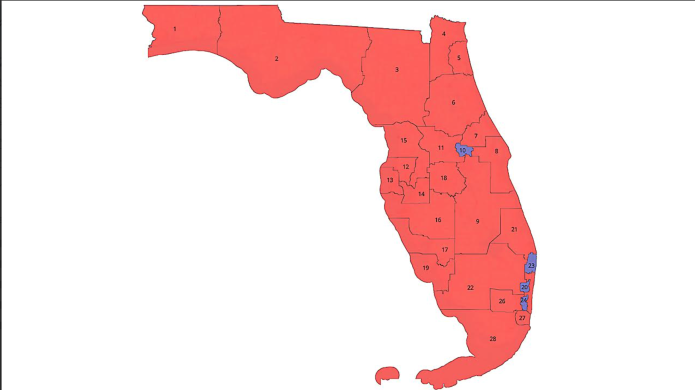
The plan could create up to four additional Republican-friendly seats.
During debate, DeSantis’s general counsel, David Axelman, argued that complying with prior court mandates risked acknowledging that race played a role in drawing districts, echoing legal arguments at the center of the Louisiana case.
Alabama
Alabama is now moving more aggressively in response to the ruling.
Gov. Kay Ivey (R-AL) said Friday she will call a special legislative session aimed at redrawing the state’s congressional maps, reversing her earlier position that she would wait for the courts to resolve litigation.
“By calling the Legislature into a special session, I am ensuring Alabama is prepared should the courts act quickly enough to allow Alabama’s previously drawn congressional and state senate maps to be used during this election cycle,” Ivey said in a statement.
The move comes as the state remains entangled in a legal fight over its maps after courts required the creation of a second majority-black congressional district. If those legal constraints are lifted, Ivey indicated the state could revert to earlier lines.
“If the court-ordered injunction is lifted, Alabama would revert to the maps drawn by the Legislature for congressional districts in 2023 and state senate districts in 2021,” she said.
Ivey also said she would ask lawmakers to consider holding special elections for members of the state’s congressional delegation and some state senators.
2028 and beyond
In Georgia, Gov. Brian Kemp (R-GA) signaled the ruling will not disrupt the state’s 2026 elections but is likely to force changes soon after, highlighting how much of the impact is being pushed into the next cycle.
“Voting is already underway for the 2026 elections,” Kemp told the Atlanta Journal-Constitution, adding that the decision makes clear Georgia will need to adopt new congressional maps before the 2028 cycle.
Kemp, who is term limited, welcomed the outcome in Louisiana v. Callais, arguing it returns greater authority to states. He said the ruling restores fairness to the redistricting process by allowing maps to reflect voters’ preferences rather than court mandates.
Georgia’s early voting period runs through May 15, just days before the primary, effectively taking near-term changes off the table.
In South Carolina, Gov. Henry McMaster (R-SC) pointed to the Supreme Court’s earlier decision upholding the state’s congressional map in 2024, but suggested lawmakers may need to revisit it in light of the latest ruling.
“The U.S. Supreme Court upheld South Carolina’s current congressional map in 2024,” McMaster posted on X. “In light of the Court’s most recent decision on the Voting Rights Act, it would be appropriate for the General Assembly to ensure that South Carolina’s congressional map still complies with all requirements of federal law and the U.S. Constitution.”
More broadly, GOP-led states are expected to revisit majority-minority districts that were previously required under federal law, potentially reshaping maps in states like South Carolina and Ohio.
Democratic-led states are also weighing their response. New Jersey Gov. Mikie Sherrill said she would be willing to revisit the state’s redistricting process to create a counterbalance, though she acknowledged constitutional limitations.
“We have some constitutional limitations on doing it immediately, we’d have to get some votes through, but I’d certainly be willing to work with the legislature to do that,” she said during an interview on CNN on Thursday.
Colorado voters could head to the polls this November to weigh a ballot measure that would permit the state to redraw its congressional map before the 2028 election cycle.
Legal constraints may limit widespread changes before 2026, but the ruling is expected to drive significant shifts by 2028 and shape the next round of redistricting after the 2030 census.
Democrats have renewed calls to pass the John Lewis Voting Rights Advancement Act, but the measure remains stalled in the Senate.
During a press conference on Capitol Hill earlier this week, Sen. Lisa Blunt Rochester (D-DE) cast the moment as a renewed fight over voting rights.
“We will march, mobilize, organize, and fight to defend the Voting Rights Act,” she said.
Rep. Troy Carter (D-LA) warned that the implications extend nationwide.
“What this really means is far deeper than Louisiana,” he said. “The impacts go throughout every congressional district, every school board district, every legislative district.”
SUPREME COURT’S LOUISIANA REDISTRICTING RULING POISED TO WIPE OUT HOUSE DEMOCRATS IN THE SOUTH
Rultenberg said the long-term trajectory will ultimately depend on whether Congress intervenes.
“If Congress doesn’t act between now and 2030 — when the next census comes out — the maps are just going to be set on fire,” he said.