
An unusual, and perhaps highly strategic, update appeared on California Democratic gubernatorial candidate Xavier Becerra’s campaign website this week. Set off in bold red text and enclosed in a matching box, the post laid out a pointed line of attack against one of his chief rivals in the crowded primary race: billionaire Tom Steyer.
What’s raising eyebrows isn’t the message itself but who its intended target audience is.
Some of the language in the box, which is still on his website as of Friday afternoon, reads: “Steyer has spent most of his career making money for himself and spending it to promote himself. Becerra has a 35-year career dedicated to public service and fighting for progressive values. While other politicians profit off the public, Xavier Becerra has a lifelong record of protecting people.”
On its face, the language appeared directed at voters. But in political circles, it bears the hallmarks of “red boxing,” a tactic campaigns quietly use to signal preferred messaging, targets, and strategy to outside groups backing them. Those groups, typically big-money independent expenditure committees, are legally barred from coordinating directly with campaigns, but can spend unlimited sums to influence elections.
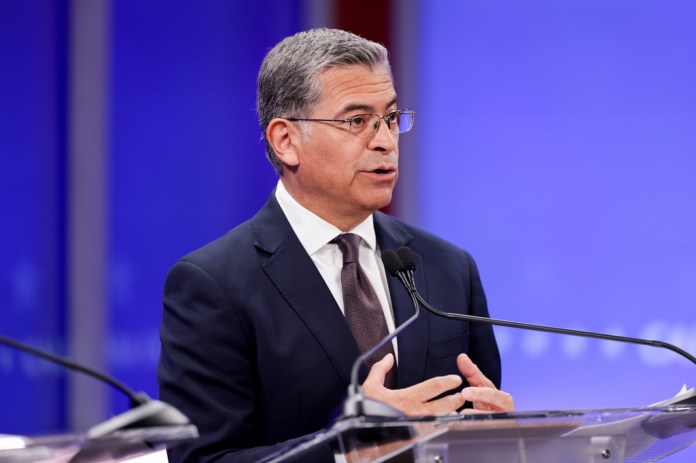
“What we’re looking at … is a textbook example,” Aaron McKean of the Campaign Legal Center, who argued Becerra’s page effectively guides supposedly independent allies on how to prosecute the case against Steyer. By publicly posting detailed messaging cues, campaigns can skirt coordination rules while still shaping the narrative, McKean told the Los Angeles Times, which first reported the story.
The legal gray zone is a product of Supreme Court rulings that limit how campaign finance can be regulated. While candidates themselves face contribution caps, in California’s 2026 gubernatorial race, donors can give up to $78,400 per candidate across the primary and general; outside groups face no such ceiling.
The result is a system where the line between independence and coordination is, at best, porous. It’s a way of technically working within the law while still helping super PACs craft their message. It’s also a practice that has become “absolutely standard procedure.”
Campaigns engaging in red boxing often publish material that looks like voter outreach but reads more like an internal memo, spelling out attack lines, ideal audiences, even preferred ad formats, sometimes literally highlighted in red.
A 2024 study in the Election Law Journal found that more than 200 federal candidates deployed the tactic in the 2022 midterm elections, and those who did frequently attracted more outside spending than those who didn’t.
For Becerra, the timing is notable. The former Health and Human Services secretary had been stuck in the low single digits as he sought to succeed term-limited Gov. Gavin Newsom (D-CA) in a race that at one point featured as many as 60 candidates.
CALIFORNIA’S ‘JUNGLE’ PRIMARY FACES RISING BIPARTISAN BACKLASH
Former California Democratic Rep. Eric Swalwell’s departure over sexual assault and misconduct allegations reshaped the field, injecting new momentum into Becerra’s campaign and boosting his fundraising. His team says it has pulled in 20,000 donations over the past 10 days, with 97% from first-time contributors. Becerra, who had a standout performance during Tuesday’s debate at Pomona College, is quickly emerging as one of the top Democratic front-runners in the race, followed by Steyer and former Rep. Katie Porter.
Calls to Steyer and Becerra’s campaign for comment were not returned.