
To the best of my knowledge, the new biopic of Michael Jackson does not rely on assistance from AI, but the experience of watching it is still akin to being subjected to over two hours of AI slop.
Just as we know that many AI images are unreal but remain incapable of turning away from them, moviegoers who buy tickets to see Antoine Fuqua’s Michael are aware that its star, Jaafar Jackson, is not Michael Jackson. And yet, while watching the movie, we enter a trance not unlike scrolling through the AI content that is overtaking the internet: We are held spellbound by the degree to which Jaafar is almost exactly like Michael: the look, the voice, the countenance. Something is slightly off that corrupts the perfection of the imitation, but then, isn’t that true of actual AI, too?
In fact, Jaafar comes by his otherworldly resemblance to Michael naturally: In real life, he is the son of Michael’s brother, Jermaine Jackson, and thus was Michael’s nephew. Since this is his sole screen credit, the filmmakers evidently cast him strictly on the basis of familial resemblance. And this seems to have been the sole standard to which Fuqua and company held themselves in making the film as a whole: The movie wants to replicate, with extreme external faithfulness, certain widely known episodes from Jackson’s public life — his appearance as a tyke on Ed Sullivan, his music video for Thriller, his fun times in the company of a chimp named Bubbles — for no purpose than their replication. We are offered no real insight into the meaning behind these events. Instead, the movie judges its own success by how well it can fool us that we are watching and listening to the real thing rather than a simulacrum.
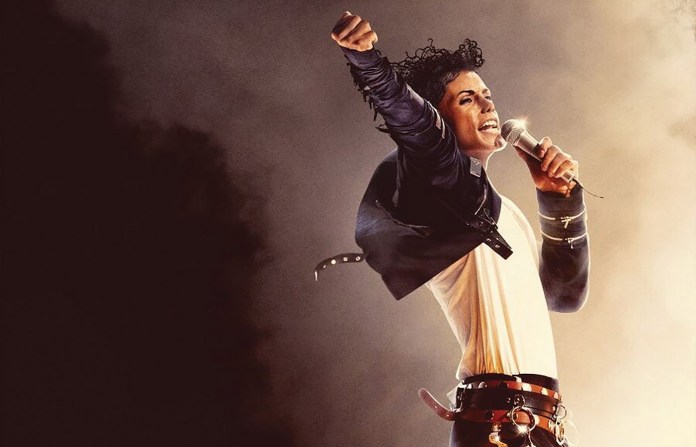
On that level, Michael works, in a bizarre sort of way: Jaafar is Michael incarnate, and obvious care has been taken to ensure that the sets, costumes, and hairstyles look just as we remember them. But to what end? We could just as easily watch Jackson’s actual Ed Sullivan appearance or the real Thriller video on YouTube. Why are the millions of moviegoers who have turned Michael into a megahit for its studio, Lionsgate, paying good money to watch what they know to be a fake version of things they already have access to? Then again, why do we ponder the AI image of the late Pope Francis in a puffer jacket when we know it to be unreal but remain fascinated by its unrepentant weirdness?
To assess Michael apart from its AI-like uncanniness is a difficult task. The script by John Logan does not exactly aim for Shakespearean depth. Whether as a youth (when he is played by Juliano Valdi) or as a young adult, Michael is made to seem lamblike in his gentleness, meekness, and apprehension around his father Joseph (Colman Domingo), who is the movie’s central adversary. The movie’s Joseph is not exactly a study in character depth, either: He is simply a domestic tyrant who insists that the Jackson 5, consisting of his sons, punch his ticket out of the steel mills of Gary, Indiana. Again, one cannot fault the filmmakers for nailing the superficial aspects of the movie: Domingo as Joseph and Nia Long as Michael’s mother, Katherine, resemble their real-life antecedents to such an extent that they come across less as actors and more as the animatronic figures from Disney World’s Hall of Presidents — a reference the real Michael would have appreciated.
Logan’s script consists less of scenes than fleeting glimpses of scenes that have been pasted into montages and slathered with music from the Jackson 5 or Michael’s solo career through Bad, where, notoriously, the film terminates (thus avoiding any reference to the criminal charges of child abuse that Jackson later faced). This is not a cradle-to-grave biopic but a “I Want You Back”-to-Bad biopic. Even so, the movie still feels overstuffed. One moment, the Jackson 5 are performing in a nightclub; the next, they are being pressured into a school-night rehearsal; the next, they are on the road in their VW bus, with Michael lost in a chapter from The Wizard of Oz. At other points, including well into adulthood, Michael is presented as being transfixed by the Three Stooges, Peter Pan, and a stuffed animal Mickey Mouse — not mere pop culture references but intended to be deep insights into Michael’s character. In lieu of real psychology, then, the movie Michael offers character insight by way of Curly, Larry, and Moe.
Michael is not the only cipher in the story. Woe to Jackson 5 fans who expected any meaningful dialogue by, or to, Jackie, Tito, Jermaine, or Marlon. The prominence of certain characters in the story, such as attorney John Branca (played by a stocky Miles Teller, long ago of Whiplash), is curious until one watches the end credits and notes, among the movie’s producers, one John Branca — not to mention a bevy of people with the surname “Jackson.”
For the most part, the movie seems eager to rush past behind-the-scenes moments in order to deliver its next recreation of a famous MJ moment, such as the making of the Thriller video. Yep, Jaafar looks just like his uncle in the video when affixed with all that ghoulish makeup, and the bearded guy who is supposed to be director John Landis is a dead-ringer for Landis. And … ? Along the way, though, there are scenes that are almost shocking in their unintentional, even clueless, ominousness, such as when Michael is shown visiting the children’s ward of a hospital. That the movie clearly does not intend such scenes to reference the subsequent abuse allegations made against Jackson is a sign of its almost proud dumbness.
REVIEW: THE UN-SHOCK EFFECTS OF UNDERTONE
Even so, Michael does its subject a disservice by continually underselling his undeniable intelligence. Thriller was a fantastically fun album with many inventive qualities, but the genius that went into its making and marketing is hardly reflected when Michael tells Branca that his aims for the record are as follows: “It’s got to be the greatest-selling album of all-time.” The Branca character lamely takes notes during this “meeting.” Later, Michael says, “I think music and dance is what we all have in common,” which admittedly sounds like the sort of sappy cliché that Jackson might have uttered in an interview, but having him say it in the movie overstates his ingenuousness and diminishes his tenacity and ingenuity.
All the same, I concede that I was seldom bored while watching Michael. Such is the insidious nature of AI-like cultural products. Watching the movie is sort of like munching on a can of Pringles: Like the ad slogan promises, you start, and before you know it, the can is empty. Although in the case of the movie, not quite. The movie ends with the distressing promise of a sequel: “His Story Continues.” Heaven help us.
Peter Tonguette is the Life & Arts editor of the Washington Examiner magazine.