
There is an old Marxist adage that says “war is the midwife of revolutions.”
Over 1,500 days into Russia’s ill-fated invasion of Ukraine, the former Soviet state has once again been transformed into a war economy. Ballooning military spending has eaten away at the government’s ability to render basic social services to its people, and censorship has been ramped up to keep public complaints to a minimum.
Amid this discomfort, the Communist Party of the Russian Federation is channeling with its spiritual predecessors, warning the national legislature that if they do not alleviate the suffering of ordinary citizens, another revolution is coming.
Communist Party leader Gennady Zyuganov made the extraordinary observation during a plenary session of the lower parliamentary chamber this week.
“We’re doing everything we can to support Putin and his strategy and policies, but you are not listening,” Zyuganov warned the State Duma.
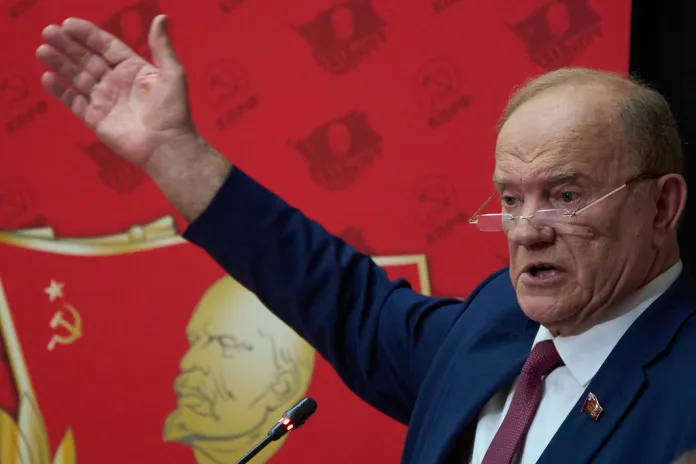
“If you do not urgently adopt financial, economic, and other measures, by autumn a repeat of what happened in 1917 awaits us,” he added in his address. “We don’t have the right to repeat that. Let’s take some decisions.”
The Communist leader specifically mentioned a recent viral video from Russian vlogger Victoria Bonya decrying a lack of action to help citizens plagued by the rising cost of living and insufficient relief to disasters.
“You know what the risk is?” the social media influencer asked in the 18-minute monologue. “That people will stop being afraid, and they’re being squeezed into a coiled spring, and that one day that coiled spring will shoot out.”
Bonya, a former reality television star who has lived in Monaco for over a decade, specifically noted several regional issues in Russia she felt had not been addressed, from oil pollution in Anapa to flooding in Dagestan.
Zyuganov said that Bonya, whom he referred to as “that lady from Monaco,” raised good questions about the direction of the country that could not be ignored.
“She listed all the questions that were raised here, and you heard,” he told the Duma. “And why is there a dirty spot in Anapa? And why was there no timely response to the assistance needed in Dagestan?”
The Communist Party in Russia is neither a political powerhouse like its Chinese parallel nor an ineffective joke like those in most Western countries. It is the second-largest political party in the country and has for decades served as a friendly controlled opposition to Putin’s United Russia milieu.
It typically acts as a vehicle of Soviet nostalgia for Russian voters disgruntled with modernity and the indignities of capitalist life in the once-powerful land of Vladimir Lenin and Leon Trotsky.
That nostalgia is not negligible. A widely-reported poll in 2019 found that 70% of the Russian population has positive feelings about former Soviet dictator Joseph Stalin.
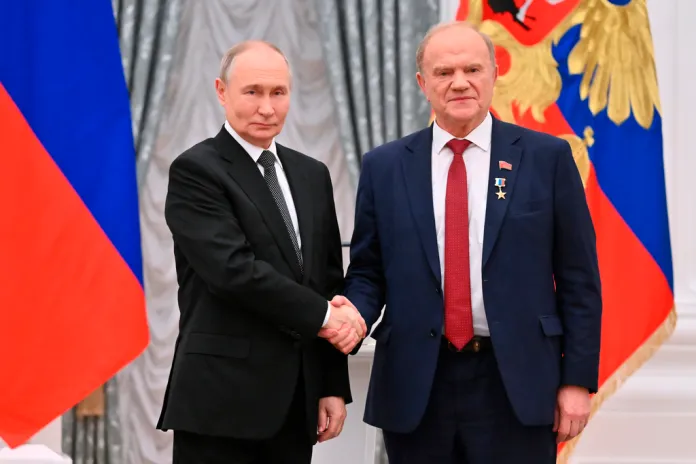
Putin hosted Zyuganov at the Kremlin in 2023 to honor the 30th anniversary of his party’s creation, commending them as a “force representing a significant part of the country’s patriotic movement.”
“The party makes a substantial contribution to the political discussion and the quest for the best solutions to move the country forward in the social sphere, the economy, defense, and security,” Putin told Zyuganov. “We have never had any differences on that level, I think.”
In his address to the Duma this week, Zyuganov notably refrained from explicitly placing any blame on the Russian president himself and framed his discontent as directed at the legislature.
The fact that discontent among the Russian people has percolated to the State Duma and given a voice to an elder-statesman usually considered a political ally of the Kremlin has surprised international observers.
“[Putin] has a deep paranoia about color revolutions, and he said as soon as he came to power that one of the greatest tragedies of the 20th century was the collapse of the Soviet Union,” Ivana Stradner, a research fellow at the Foundation for Defense of Democracies, told the Washington Examiner.
Stradner explained that while many ordinary citizens in Russia might be fine with Putin’s invasion of Ukraine and support the idea on paper, it is becoming a point of rancor for the population because “he is not winning that war.” By some outside estimates, military spending now accounts for approximately half of the Kremlin’s overall budget.
Meanwhile, a key European ally has been lost as Kremlin-friendly Prime Minister Viktor Orban of Hungary is set to leave office after losing to the West-aligned Peter Magyar.
Orban once served as a stopgap within the European Union to prevent the continent from acting too aggressively towards Russia. Comparing himself to a mouse aiding a lion, Orban threw vetoes at Ukraine security loans and steps towards membership for the invaded nation.
Some of that red tape is being rolled back before Orban is even officially out. The outgoing prime minister relented on a loan package for Kyiv this week that will ensure the Ukrainian military stays capable of holding the line against Russian forces.
Stradner suspects that “Putin knows he’s in trouble” because the Stalin-approving, cash-strapped people of his nation “care more about having normal lives than they care about some abstract things such as democracy.” In short: They don’t care about political philosophy as much as they care about results.
State pollster VTsIOM reported on Friday that Putin has an approval rating of 65.6%. The questionable veracity of Kremlin-sponsored polling on an autocratic leader aside, the result is notable because it is, by the pollster’s own metric, his worst rating since the invasion of Ukraine.
UKRAINE HAS NO ‘UNREALISTIC EXPECTATIONS’ FOR HUNGARY AS IT PITCHES ITSELF AS ALLY TO MAGYAR
There is little tangible evidence of a brewing revolution against Putin and his government. Routine political arrests, restrictions on public demonstrations against national policies, and sweeping internet censorship ensure that an organized movement to oust leadership will trigger bloody resistance. Silent frustration is currently the norm.
But it is worth remembering a historical note unspoken but well understood by a communist like Zyuganov: The February Revolution of 1917 only took about a week to overthrow three centuries of Romanov autocratic monarchy. If a Russian leader cannot deliver on the battlefield while failing to keep the domestic economy in order, he begins to bear a striking political resemblance to Tsar Nicholas II.