
House Republicans are escalating their response to activist-led jury nullification efforts, with Rep. Julia Letlow (R-LA) rolling out new legislation and advancing an appropriations directive aimed at shutting down training programs that encourage jurors to disregard evidence and the law to send a political message.
Letlow on Thursday introduced the “No Rogue Jurors Act,” which would prohibit federal funds from going to organizations that train prospective jurors to acquit defendants regardless of the facts presented in court. The move follows reporting, including by the Washington Examiner, highlighting organized efforts in Washington, D.C., to turn jury service into a form of political activism.
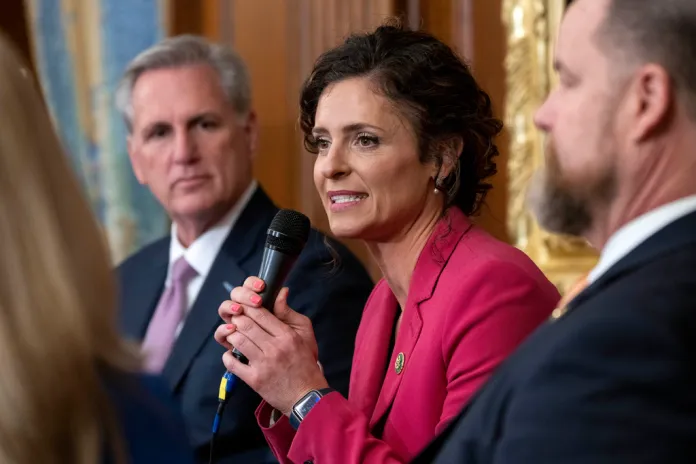
“Far-left organizations are training jurors to ignore evidence and acquit criminals — even when the facts are clear,” Letlow told the Washington Examiner. “It’s a shameful violation of the rule of law and must be stopped.”
Washington, D.C., has become a proving ground for President Donald Trump and Republican critics who say a pattern is emerging in cases brought by U.S. Attorney Jeanine Pirro, with charges downgraded or juries acquitting at trial. The most high-profile example came on Nov. 6, 2025, when a jury declined to convict a former DOJ attorney charged with misdemeanor assault for throwing a sandwich at a U.S. Customs and Border Protection agent.
But the issue extends beyond atypical cases such as that one. In recent weeks, CNN has reported that Pirro’s office has lost half of the eight criminal cases it has taken to trial this year alone.
The legislation from Letlow would aim to address these problems by blocking any federal grants, contracts, or financial assistance from going to organizations or schools that promote jury nullification, which is defined as the deliberate act of voting to acquit regardless of whether prosecutors have proven their case.
The push centers in part on groups such as Free DC, which has hosted “Juror Information Project” training in recent months, encouraging attendees to use jury service to influence trial outcomes. Free DC operates as a fiscally sponsored project of the Center for Community Change and Community Change Action, nonprofit organizations that provide administrative and financial backing.
Other activist efforts have gone further. A network known as Freedom Trainers has hosted webinars and circulated materials instructing participants on how to increase their chances of being selected for juries and how to avoid detection during the vetting process. According to training materials reviewed by the Washington Free Beacon, attendees are advised not to disclose intentions related to jury nullification during voir dire and to present themselves as neutral jurors, only to vote later to acquit “for any reason” once seated.
The materials also encourage activists to keep their voter registration and addresses updated to ensure they receive jury summons and to distribute pamphlets outside courthouses promoting the concept of acquitting defendants regardless of whether the legal elements of a crime have been met. Organizers frame the tactic as a form of “noncooperation” with the justice system and a way to influence outcomes in politically sensitive prosecutions.
Alongside the stand-alone bill, Letlow also secured passage of an amendment through the House Appropriations Committee requiring the federal judiciary to examine the issue. The provision directs the Judicial Conference, led by Chief Justice John Roberts, to report to Congress within 180 days on whether organized jury nullification efforts are affecting federal jury management and on the safeguards that exist to address them.
“The Committee is aware of organized advocacy efforts to encourage individuals to approach jury service with the intent to vote contrary to the evidence,” the amendment states. Letlow framed the effort as both a crackdown and a fact-finding mission.
“My amendment requires the federal judiciary to study this issue and tell Congress how deep the rot runs,” she said. “Ideological activism has no place in the courtroom.”
As an initial wave of cases brought by Pirro’s office began to encounter repeated pushback in the district, the Washington Examiner spoke with legal experts about what might be driving the trend. They offered a range of explanations and cautioned against drawing definitive conclusions.
While some acknowledged that jury nullification could be a factor, they emphasized that it is difficult to prove a verdict was driven by that dynamic alone, noting that such outcomes, while controversial, have long been a recognized feature of the justice system.
Former federal prosecutor Neama Rahmani said nullification can occur “when there is a very likable defendant or an unlikable victim,” noting that any case seen as a response to Trump’s criminal crackdown could face a higher risk of nullification given D.C.’s heavily left-wing political demographics.
PIRRO FACES GRAND JURY PROBLEM AS DC RESIDENTS REFUSE TO INDICT ANTI-TRUMP SUSPECTS
South Texas College Law Professor Josh Blackman said anyone who might be engaging in jury nullification is “not disputing that the defendants committed the acts — they’re saying they don’t agree with the charges.”
The legislative push also lands as Letlow’s political profile continues to rise back home. Louisiana Republicans are preparing for a Senate primary showdown between Letlow and incumbent Sen. Bill Cassidy (R), who drew backlash from Trump allies after voting to convict the president during his 2021 impeachment trial.