
She was finally going to run. After half a decade and repeated attempts by party leaders to recruit her, Shelley Moore Capito (R-WV) was ready to challenge a political titan of West Virginia for his long-held Senate seat.
“In 2012, I decided I was ready to go up or out,” Capito said in an interview. But first came the task of telling Sen. Mitch McConnell (R-KY), the inscrutable Senate GOP chief who had tried unsuccessfully to get Capito, then a House member, to run as their nominee.
“I go to McConnell, and we’re sitting in his office, and I said, ‘Well, I’m going to run against Sen. Rockefeller,’ and he sits there like he does,” Capito told the Washington Examiner, settling into a lower octave to match his gravelly baritone. “And he goes, ‘Shelley, you’ve been a bridesmaid too many times. Prove it!’”
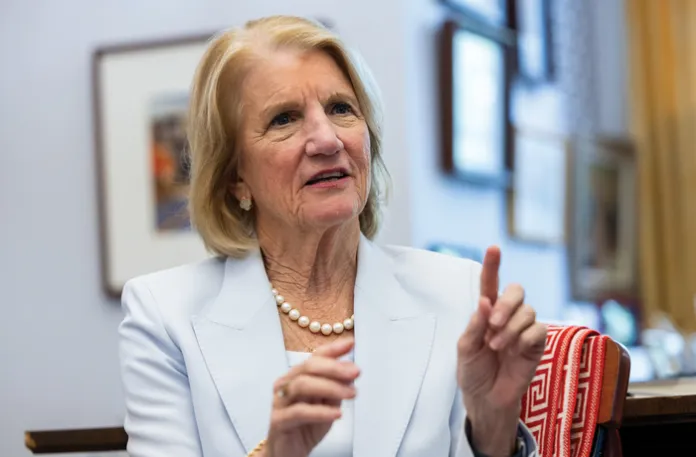
“He’s like, I’m not buying what you’re selling,” she said with a chuckle.
Capito used her 59th birthday to put McConnell’s doubts to rest. She announced on Nov. 26, days after winning a seventh term to her House seat, that she would challenge Sen. Jay Rockefeller, a Democrat whose career in the Senate spanned almost three decades. Weeks later, Rockefeller decided to retire, and the Democrat who did run in the general election lost to Capito by 28 points.
Her victory was part of a startling collapse of Democrats’ dominance in West Virginia. When Capito arrived in Washington in 2001, she was the only Republican in the state’s congressional delegation. But just a decade later, she had sent it lurching one step closer to single-party GOP rule.
Today, Capito is the senior senator from one of the most Republican states in the country, one that voted for President Donald Trump by 42 points in 2024.
Capito is not necessarily an easy fit for the new, MAGA GOP of West Virginia (though she boasts the president’s endorsement). But Capito’s story is inextricably linked to its rightward shift, and she is carrying on a dynasty that began with her father, Arch Moore, a six-term congressman and three-time governor of West Virginia who, as a Republican, represented a rare exception to that period of Democratic control.
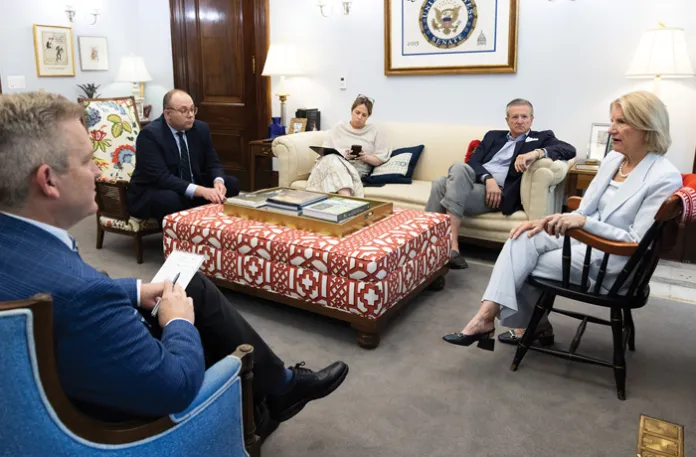
Capito shares her father’s willingness to work across the aisle, something she connects to her days of public service in the West Virginia legislature, when getting anything done as a Republican meant cooperating with Democrats.
“We had to, and I wanted to,” Capito said.
In terms of temperament, Capito is more understated than her father, but friends and allies say that she, too, has a knack for the old-school brand of retail politicking that still predominates the state.
“She was tutored by the best,” said former Sen. Joe Manchin, who came up through West Virginia politics with Capito and served with her for a decade in the U.S. Senate.
“Her father was very, very engaging, and Shelley’s very engaging,” Manchin told the Washington Examiner in a phone interview. “So that’s a natural trait — that’s in her DNA.”
“She doesn’t have to pretend that she wants to meet you,” Manchin added. “She don’t have to pretend if she likes you. She don’t have to pretend that she really cares, because she does all three of those, and it comes across genuinely.”
‘All about the timing’
Capito has blazed her own trail as the first woman elected to the Senate from West Virginia. And though the influence of her father came up repeatedly across a one-hour interview at her Capitol Hill office, it’s clear that Capito has added her own distinctive mark to a career that builds on his.
There’s the simple fact that Capito holds a Senate seat that her father failed to win four decades earlier, one of the rare blemishes on his electoral record. In 1978, Moore ran against Democratic Sen. Jennings Randolph, another heavyweight of West Virginia politics, but fell 5,000 votes short.
Capito also expressed astonishment that constituents still come up to her with stories about how her father, known for his uncanny ability to remember names, had an impact on their lives. The nostalgia was behind Capito’s decision to start Girls Rise Up, a program to mentor elementary school girls, in the hope of passing on to her daughter a similar legacy.
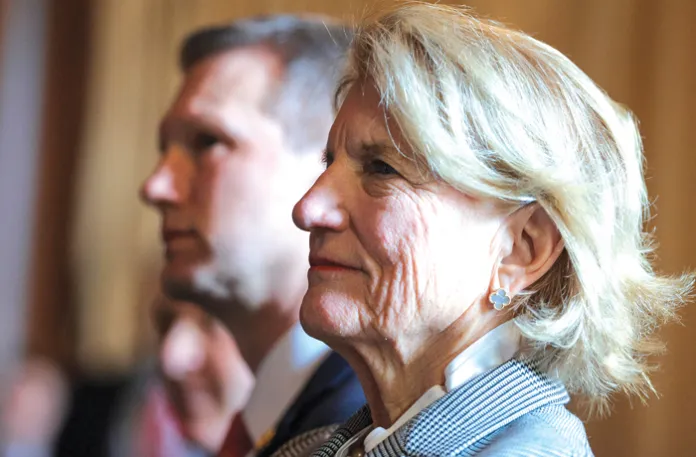
“I’d love for some young woman to come up to her and say, well, your mother, she inspired me to run for public office, or she brought the astronaut to her class, and now I’m in space,” Capito said.
Another through line of the interview was the importance of timing to Capito, who recounted some early advice her father gave when one of West Virginia’s House seats opened up in 2000. At the time, she was still raising her teenage daughter, the youngest of her three children, and was reluctant to leave for Washington.
“It’s all about the timing,” Capito recalled Moore saying. “You got to go on the timing.”
As for her ascension to the Senate, it was, for Capito, more an exercise in strategic patience, and she expressed bafflement at the hurry of most politicians gunning for statewide office.
In 2006, Capito passed on a chance to run against nine-term Sen. Robert Byrd, questioning whether she could actually defeat a “beloved” figure in the state despite GOP leaders “working her over” with polling showing she’d be competitive. Capito also grimaced at the thought of running a campaign that, to have a shot at success, would require her to capitalize on his declining health.
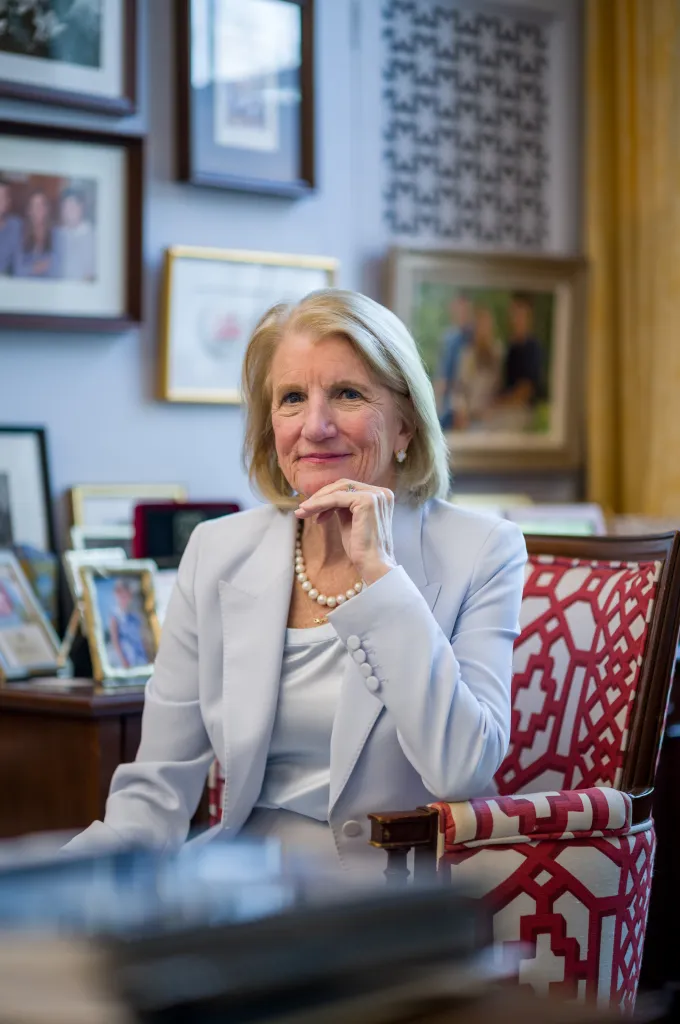
Capito passed again when McConnell, by that time the Senate GOP leader, encouraged her to challenge Manchin, who was coming off two successful terms as governor when Byrd’s death in 2010 opened up his seat.
“I see some of these folks, they jump so quickly to try to run for something. And for me, I just wasn’t ready to give it up,” Capito said, insisting that, despite the dysfunction of the House today, she was actually content with the career and friendships she had developed there.
By the time Capito was prepared to challenge Rockefeller in 2012, it was based on her sense that he’d been “badgered” by Democrats the last time he agreed to run and might retire if confronted with a serious Republican challenge.
“The timing of that was obviously perfect. Our state had changed. He ends up retiring six weeks later,” Capito said, “and I had the leg up.”
McConnell also helped shore up her chances by encouraging her to announce early, and certainly before Christmas, when possible rivals would be discussing their futures with family.
“There were a lot of people that probably thought, ‘Well, this is going to be my shot,’ but because I got in there early, it really helped,” Capito said.
At her peak
Fast-forward to today, and Capito, 72, is a West Virginia titan in her own right. She has a seat at the leadership table as the No. 4 Senate Republican and attained the title of senior senator from West Virginia last year, when Manchin retired after more than a decade in the Senate.
She still regards timing as critical to the trajectory of her career, noting that an early endorsement from President Donald Trump last May helped convince her to run for a third Senate term this fall. But the apprehension that defined those early stepping stones is gone, and today, she is one of the major figures forging a new, Republican-dominated era of politics in West Virginia.
“I just feel I’m sort of at the pinnacle of where I can be more influential than ever with my leadership position, my chairmanships, my relationships,” Capito said.
“I’ve been more successful for our state now that I’m the senior senator, and I just didn’t want to walk away from it,” she added. “I think it’s better for our state. And I’m not sacrificing myself or anything. The joy of it is still very alive for me.”
As for her age, Capito remarked that she feels like a “young 72″ — she’s active in congressional sports on Capitol Hill, competing in the annual softball and pickleball matches — but Capito also hinted that she couldn’t see herself serving more than another six-year term.
“I don’t know how people go into their 80s and do something like this,” Capito said. “I mean, I haven’t hit my 80s, but …”
When asked directly if she would run for a fourth term if elected again in November, Capito was more coy, remarking that most people would probably assume she’ll retire.
“I haven’t really thought about it,” Capito said. “I don’t want to get too far ahead of myself. Six years is a long time.”
Already, a new generation has begun to carry on the Moore family dynasty. Capito’s son is a U.S. attorney for the Southern District of West Virginia, while her nephew, Rep. Riley Moore (R-WV), was elected to her old House seat in 2024.
‘Worthy of leading’
In the halls of Congress, Capito is regarded as a pragmatic legislator and is one of a rare breed of politician intent on forging relationships with members of the opposite party.
From her perch chairing the Environment and Public Works Committee, Capito is currently helping lead negotiations between Democrats and the White House on permitting reform. Capito is also credited with jump-starting negotiations with President Joe Biden in 2021 over that year’s bipartisan infrastructure law, though she later stepped back from talks when Biden expressed frustration at her unwillingness to agree to its $1 trillion price tag.
Today, Capito recalls with amusement the phone call she got from Biden to cut off negotiations.
“He was really nice the way he did it,” she said. “I liken it to when your boyfriend breaks up with you, and he says, ‘It’s really about me.’ It was that kind of a conversation.”
Though Capito is a reliable GOP vote and rarely breaks with Trump, she has, at times, crossed over to support Democratic priorities when Republicans were in the Senate minority. In 2022, she was one of 15 Republicans to vote for the gun control bill passed in the wake of a mass shooting at an elementary school in Uvalde, Texas. She also voted for the 2022 bill that federally recognized same-sex marriage.
“She’s a serious person, and she’s an experienced legislator, so although we might not agree on a lot of issues, she’s worthy of leading, being a member of leadership, and she’s trusted on both sides of the aisle,” said Sen. Brian Schatz (D-HI), who is in line to become the No. 2 Senate Democrat in the next Congress.
“Even when we’re on opposite sides, I feel like it’s the way the country is supposed to work — hard on the issues, easy on each other,” Schatz added.
A new GOP
Capito’s willingness to find common ground has long placed her at odds with the right wing of the party. That was true in the Tea Party era, when the fiscally conservative Club for Growth opposed her first run for Senate, and it is still true today as the GOP adopts a new kind of MAGA orthodoxy.
Capito hasn’t faced a serious challenge since her election to the House in 2000, and she enjoys a constructive working relationship with Trump. Still, Capito acknowledged that some within his movement view her with suspicion, at one point expressing surprise at the attacks she received for supporting aid to Ukraine.
“That really kind of shocked me, when I got some negative blowback on that,” Capito said. “That was something that was unusual, I think, because a strong national security is something that I voted for.”
As for that Trump endorsement, Capito had been planning to ask for it, seeing his backing as a helpful signal to the base that she’s aligned with his agenda. Yet the president beat her to the punch, calling Capito out of the blue one day to read the “quite lengthy and very detailed” statement he had drafted for Truth Social.
He was on his way back from the Middle East, and she rushed out of a Pilates class to take the call, recalling how intent Trump was for her to know he personally wrote it as she stood outside the studio.
“I never go!” Capito groaned as she shook her head at the inopportune timing.
Capito believes that the Republican Party, at its core, has not changed all that dramatically, describing the One Big Beautiful Bill Act as proof that conservatism is still about “lower taxes and personal responsibility.” But she acknowledged that the ideological drift on tariffs and foreign policy has created friction, and, in some ways, she views Republicans as victims of their own success in West Virginia.
“Now that it’s so dominant, what happens?” Capito said. “You infight, and, you know, we’re breaking apart.”
BY THE NUMBERS: HOW MANY SEATS HAS EACH PARTY GAINED IN REDISTRICTING?
In terms of her own politics, Capito still views herself as fitting firmly within the mainstream of the Republican Party.
“I don’t agree with, ‘You have to be one kind of Republican.’ I don’t agree you can’t be Susan Collins and you can’t be Mike Lee and still be Republicans,” Capito said. “And so, I think I fit somewhere in the middle there, probably, but I’ve always been a Republican. I was raised that way.”
David Sivak (@DISivak) is Congress and campaigns editor for the Washington Examiner.