
There was a time when a Supreme Court justice could be a fairly obscure figure. Known in Washington, maybe, and recognized within the legal profession, but nothing like the celebrities that make up the elected branches of government.
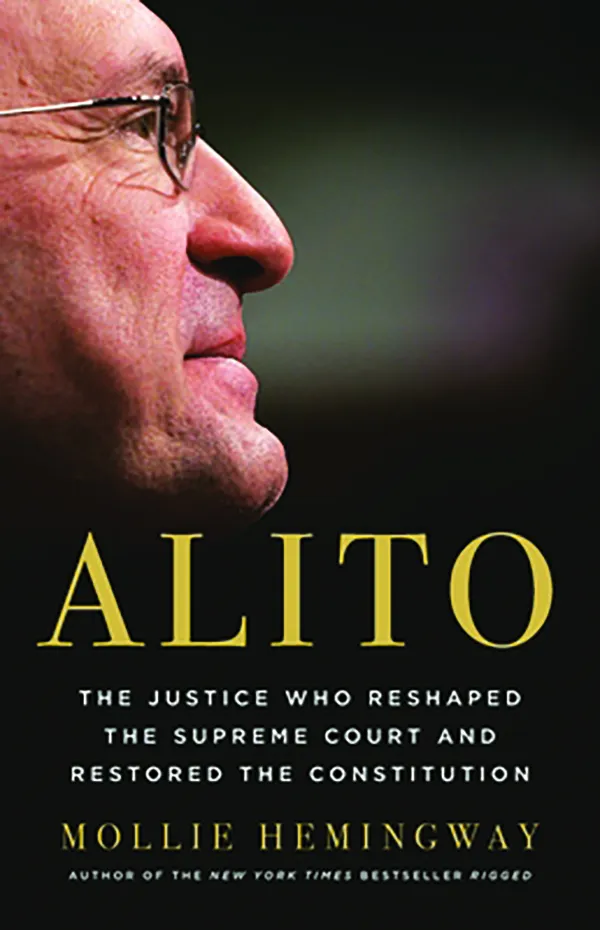
That was the state of affairs when Justice Samuel Alito began his career, and one that likely suited him just fine. It is not the world of 2026. In her latest book, Alito: The Justice Who Reshaped the Supreme Court and Restored the Constitution, author and editor-in-chief of the Federalist Mollie Hemingway presents a timely biography of the associate justice thrust into the spotlight by the growing attention on the court, the ever-deepening tribal warfare in American politics, and — most of all — by his authorship of the most politically impactful decision of the 21st century, Dobbs v. Jackson Women’s Health Organization.
Dobbs unsurprisingly takes up a large part of the narrative, but Hemingway begins with a sketch of her subject’s life, beginning with his upbringing in and around Trenton, New Jersey. The son of an immigrant father and a mother who was herself the daughter of immigrants, the lives of Alito and his parents are a classic tale of the American dream in action. Theirs was a family that valued education as the key to success in America.
Alito also emerged from that upbringing with a sense of patriotism and devotion to serving the country, a spirit that in the Vietnam War era was less popular than it once had been. After graduating from Princeton University and Yale Law School, Alito served in the Army and then embarked on a career in the Justice Department, where many of his talent and elite credentials would have been happy to make a small fortune at a white-shoe law firm in New York.
Even after his move to the solicitor general’s office in Washington, Alito’s colleagues were not able to discern his politics. He stood out not by getting in front of a camera, as is the usual path from prosecutor to political success, but through hard work and the gift of a brilliant, incisive legal mind. He was also remembered by co-workers as one who “doesn’t lose his temper, even when working on controversial issues.”
That combination of intelligence and quiet competence, combined with conservative politics that were in line with the growing originalist legal movement, led to Alito’s appointment to a seat on the Third Circuit Court of Appeals in 1990. Sixteen years later, his consistent jurisprudence led President George W. Bush to appoint him to the Supreme Court.
By that time, the conservative legal movement had been spurned and disappointed by so many Republican nominees that turned out to be conservatives in name only that there was suspicion of Alito, despite his solid record. Ironically, the strongest pushback came from the pro-life movement, one spokesperson for which suggested that Alito “has not advanced the ball intellectually on how to overturn Roe and Casey.”
Republican senators ignored that criticism and confirmed Alito by a vote of 58-42. The next 20 years would prove him to be no fair-weather conservative in the mold of late Justices John Paul Stevens or David Souter. Instead, as Hemingway details, he proved to be a “Burkean conservative” and a “practical originalist,” one who remained true to his principles instead of chasing the admiration of the Washington glitterati and the press.
Alito became a pillar of what one of Hemingway’s sources calls “the best court in history.” For conservatives, for textualists, and for originalists, that description is apt. Conservatives today enjoy a dominance on the high court akin to that which living-constitutionalist liberals maintained for the long years of the Earl Warren and Warren Earl Burger courts of the mid-to-late 20th century.
The decision to grant Alito authorship of Dobbs, Hemingway writes, was decided immediately after the justices’ initial vote, which showed five votes in favor of overturning Roe v. Wade and Planned Parenthood v. Casey and returning to that pre-1973 state of having abortion governed by state laws, enacted by legislatures, not judges. Because Chief Justice John Roberts was initially in the minority in that vote, the decision fell to the senior justice in the majority, Clarence Thomas. Beyond the need to spread the important decisions around — he was already slated to author New York State Rifle & Pistol Association v. Bruen — Thomas recognized Alito’s temperament was necessary to keep five votes onside when there would be intense pressure for one to defect, which is what happened in Casey.
Those pressures came, and then some.
The leak of the draft opinion in Dobbs was unprecedented in Supreme Court history. It shook the foundations of the institution, which had always valued professionalism and trust. It also imperiled more than just the court as a body: no decision is final until it is issued, and the leak of a decision beforehand created an instant incentive for some deranged person to assassinate one of the justices in the majority. The conservative justices found themselves besieged in their homes — a condition that abated but did not disappear after Dobbs was finally issued.
Indeed, that siege warfare has come to typify the left-wing reaction to a court that tries to judge in line with the text of the laws and the original public understanding of the Constitution. Since then, millions of dollars have flowed into efforts to smear the justices with phony ethics charges, demands for unneeded recusals, and general harassment at public events. Alito has persevered and, if the latest reporting is true, he intends to return for another year on the court.
MAGAZINE: PENNSYLVANIA DEMOCRATS, IN MODERATION
And why not? For the quiet scholar known as a “judge’s judge” since his Third Circuit days, this is the 20th year in a dream job. Even at 76, the temptation for him to remain must be substantial.
Hemingway gives us the best look to date at the life and times of Sam Alito. Where the book falls short, it does so in the same way all biographies of living judges must: first-hand evidence of their careers and choices will not be known for decades, when their papers become available to historians. That problem is doubled in the case of a judge who does not seek the limelight like many of his colleagues. His thought processes are inaccessible and will remain so for some time. Explaining that will be a task for the next generation of legal historians.
Kyle Sammin is the managing editor of Broad + Liberty.