
Gov. Gavin Newsom (D-CA) is facing a high-stakes decision that could shape not only the contest to succeed him, but his own political future.
Former Rep. Eric Swalwell’s abrupt exit from California’s gubernatorial race following allegations of sexual assault has further splintered an already crowded and volatile Democratic field. Party insiders have been urging Newsom to step in to help consolidate support behind a credible candidate, or at least impose some order on a race that risks turning chaotic. But any move to anoint or even subtly boost a candidate carries real danger for the outgoing governor. If his preferred choice falters, Newsom could emerge politically weakened, undercutting his standing ahead of a potential 2028 presidential run.
The result is a classic catch-22 for the governor.
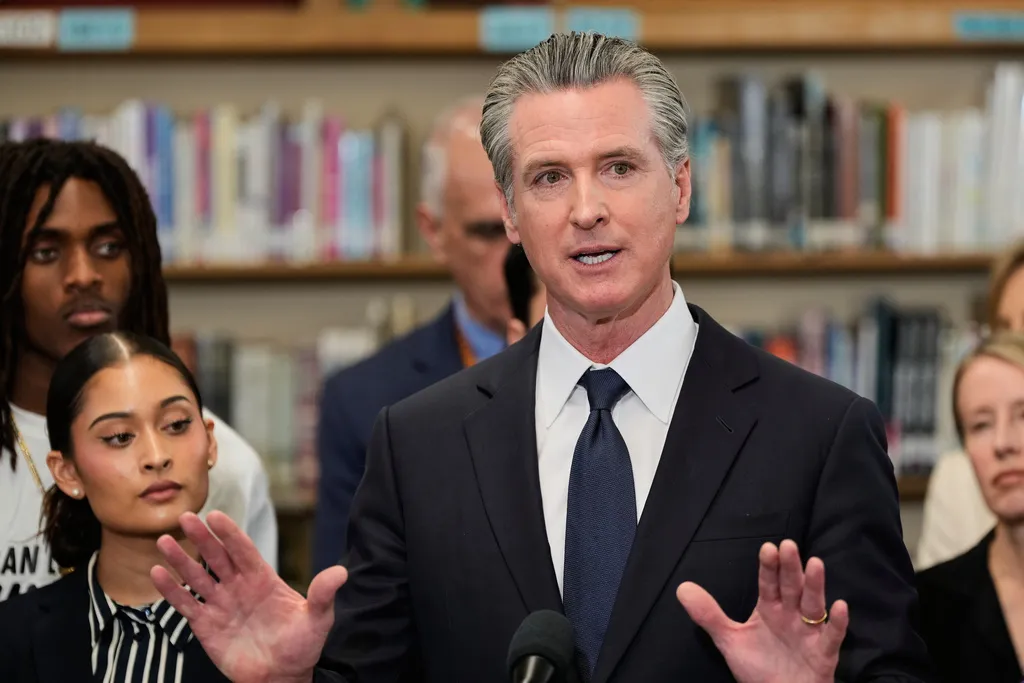
Staying neutral risks allowing the race to spiral, potentially producing a nominee who struggles in the general election or governs in ways that reflect poorly on Newsom’s legacy. But intervening could tether his national ambitions to the fate of a single candidate in an unsettled field.
California Democratic Party leaders are now grappling with a problem of their own making ahead of the 2026 governor’s race: a crowded slate of contenders, many offering only marginally different agendas as they compete to succeed Newsom. Polling underscores the lack of clarity, with no dominant front-runner and Democratic voters splintered across the field.
That dynamic opens the door to a worst-case scenario. Because of California’s top-two primary system, two Republicans could emerge from the June contest and advance to the general election, shutting Democrats out altogether. It’s an outcome that would sting in a state where they hold a sizable registration advantage.
“As a matter of politics, legacy, and his looming presidential bid, putting his thumb on the scale for his successor bears risk,” Jeff Le, managing principal at 100 Mile Strategies, told the Washington Examiner. “In a recent interview, [Newsom] highlighted concerns about a number of the gubernatorial candidates and their ability to do the job. Each of these candidates have support from influential stakeholders and political groups with heavy financing. The idea of anointing one in a crowded field makes one candidate happy and every other candidate (and their respective teams) unhappy.”
Le pointed to labor groups in particular. All of the major ones threw their support behind Swalwell, only to get burned. They have since hedged their bets, spreading endorsements and support across multiple candidates.
“The governor is likely considering how not to get sideways with organized labor, who have also chided him for not supporting a proposed billionaire’s tax,’ Le added. “In a long and expensive presidential primary, making long-term enemies to support a successor likely has significant consequences.”
Jeff Burton, co-founding partner at Maven Advocacy, believes Newsom will play it safe and do nothing.
“Governor Newsom has spent the last 18 months focused on his presidential ambitions, not managing the state’s political bench,” the GOP strategist told the Washington Examiner. “There’s no reason to think he’s going to suddenly change course now. The reality is donors and interest groups are split, and the first rule of politics is don’t make unnecessary enemies. There’s very little upside for Newsom in wading into the crowded primary, especially with the national picture still shifting and Kamala Harris re-entering the mix.”
Harris, the former vice president, was in South Carolina this week. Her visit to the crucial presidential primary state came just days after she told the Rev. Al Sharpton at the National Action Network’s 35th Anniversary Convention that she was considering a 2028 run.
“I might. I might,” Harris said. “I’m thinking about it… I’ll keep you posted.”
Democratic strategist Garry South, who has run campaigns for Newsom and former Gov. Gray Davis (D-CA), cautioned against putting too much weight on Newsom’s endorsement.
“It’s not common in California for sitting governors to try to designate their preferred successor,” South told the Washington Examiner. “Instead, they usually allow the election to play out, accepting whatever result the voters come up with. In this case, it’s not entirely clear to me that a Newsom endorsement alone would elevate a low-polling candidate into contention. If Newsom, [Rep. Nancy] Pelosi (D-CA), [Sen. Alex] Padilla (D-CA), and [Sen. Adam] Schiff (D-CA) — or two or three of them — all endorsed at the same time, that would probably get Democratic voters’ attention and boost a candidate into the top ranks.”
Pelosi, who urged Schiff to run for Senate and former President Joe Biden to drop his re-election bid in 2024, has not gotten involved.
“People have reached out to me saying, ‘Your mom has to do something!’” her daughter, Christine Pelosi, a candidate for state Senate, told CalMatters.org. “I said, ‘You know what? She doesn’t, though. She already did that with Biden and Harris. She’s not going to — don’t look to her to do that again.”
NEWSOM ADMITS CALLING SPEEDY SWALWELL SPECIAL ELECTION TO UNDERCUT MIKE JOHNSON
A new Emerson College Polling/Inside California Politics poll published Thursday showed Democrats are now splitting their vote between billionaire Tom Steyer, former Rep. Katie Porter, and Obama-era Health and Human Services Secretary Xavier Becerra. The survey, conducted on April 14 and 15, still shows the two Republicans in the contest, former Fox News host Steve Hilton and Riverside Sheriff Chad Bianco, beating the Democratic field in the blue state race.
Mail-in ballots go out in early May. California’s all-party primary is June 2. Assuming no gubernatorial candidate in the highly fractured field captures 50% or more, the two top finishers will face off in the Nov. 3 general election.