
Spanish Prime Minister Pedro Sanchez on Monday pushed China to embrace a larger role on the world stage as Europe increasingly turns to Beijing amid growing tensions with the United States.
Sanchez’s speech at Beijing’s Tsinghua University follows recent moves from the United Kingdom, Germany, France, and others to tighten ties with China after the Trump administration redefined its relationship with Europe, leading many allies to question Washington’s commitment to long-standing alliances.
On the day before he is set to meet with Chinese President Xi Jinping, Sanchez pushed back against the notion that Europe holds little value and called on China to help fill what he described as a new power vacuum left by the U.S.
“Europe may seem small on a map. But its weight is decisive, and its unity is a guarantee of stability and prosperity in the world, a world that cannot be understood without China,” Sanchez said. “We are called upon to understand one another and to cooperate.”
“Europe will also have to redouble its efforts, especially now that the United States has decided to withdraw from many of these fronts,” he added.
Sanchez asked Xi to ramp up involvement in the Iran war, as many European countries question the U.S.’s handling of the conflict. Sanchez has closed Spain’s airspace to U.S. planes being used in Iran, and refused to allow the Pentagon to use jointly operated military bases in southern Spain. Beijing was already involved in pressing Iran to make a two-week ceasefire deal with the U.S. that was reached last week, and it has been rumored to be helping the regime rearm before the truce ends.
“China can do more,” Sanchez said. “For example, by demanding as it is doing, that international law be respected and that the conflicts in Lebanon, Iran, Gaza and the West Bank and Ukraine cease.”
He also pushed Beijing to open its markets to European exports, particularly as Spain holds a nearly $50 billion trade deficit with China.
“We need China … to open up so that Europe does not have to close itself off,” the prime minister said.
Spain is one of a host of countries that faced sweeping repercussions when President Donald Trump was sworn into office for a second term in January 2025. The Pentagon’s 2025 National Security Strategy, released that fall, embodied the shift, noting that “the days of the United States propping up the entire world order like Atlas are over,” and that it is “far from obvious whether certain European countries will have economies and militaries strong enough to remain reliable allies.”
The new administration’s more transactional tone towards Europe highlighted perceived sweeping trade imbalances that the White House sought to rectify through Trump’s global “Liberation Day” tariffs, which caught allies off guard.
The continent, and longstanding partners such as Canada, were again thrown into turmoil by Washington’s skepticism of NATO, which was revived with the onset of the Iran war as Trump expressed outrage that members of the alliance were not doing more to aid the U.S. in the Middle Eastern conflict. The administration’s vocal accusations that allies have moved away from commitments to democracy, free speech, and other values that undergird Western civilization, particularly noted in Vice President JD Vance’s speech at the 2025 Munich Security Conference, further deteriorated the relationship.
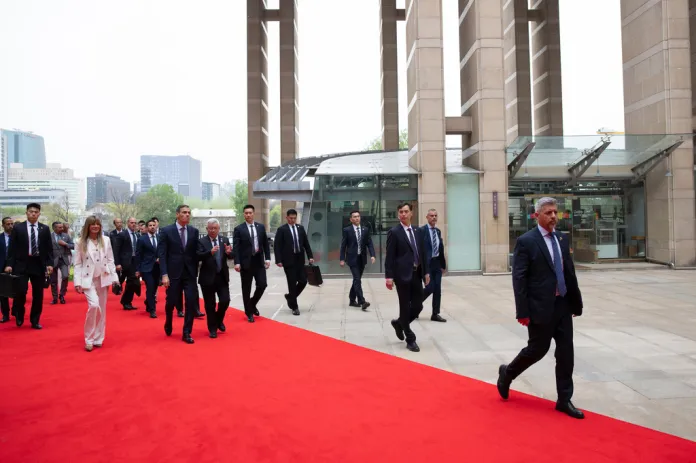
Many countries have begun to reset relationships with China amid fallout with the U.S. A stream of leaders, including German Chancellor Friedrich Merz, Canadian Prime Minister Mark Carney, British Prime Minister Keir Starmer, and French President Emmanuel Macron, have met with Xi in recent months to do just that.
“There’s not just one game,” Carney warned the U.S. last fall, as Ottawa touted efforts to reduce dependence on Washington and boost economic ties with Beijing. “That’s the point. There are other games, and yes, we’re going to spend more time, to extend the analogy, in the game with the United States, but we’re going to play other games with other players.”
XI JINPING’S PURGE OF GENERALS SETS GRIM TONE FOR ANNUAL COMMUNIST PARTY MEETINGS
China has sought to capitalize on the tensions.
“The more turbulent and intertwined the world becomes, the more China and Germany need to strengthen strategic communication and enhance strategic mutual trust,” Xi said in February during a meeting with Merz.