
Democrats have been outspending Republicans in the Virginia redistricting fight, and the difference is starting to show. Virginia registered voters overwhelmingly said they would vote ‘yes’ on implementing new maps in favor of Democrats, according to a new poll.
Findings by a Washington Post-Schar School poll taken at the end of March showed 53% of registered voters would vote ‘yes’ on the redistricting bill, while 44% would vote ‘no.’
However, when asked whether Virginia’s maps should represent the purple state’s political makeup or balance what other states have done, an overwhelming 57% believed the maps should reflect Virginia voters. Only 34% wanted to change Virginia’s map in response to other states.
“Purposely” Confusing Ballot Language
Arlington County Republican Committee Chairman Matthew Hurtt criticized the wording of the constitutional referendum, arguing it is intentionally misleading and that election officials are limited in what they can clarify to voters at the polls.
“Should the Constitution of Virginia be amended to allow the General Assembly to temporarily adopt new congressional districts to restore fairness in the upcoming elections, while ensuring Virginia’s standard redistricting process resumes for all future redistricting after the 2030 census?” the Virginia ballot question reads regarding redistricting.
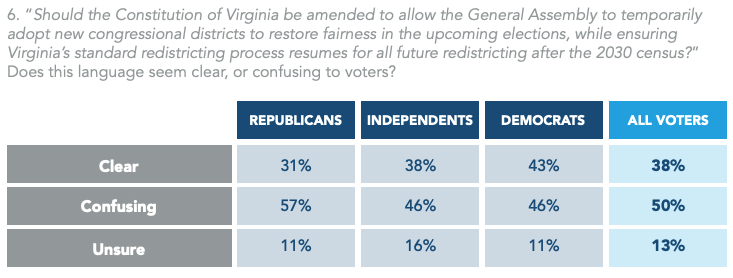
“The law prohibits election officials to editorialize about the messaging on the constitutional referendum,” Hurtt said. “The referendum was written in a way to purposely confuse low-information voters, purposely confuse voters, and they refused to put two maps in each voting location to show voters what the districts would look like if this referendum passes.”
Currently, Virginia has five Republican and six Democratic Representatives. If passed, Democrats could land a 10-1 advantage in Virginia’s U.S. House delegation.
Polling from Heritage Action shows Democratic voters oppose gerrymandering in principle. According to Hurtt, voters are being swayed by the way the ballot question is phrased.
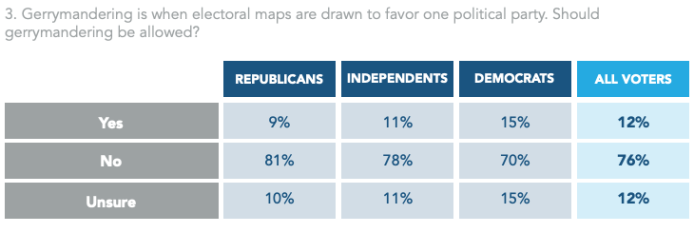
“The most recent poll said 70% of Democrats oppose gerrymandering, but when the language of the referendum is put to them, it flips almost immediately,” he said. “Voters should know what is right, but the language is deliberately wrong.”
Youngkin’s Role and lack of support from National Republicans
Republicans have questioned whether former Gov. Glenn Youngkin (R-VA) has been visible enough in the fight. Other than a few posts on X, Youngkin has said little publicly.
Youngkin must have heard the whispers as he has stepped up his appearances recently. He went on Sean Hannity’s podcast, “Hang Out with Sean Hannity,” calling it an “illegal and unconstitutional redistricting referendum.” Youngkin will also be heading to a “Vote No” rally on April 11, partnering with Turning Point Action in Lynchburg, Virginia.
“In the most recent weeks, Former Gov. Youngkin has come out and made some pretty strong statements calling out Gov. Spanberger, advocating that voters vote ‘no,’” Hurtt said, defending Youngkin. “I’m appreciative of any support Governor Youngkin is willing to lend.”
Meanwhile, Gov. Abigail Spanberger (D-VA) and Former President Barack Obama have been seen by voters in multi-million dollar ad campaigns across Virginia, playing at gas stations and before videos on YouTube. While Democrats have been out raising Republicans, Hurtt insists Republicans have been wise with their spending.
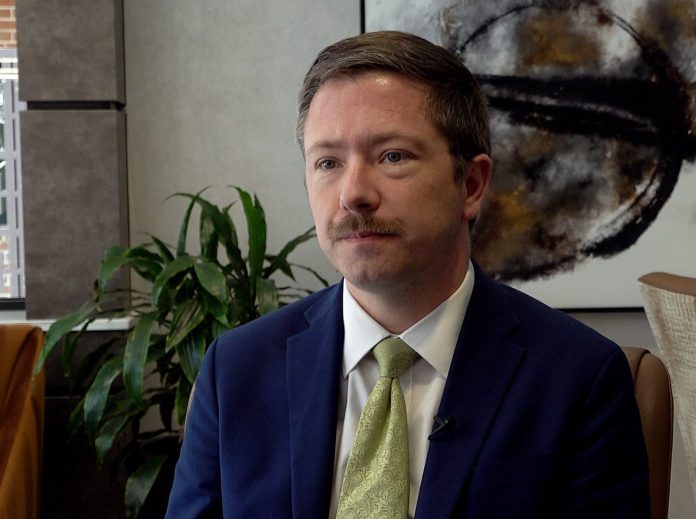
“The far left is spending tens of millions of dollars on the airwaves,” Hurtt said. “Republicans have less resources, and I think they’re spending them much more wisely. What we’re seeing is targeted mailings, targeted postcard writing efforts, door-to-door, and phone banking that is really diffused across the localities.”
Dr. Stephen Farnsworth, professor of political science at the University of Mary Washington, thinks Republicans are making a big mistake by largely sitting this fight out.
“Republicans are making a mistake nationally to not invest more in the anti-movement in Virginia,” Farnsworth told the Washington Examiner. “This poll shows a very much a 50–50 question right now in the minds of Virginia voters, and the advantage that the yes side has in terms of the financial advantage, really, if it’s not being matched by the comparable numbers on the no side, that’s a big, big problem.”
Farnsworth does not understand why National Republicans have abandoned Virginia and believes this would have been a “sound investment” for midterm elections.
“National Republicans have raised a lot of money for the midterms to come,” Farnsworth said. “They are dramatically outraising Democrats when you think about the congressional elections later this year. Some of that money being diverted to this question strikes me as a sound investment for Republicans.”
“Don’t Divide Arlington”
Hurtt argued the proposed map, which would divide Arlington into two districts stretching through Northern Virginia and beyond, exemplifies gerrymandering at its worst. Arlington is solid blue, voting 78% for then-Democratic presidential candidate Kamala Harris in 2024 and 84% for Spanberger in 2025. In response, Arlington Republicans have launched a “Don’t Divide Arlington” effort, mirroring similar messaging in neighboring Fairfax County.

“The Arlington Republicans have paid for signs out of the support of our membership to say, ‘Don’t divide Arlington,’ similar to Fairfax, ‘Don’t divide Fairfax,’” Hurtt said. “Arlington Republicans are telling voters, Republicans, independents, Democrats, all who overwhelmingly oppose gerrymandering, that we don’t want Arlington’s political power or presence in Washington to be divided.”
Hurtt believes Democrats are using Northern Virginia’s blue districts to push their agenda.
“This gerrymandering effort by the far Left is a naked quest for power,” Hurtt said. “They know that if this passes, they will retake the House, they’ll impeach President Trump, and that’s exactly why they’re drawing so many of the congressional districts through Northern Virginia.”
Turnout and Momentum
Hurtt said he is not discouraged by the polls and the Democrats’ spending advantage.
“Rural turnout across Virginia is very high,” Hurtt said. “The early voting numbers are up even over 2025 turnout, sometimes 200% of a rural county’s voting population is already—they’re voting at that level because they want to say they’re part of the state.”
The last day to vote on the Virginia redistricting proposal is April 21. The Virginia Supreme Court allowed the election to proceed despite ongoing legal proceedings over the maps. The judges ruled that it was not the court’s place to stop people from voting.
If the Virginians vote no, the cases would be dismissed. However, even if the referendum passes, it could still go back before Virginia’s Supreme Court.