
Congress may be ready to assert its authority more than a month after the United States first bombed Iran, despite the GOP-controlled chambers giving President Donald Trump a wide berth to wage war.
Some Republicans want to weigh in on any lasting deal the president strikes with Tehran by using a 2015 Obama-era law that gives lawmakers authority over international agreements involving Iran’s nuclear program.
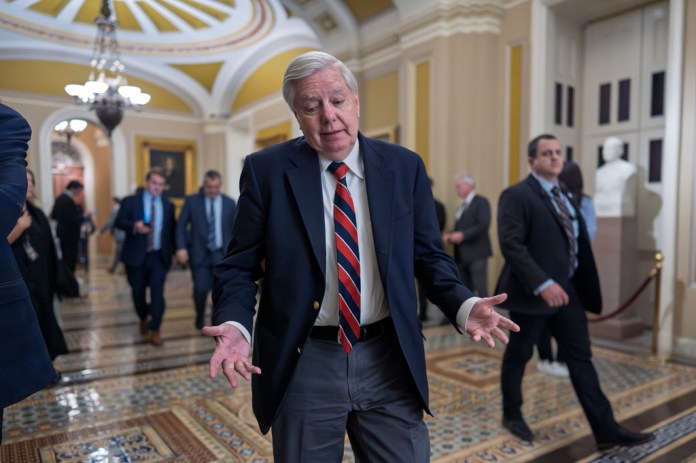
Sen. Lindsey Graham (R-SC), a close Trump ally and strong advocate of U.S. military intervention in Iran and elsewhere, said he was “extremely cautious regarding what is fact vs. fiction or misrepresentation” with the two-week ceasefire struck with Iran.
“That’s why a congressional review process like the one the Senate followed to test the Obama Iranian deal is a sound way forward,” Graham wrote in a tweet. “Fair and challenging questions with a full opportunity to explain, and a healthy dose of sunlight is generally the right formula to understand any matter.”
He added, “Simply put, kick the tires.”
Still, it remains unclear whether any votes would take place or if leadership may try to thwart them. The authority provided to lawmakers under the Iran Nuclear Agreement Review Act of 2015 offers a review period that could lead to express approval, disapproval, or no action at all.
Senate Majority Whip John Barrasso (R-WY) put the onus on Iran “to choose peace” when asked whether Congress will ultimately play any sort of role in the war.
“Iran has been at war with the United States for 47 years, and it’s time for Iran to choose peace,” Barrasso told reporters Thursday at the Capitol. “What we have seen is American peace through strength, and with this operation that is going on now, incredible success by the United States.”
In 2022, Republican senators, including Barrasso, invoked the law to warn former President Joe Biden that any Iran agreement involving its nuclear program “is of such gravity for U.S. national security that by definition it is a treaty requiring Senate advice and consent.”
The White House did not directly address whether it believes an agreement reached by Trump will be subject to congressional review but pushed back against bipartisan scrutiny that senior administration officials have not kept lawmakers or the public adequately informed.
“President Trump has been transparent with the Hill since before Operation Epic Fury began, and administration officials provided over 20 bipartisan briefings for members of Congress to keep them apprised of military updates,” White House Deputy Press Secretary Anna Kelly said in a statement. “As the president said, many points have already been agreed to during the diplomatic process, and we are far along with a definitive agreement to deliver long-term peace in Iran and across the region.”
The president is approaching a May 1 deadline that will mark 60 days since the war began on Feb. 28, at which point he’ll be required to receive congressional approval to continue operations or will be forced to withdraw forces.
Trump has stated a deal with Tehran will mean “no enrichment of Uranium, and the United States will, working with Iran, dig up and remove all of the deeply buried (B-2 Bombers) Nuclear ‘Dust.’” He also said a deal could include tariff and sanctions relief.
If those components are part of a long-term arrangement, it would likely be subject to congressional review under the 2015 law and face further stipulations based on Congress’s course of action.
Democrats, meanwhile, have their sights set on forcing more war powers resolution votes that would force Trump to end the war, despite several failed attempts. Dozens have also called for Trump’s Cabinet to remove him from office via the 25th Amendment. Democrats are still expected to lack the support next week in both chambers, even with GOP defections from Rep. Thomas Massie (R-KY) and Sen. Rand Paul (R-KY).
“Congress must reassert its authority, especially at this dangerous moment,” Senate Minority Leader Chuck Schumer (D-NY) told reporters this week. “Republicans will once again have the opportunity to join Democrats and end this reckless war of choice.”
US AND IRAN AGREE TO TWO-WEEK CEASEFIRE AFTER TRUMP ACCEPTS ‘WORKABLE’ 10-POINT PLAN
But even Massie was skeptical that an agreement with Iran reached by Trump would require buy-in from all of Congress.
“If it’s a deal that constitutes a treaty, the Senate should ratify it,” Massie said in a text to the Washington Examiner. “I don’t foresee the House being involved unless it spends money. Most sanctions levied on Iran can probably be lifted without congressional involvement.”