
Can Democrats out-Christian Republicans in the midterm elections? The party is tightly wedded to progressivism, perhaps even radicalism, on social and cultural issues. White liberals in particular are as secular as ever.
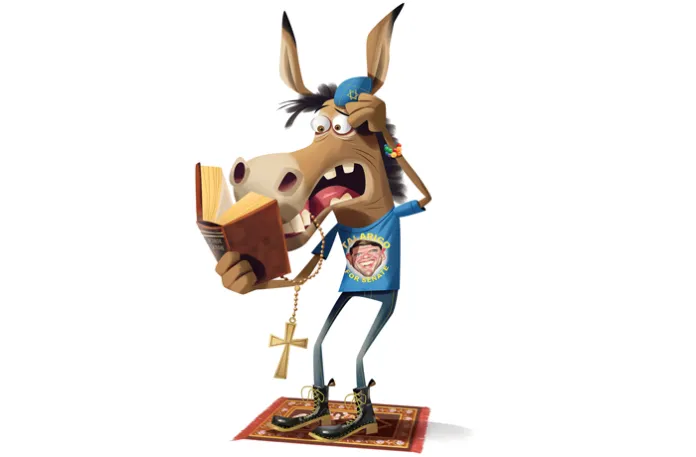
As implausible as it may seem, Democrats sense a couple of openings. One is in Texas, where the party has nominated state Rep. James Talarico for Senate. Talarico is a 36-year-old Presbyterian seminarian who has been outspoken about his faith and adept at wrapping a steadfastly liberal platform in a veneer of Christian-speak.
Democrats are hoping that Texas Attorney General Ken Paxton topples Sen. John Cornyn (R-TX) in next month’s GOP primary runoff. There hasn’t been a considerable amount of high-quality public polling since Cornyn narrowly finished first in the initial round of voting, but the RealClearPolitics average has Paxton up by 5.5 percentage points. A Quantus Insights poll in late March showed Paxton, who is running as the true MAGA candidate against the dreaded Republican establishment, receiving just under 50% of the vote.
Paxton’s wife, a Republican state senator, filed for a divorce last year on “biblical grounds,” alleging adultery. The couple agreed to unseal their divorce records in December as local media outlets aggressively pursued the information contained therein. The Republican-controlled state House of Representatives voted to impeach Paxton in 2023, but he was acquitted by the state Senate.
Cornyn has made character concerns central to his case against Paxton.
“He believes that all his misbehavior and his scandals are sort of baked in the cake, and he’s won a couple of elections since much of that has come out,” Cornyn said. “But there is much more that will come out in the runoff, and which will demonstrate his unfitness for office and his liability, of his potential liability of him being the nominee in November.”
Washington Republicans worry that if Cornyn falls, Paxton will either put the seat at risk or force them to spend copious amounts of money that would be better directed at other races in order to pull him across the finish line. Both MAGA and Democrats have touted an internal poll from Talarico’s campaign showing Cornyn performing no better against the Democratic Senate nominee.
Democrats are looking to Talarico to get some Christian voters who are disaffected with President Donald Trump to cross over to their side, especially with Paxton as a foil. While it is still quite early, the national midterm election environment does appear to be shaping up rather well for Democrats.

There are some problems with this strategy, however. Blue Texas has been the Democrats’ white whale for much of the past decade. There have been some close calls, but it has always ended in disappointment. No Democrat has won a statewide office in Texas since Bob Bullock was last reelected as lieutenant governor in 1994. The state hasn’t voted Democratic at the presidential level since Jimmy Carter in 1976.
During the last blue wave in 2018, Democrat Beto O’Rourke managed to win 48.33% of the vote to Sen. Ted Cruz’s (R-TX) 50.89%. Cruz had been a highly touted national candidate just two years earlier. But that was still a Democratic loss, and Cruz held his 2024 challenger to less than 45% of the vote. Democrats spent a lot of time and money on both races.
The other problem is that Talarico’s theology is closer to the liberal mainline than the Texan evangelical mainstream, resulting in reliably left-wing positions on social issues. He has invoked Mary and the birth of Jesus in defense of legal abortion. He has famously spoken of God being “non-binary.” Talarico is especially zealous about transgenderism, a position even national Democrats briefly flirted with running away from after their 2024 election loss.
There also remain bruised feelings from Talarico’s defeat of Rep. Jasmine Crockett (D-TX) in the Democratic primary. Some black Democrats believe that questions about Crockett’s electability, or 2024 Senate nominee former Rep. Colin Allred’s quality as a candidate, amounted to thinly veiled racism.
“It’s on me to ensure Black Texans feel welcomed in, represented by, and proud of this campaign,” Talarico told Reuters in a statement. “That’s why we’re out doing the work right now to build the coalition we need to win in November: showing up everywhere to listen and to learn.”
But in order to do so, will he revert to his George Floyd-era excesses, such as speaking of whiteness as a contagious disease, and potentially alienate other persuadable voters in the process?
Nevertheless, Democrats are already gunning for Republican-held Senate seats in Ohio, North Carolina, and Maine. If they can actually put Texas in play, party strategists believe there is a path to flipping the Senate, which currently has a 53-47 GOP majority.
A longer shot, but one worth watching, is whether Democrats can exploit tensions between the leadership of the Catholic Church and the Trump administration — and possible rifts emerging between Catholics and evangelicals.
There was grumbling to the media when War Secretary Pete Hegseth’s Pentagon held a Protestant, but not Catholic, worship service on Good Friday. (Good Friday is not a holy day of obligation and there is no Mass, though many Catholics do attend church.) There was also a disputed Free Press report about a tense meeting between Trump defense officials and a Vatican diplomat that has since been widely circulated among “very online” Democrats. (The War Department described the meeting as “very cordial.”
Pope Leo XIV has been outspoken about the injustices of war as Trump bombed Iran. He more overtly spoke out against Trump’s April 7 ultimatum to Iranian leaders, which included the line that a “whole civilization will die tonight, never to be brought back again.”
“Today, as we all know, there has also been this threat against the entire people of Iran,” the pope, who is the first American to ever hold the office, said to reporters at Castel Gandolfo, the papal retreat outside Rome. “And this is truly unacceptable. There are certainly issues of international law here, but even more, it is a moral question concerning the good of the people as a whole, in its entirety.”
Democratic activist Christopher Hale has been posting on X about the pope like he is a liberal icon. The left side of the internet practically blew up when it was reported that Leo met with Democratic strategist David Axelrod, a fellow Chicagoan.
What this would actually mean electorally is hard to say. Pope John Paul II, revered by American conservatives for his heroic role in the Cold War (see John O’Sullivan’s important book The President, The Pope, and The Prime Minister, in which JPII shares top billing with Ronald Reagan and Margaret Thatcher), was not a fan of the Iraq War. While this might have had some impact on American Catholics’ opinion more broadly, it did not drive a wedge between politically active conservative Catholics and evangelicals.
Conservative opponents of the Iraq war were perhaps disproportionately Catholic, with columnists Robert Novak and Pat Buchanan being prime examples. But plenty of conservative Catholic intellectuals sought to defend George W. Bush’s foreign policy from the perspective of just war theory.
“The opponents of abortion and euthanasia insist there are truths about human life and dignity that must not be compromised in domestic politics,” Joseph Bottum wrote in a 2005 First Things essay calling for a “new fusionism” of foreign-policy hawks and social conservatives. “The opponents of Islamofascism and rule by terror insist there are truths about human life and dignity that must not be compromised in international politics.”
First Things memorably launched the “Evangelicals and Catholics Together” initiative with editor Richard John Neuhaus and religious right leader Charles Colson back in 1994, a major development in Christian conservatism. It was therefore striking to see another First Things alum, Matthew Schmitz, more recently writing in the Washington Post about the prominence of new Catholic converts in the conservative influencer space and the rise of a new Christian identity politics.
“Many of these influencers are ‘trad Caths,’ Catholics drawn to the traditional Latin mass and alienated from the church hierarchy,” Schmitz observed. “They are creating a religious right distinct from the one that was once led by evangelicals.”
“It strikes me as performative that so many of podcastistan identify as Catholic,” the evangelical radio host Erick Erickson wrote in a controversial X post. “It is a far more ritualistic denomination than most Protestant denominations (kneel, sign of the cross, etc), is perceived as more formal and refined, and is much more hierarchical. So the denomination choice mirrors the biases of the podcasters.”
Yet, it is always difficult to ascertain how relevant internet feuds are to the real world. In 2024, Trump won 63% of Protestants and 59% of Catholics, according to exit polls. Trump carried 72% of white Protestants and 63% of white Catholics. Among born-again or evangelical Christians, Trump broke 80% of the vote. Some slippage is to be expected in the midterm elections, as well as some lower turnout from burned-out conservative Christians, but Democrats could also be barking up the wrong tree with these demographics.
It is not particularly new for Democrats to pit opposition to war, support for social programs intended to benefit the poor, and immigration advocacy against conservative stances on abortion, sex, and the family as Christian priorities. Catholics in particular are much more politically diverse than white evangelicals have been since the 1980s.
None of this has arrested the rightward movement of religious voters that has been observable for decades. There has, however, been some concern that Trump has been less committed to the pro-life cause in his second term, as Republican elected officials are no longer constrained by Roe v. Wade (thanks in large part to Trump’s own judicial appointments). Vice President JD Vance is releasing a book about his Catholic faith in June.
But Democrats are a long way from having a real strategy to capitalize on this disenchantment, since the socially conservative wing of their party is practically extinct. Thus, they are left hoping that candidates like Talarico can revive a religious Left tradition that survives mainly in Democratic communities of color and build something bigger.
W. James Antle III (@jimantle) is executive editor of the Washington Examiner magazine.