
Artificial intelligence is seeing a massive “rebuild” as companies struggle to actually use it effectively. The focus has shifted from what AI could do to how we move beyond experimentation to deliver real-world impact.
From 2020 to 2025, the conversation was dominated by “what if” thinking. Those years were a test run. Now that AI has begun to integrate into society, the next five years will be defined by “how.” Businesses and organizations are finding out that discussing AI is easy, but integrating it into existing infrastructure is a massive undertaking.
This challenge persists even as demand for AI continues to grow. Reports show strong interest, but the gap between enthusiasm and implementation remains a major hurdle.
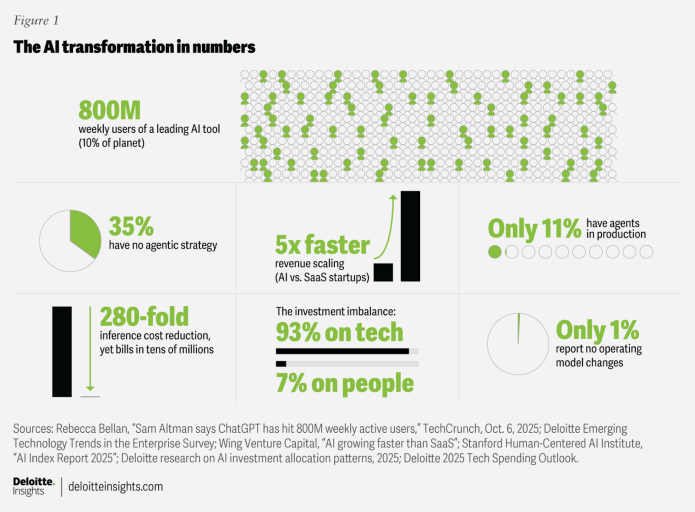
While nearly 40% of companies are currently testing AI, only 11% have actually put it to work in their daily business. This gap creates what experts call “pilot purgatory” — a frustrating middle ground where big ambitions and fancy demos are getting stuck.
It’s the point where the excitement of a “test run” meets the harsh reality that the company’s actual foundation isn’t ready to handle the technology at scale. In short, businesses are finding it easy to start the race, but nearly impossible to cross the finish line.
One executive told Deloitte, “The time it takes us to study a new technology now exceeds that technology’s relevance window.” In other words, the technology is advancing faster than organizations can adapt their underlying logic. This creates a dangerous friction point. When the pressure to deploy meets an obsolete foundation, the result is failure by design.
This “rebuild” phase is revealing a systemic flaw: Many companies are attempting to overlay 2026 technology onto 2010 workflows. Gartner predicts that 40% of AI projects will fail by 2027, not because the AI isn’t working, but because companies are “automating broken processes.” Instead of using AI to rethink how work is done, organizations are simply using it to do the wrong things faster, to put it simply.
This failure isn’t just a lack of imagination. It’s a misallocation of resources. While companies are racing to acquire the latest models, the investment split remains dangerously lopsided. Data suggests that organizations are spending close to 93% of their AI budget on the technology itself, leaving a mere 7% for the “people” and “process” side of the equation.
We’re essentially buying a Ferrari and trying to drive down a muddy road; for one, that’s not what the car was made for, and two, it’s way too nice a car to be misused.
The AI situation is on a similar level of misuse. To stop spinning our wheels, we have to stop looking at the car and start looking at the terrain.
Paving smooth roads for the Ferrari-style technology requires more than a software patch — it requires a redesign. It will require a complex problem-solving approach that breaks challenges down to their most fundamental, undeniable truths to rebuild these innovative solutions from scratch.
This rebuild begins by shifting the investment ratio. If we want to move out of the “pilot purgatory” that so many businesses are trapped in, we must balance the scales between silicon and strategy. Success requires moving beyond a heavy reliance on technology alone to pair innovative tools with an agile, long-term road map.
It also means prioritizing data liquidity over model automation speed. The goal is no longer to “implement AI,” but to build an organization that is “AI-ready” by design — one where the underlying logic is modular enough to evolve as fast as the technology itself.
The next five years won’t be won by the companies with the most powerful AI but rather by those with the most adaptable foundations. The “how” of AI isn’t fitting a new tool into an old toolbox. It’s about building a better toolbox.
AI’S ENERGY DEMANDS ARE FUELING A NUCLEAR COMEBACK
In an ever-changing and accelerating race for AI dominance, the finish line for companies isn’t a piece of software per se — it’s a redefined operating model.
Businesses that continue to automate the past will be left there. The future belongs to those brave enough to rebuild the road.