
Political messaging is often trite or meaningless, but in the case of the Hungarian parliamentary elections, two of the contenders’ slogans are actually quite revealing. Fidesz, the ruling conservative party led by Prime Minister Viktor Orban, is a biztos valasztas — “the safe choice.” Tisza, a relatively new political movement led by the young and charismatic Peter Magyar, has a different message. For the challenger, this election is most vagy soha — “now or never.”
Eastern European elections rarely attract international attention beyond a few perfunctory headlines, but Orban has dominated continental politics for years, becoming a globally recognized hero to the populist Right in the process. Many believed Fidesz to be untouchable, a political juggernaut that had neutered its major rivals and effectively transformed Hungary into a one-party state.
Enter Magyar, who has upended Hungarian politics in the space of just a few years. A relative unknown in Hungarian politics until 2024, Magyar and the recently formed Tisza Party have seized on economic anxiety, concerns over corruption, and fears that Hungary has drifted too close to Russia to challenge Orban and Fidesz for leadership. Recent polling shows Tisza with a significant lead going into the April 12 parliamentary elections.
In another era, Magyar would be called “telegenic.” In 2026, he is the candidate of social media, mobilizing voters with memes, video clips, and pithy remarks that usually touch on what Americans call kitchen-table issues. Magyar’s relative youth and energetic presentation haven’t hurt him, either. “He’s very good looking,” said Sarah Laki, a 20-year-old real estate agent and part-time student in Budapest. “They call him ‘daddy’ on the internet.”
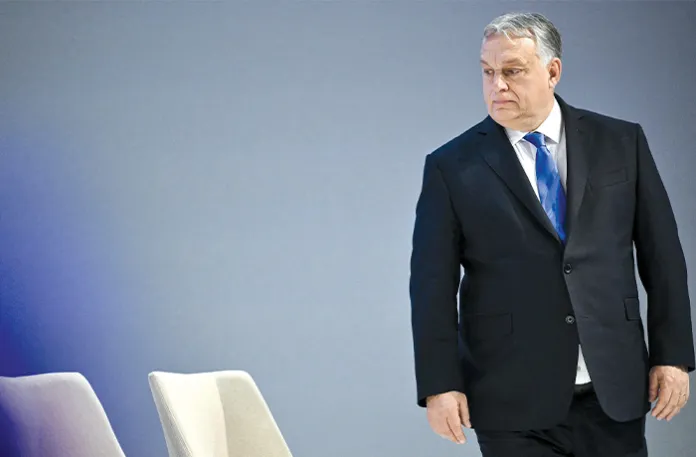
Magyar’s political rise can partly be explained by his relentless focus on quality-of-life issues. Although Tisza appeals to a range of voters disenchanted with the status quo, it is ostensibly a center-right party that has largely avoided culture-war battles. Magyar himself is a former Fidesz member, as are many of his party’s most prominent figures. The focus on the economy and corruption has helped it reach voters with moderate or even conservative sympathies who are tired of Orban and Fidesz.
Magyar is center-right, said Barna Csibran, a 19-year-old university student and Laki’s boyfriend. Csibran’s own views are considerably to the left of Magyar’s, but he’s willing to compromise to beat Orban. “We’ll give him our vote before we give him our trust.”
“Orban was a really great politician until 2018,” said Daniel Kiss, a 34-year-old software engineer who lives with his wife and young daughter in Sopron, a prosperous mid-sized town on Hungary’s western border. With its well-maintained infrastructure, charming historic downtown, and proximity to Austria, Sopron seems insulated from many of the issues that bedevil poorer Hungarian areas. But Kiss grew up in Borsod, a region in northeastern Hungary that is a national byword for economic torpor.
Kiss is not your typical left-wing Orban skeptic. In his first national election in 2010, he said he voted for Jobbik, then a party of the extreme Right. Since that experience, his politics have mellowed. “I was 18,” Kiss said by way of explanation.
Today, Kiss describes himself as politically homeless, dissatisfied with the way things are going but unsure about the opposition. Like Csibran, he thinks that Magyar is not offering a radical break with the Orban era. “If I didn’t know Peter Magyar was running for the opposition, I would think he was for Fidesz,” he said.
One noteworthy feature of Orban’s tenure in office is the Hungarian prime minister’s outsize international reputation, which has garnered him fame abroad but perhaps hurt his ability to keep his finger on the pulse of national politics. Some Hungarian pundits think that after an easy reelection victory in 2022, Orban and Fidesz underestimated the chances of a serious challenger emerging in 2026. Others suggest that the prime minister has grown bored with parochial Hungarian concerns and turned his attention to the world stage.
Benedek, a young Hungarian government official who requested his official name not be used to speak candidly, also suspects that Orban’s attention to national politics has waned in recent years. “I think he still has ambitions, not just within Hungary, but globally,” Benedek said. “He has this dream about a right-wing takeover of the EU. He imagines himself as the leader of this movement.”
Benedek still describes himself as an Orban supporter, but he knows many people have soured on the prime minister. “Fidesz definitely lost a lot of voters,” he said. “I know this for a fact.” Several of his friends and family members have switched allegiance to the opposition.
To win in April, Magyar and his party will have to look beyond hardcore anti-Orban voters and reach undecided Hungarians. Balint Callens, 22, who works at a hotel in Budapest’s prosperous fifth district, is one such voter. “Every single one of my peers wants to vote for the opposition,” he said, but his mother is still a committed Fidesz supporter. The campaign season has highlighted the generational divide between older, conservative voters and younger, left-leaning Hungarians.
This divide weighs heavily on Callens. “The psyche of [older] Hungarians is very inward-looking,” he said. “You can see people with their heads down. It’s like this generational trauma that the new generation doesn’t want forced upon them.”
Despite the enthusiasm of his peers, Callens isn’t completely sold on the opposition. He thinks Magyar comes off as ambitious and worries about putting a young leader in charge at such an uncertain juncture. He has also been turned off by the ugly tone of Hungarian politics. “It devolves into screaming matches,” he said.
Tisza supporters, undecided voters, and Fidesz loyalists all acknowledge that the opposition and its charismatic frontman have proved adept at political organizing. Magyar’s success can partly be attributed to his media savvy, but Tisza has also been very effective at mobilizing voters across the country. Supporters can get involved via their local “island” — Tisza is both a political acronym and the name of a famous Hungarian river — an approach to organizing that seems to have galvanized voters in Fidesz’s rural heartland.
Magyar has also made headlines by relentlessly campaigning in rural areas, harping on problems such as crumbling infrastructure, government corruption, and persistent inflation. Last summer, he toured the countryside on a canoe trip down his party’s namesake, the Tisza River. When 500 apartments in the town of Kazincbarcika lost power during a recent January cold snap, Istvan Kapitany, Magyar’s top economics adviser, was there to tour the buildings and speak about a national heating modernization program.
“Magyar goes to different cities and different villages,” said Csibran, who has been impressed by the candidate’s stamina. “It’s almost the same strategy as Orban in the 1990s.”
Even Magyar’s critics admit that many voters are looking for change. “Magyar is playing on this fatigue a lot of people have with Fidesz,” said Tamas Magyarics, former Hungarian ambassador to Ireland, a veteran political pundit, and a history professor at Eotvos Lorand University in Budapest (full disclosure, this is my university). “Sixteen years [in power] is a long time.”
Tisza also benefits from a public fed up with official corruption, a pervasive problem in post-Soviet states that has lately become a major flashpoint in Hungarian politics. “No question, there’s corruption,” Magyarics said, a result of what he describes as a deliberate government strategy to put more power in the hands of Hungarians after the go-go liberalization of the 1990s and early 2000s.
Magyarics’s point is a reminder that Orban, despite the reputation he enjoys among American conservatives, is no free-market purist. Over the past decade and a half, Fidesz has readily intervened in almost every facet of the Hungarian economy, from implementing price controls to doling out corporate subsidies to generous loan programs for young families.
“There was a conscious policy to prefer Hungarian companies and Hungarian entrepreneurs,” Magyarics said. Fidesz supporters believe this was a necessary corrective to years of reckless globalization, but it also widened the scope for political corruption, an issue that has dogged Orban for several election cycles.
The corruption issue may hurt Orban, but Magyar has his own vulnerabilities. For many voters, Magyar’s former life as a Fidesz supporter raises questions about his real agenda. Orban has tried to capitalize on this by portraying him as “Two Face” — half proud Hungarian, half creature of Brussels, Kyiv, and Big Oil.
Despite grassroots enthusiasm for Magyar and voter fatigue with the Orban era, Fidesz still has some important advantages. International uncertainty might discourage voters from choosing a young, untested candidate for prime minister. And older voters and rural Hungarians are still very conservative. Since the post-Soviet resumption of competitive elections in 1990, parties and coalitions have come and gone, but the Hungarian electorate usually favors conservative candidates. Magyar has cultivated a moderate image, but will this be enough to win over a critical mass of center-right voters? The outcome of the April elections may hinge on that very question.
Orban’s most strident critics say he has turned Hungary into a one-party state. This is an exaggeration, but there’s no question that Fidesz has taken advantage of state media and government organs to cast its message in a favorable light. A characteristic example is the official government video commemorating the revolution that began on March 15, 1848, a major Hungarian holiday akin to Memorial Day or the Fourth of July in the United States. Although the video doesn’t mention either candidate, it dwells on the dangerous international situation and the prospect of rising oil prices, two themes that Orban has repeatedly mentioned on the campaign trail.
The divergent media diets of younger and older Hungarians are one reason Fidesz typically dominates the countryside. Older, rural voters tend to watch a lot of state television, which generally follows the Fidesz party line. “Above 40, it’s TV,” said Csibran. “Below 40, social media.”
Despite the polls, Fidesz’s structural advantages and Orban’s political savvy may still be enough to eke out a victory, or at least prevent the opposition from claiming a commanding majority. “Populist leaders tend to be underestimated,” Benedek said. “I think it’s very tight.”
Magyarics agrees, citing U.S. President Donald Trump’s shocking victory in 2016 and Orban’s surprisingly decisive win in 2022 as precedents. “Even the Iranian situation may influence Hungarian voters,” he said. “The crisis in the Middle East may trigger a migration and energy crisis.”
The unsettled international landscape seems to have injected Hungarian politics with an extra dose of unpredictability. In early March, Hungarian counterterrorism operatives detained Ukrainian bank officials transporting cash and gold from Austria to Ukraine. According to the Washington Post, Russian agents recently proposed staging an Orban assassination attempt to energize Fidesz voters. For the March 15 holiday, Magyar and Orban headlined duelling rallies in Budapest and traded accusations of foreign interference — Brussels is Orban’s favorite target, Moscow is Magyar’s. Meanwhile, seemingly every young Hungarian in the country has RSVP’d for a “citizens’ resistance” concert in Budapest on April 10 headlined by Azahriah, a local rapper who effortlessly switches from Hungarian to English and back again mid-verse.
If Orban clings to power, some Fidesz opponents predict rioting or worse. “There’s going to be a revolution in the streets,” said Andras, a 34-year-old entrepreneur who manages Airbnb properties in Budapest and fears for the future of his business. Several Fidesz politicians have expressed a desire to crack down on Airbnb rentals, and more economic uncertainty and estrangement from the European Union threaten the influx of tourists and international visitors on which his income depends.
Laki, the young real estate agent, echoed these dire predictions. “I’ve never been to one protest because I’m afraid of the crowds,” she said. “But if Fidesz stays, even I’m going to go!”
If Orban holds on, will another revolution erupt in Budapest? Probably not. Like most European countries, Hungary is an aging society, which makes revolutionary violence or even a sustained postelection protest movement unlikely. Instead, an Orban victory will probably intensify the almost palpable sense of fatigue that pervades modern Hungary. Orban has been prime minister for 16 years and a fixture on the national political scene since the end of the Soviet era. Even some Fidesz voters aren’t convinced another term in office would be a good thing. Despite his pro-Orban sympathies, Benedek thinks that the party might benefit from a few years out of power to recharge and reorganize.
Meanwhile, Hungarians seem tired and worn out. In the 2010s, Orban presided over steady economic growth and low unemployment. His stand against mass migration won him votes at home and plaudits abroad. The country’s pro-natalist policy was widely seen as a modest but real success at improving the country’s birth rate.
Now the economy is stagnant, and the birth rate has once again started to decline. A suite of pro-natalist subsidies, from child tax breaks to favorable loans for young families hoping to buy their first homes, hasn’t coaxed young Hungarians into having more babies. Almost every young person you meet says they’ve at least thought about leaving the country, and most know someone who has already moved abroad. It’s hard not to connect this malaise to the country’s stale political scene.
In late January, several prominent conservative leaders released a video in support of Orban’s reelection effort. Italian Prime Minister Giorgia Meloni, Marine Le Pen of France’s National Rally, Alternative for Germany’s Alice Weidel, and even Israeli Prime Minister Benjamin Netanyahu all made cameo appearances. It’s a testament to Orban’s reputation that he can attract public endorsements from such figures. But the production had the feel of younger pop musicians paying tribute to an aging rock star. When Orban made his stand against open borders during the 2015 migration crisis, he was a lonely figure on the European Right. Now, a new generation of conservative populists is following in his footsteps. Any account of European politics in the 21st century would be incomplete without Viktor Orban. But after 16 years of electoral success, it may be time for him to exit stage right.
Will Collins is a lecturer at Eotvos Lorand University in Budapest, Hungary.