
House Republicans voted behind closed doors Tuesday evening to send classified transcripts tied to former CIA Director John Brennan to the Justice Department, a move that signals the Trump administration is advancing a possible criminal case against one of the most prominent figures in the discredited Russia investigation from President Donald Trump’s first term.
The vote, taken inside the Capitol’s secure facility, fell along party lines and exposed sharp divisions within the House Permanent Select Committee on Intelligence. Republicans backed the transfer of the transcripts at the DOJ’s request, while Democrats objected, arguing they were given insufficient time to review the material after receiving it just days earlier.
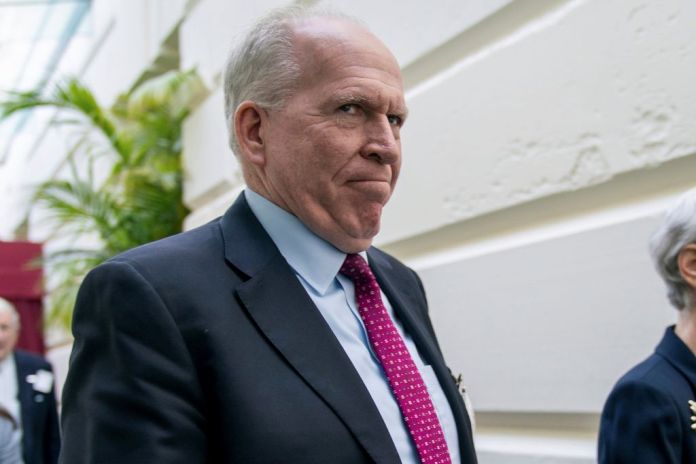
The committee approved sending classified interview transcripts to the DOJ as part of a criminal inquiry tied in part to its own investigation of the Russia saga, which the committee detailed in a report.
The report, which was completed in 2020 but not declassified for release until last year, found that Brennan manipulated intelligence to support the claim that Russian President Vladimir Putin wanted to help Trump win the 2016 election. That claim, for which the intelligence community actually did not have evidence, allowed the FBI to pursue a yearslong criminal investigation into whether Trump’s campaign sought to accept Putin’s help.
A source familiar with the matter told the Washington Examiner the DOJ is expecting the transfer of the transcript copies. The transcripts include interviews related to Brennan and one interview with Brennan himself.
The DOJ request, reported by Punchbowl News, marked a significant escalation in a long-running effort by Trump and his allies to scrutinize the start of the Russia investigation. Brennan led the CIA from 2013 to 2017 and played a central role in the intelligence community’s response to Russian interference in the 2016 election. Brennan helped initiate the counterintelligence investigation into Trump’s campaign despite having very little evidence to justify doing so. The Russia investigation has remained a flashpoint in partisan battles for nearly a decade, particularly after the Trump administration began releasing documents last year that showed the FBI and CIA relied on opposition research funded by Trump’s opponent, Hillary Clinton, to open their counterintelligence investigation while burying evidence that emerged at the time to suggest the claims of Russian collusion had no merit.
Federal prosecutors have already signaled heightened interest in Brennan. His attorneys said in a December letter that prosecutors in the Southern District of Florida informed them he is a target of a grand jury investigation tied to the 2017 intelligence community assessment on Russia. The investigation is being overseen by U.S. Attorney Jason Reding Quinones, according to sources familiar with the matter.
Brennan’s legal team has pushed back forcefully, calling the investigation unfounded while questioning its legal basis.
The referral builds on earlier efforts by House Judiciary Committee Chairman Jim Jordan (R-OH), who previously urged the DOJ to pursue criminal charges against Brennan over alleged false testimony Brennan gave in 2023 regarding the origins of the Russia investigation. Brennan’s lawyers have denied those allegations.
The latest development comes as the Trump administration has faced hurdles bringing politically sensitive cases in Washington, D.C., where juries have been reluctant to indict in several high-profile Trump opponents. That dynamic has raised questions about venue strategy and whether prosecutors may lean more heavily on jurisdictions like South Florida, where the Brennan inquiry is based.
Separately Tuesday, the Intelligence Committee voted to release two transcripts from 2019 interviews with former Intelligence Community Inspector General Michael Atkinson. Those interviews focused on Atkinson’s handling of the whistleblower complaint that ultimately triggered Trump’s first impeachment.
JORDAN EYES SPY POWERS WARRANT DEBATE AFTER SHORT-TERM EXTENSION OF FISA SECTION 702
The closed-door vote unfolded alongside a broader push by Republican leaders to shore up support for reauthorizing Section 702 of the Foreign Intelligence Surveillance Act, a key surveillance authority set to expire on April 20. Jordan and Intelligence Committee Chairman Rick Crawford (R-AR) briefed GOP lawmakers Tuesday night in an effort to win over holdouts.
Despite pressure from senior Trump administration officials to pass an extension on FISA powers, several House Republicans have remained wary of the program’s history of misuse involving Americans and are demanding additional reforms. GOP leaders were forced to delay a planned vote this week due to insufficient support, with the measure now expected to come up after lawmakers return from a two-week recess in mid-April.