
Sen. Cory Booker (D-NJ) outlines his vision for America’s path forward from political division in his new book, Stand.
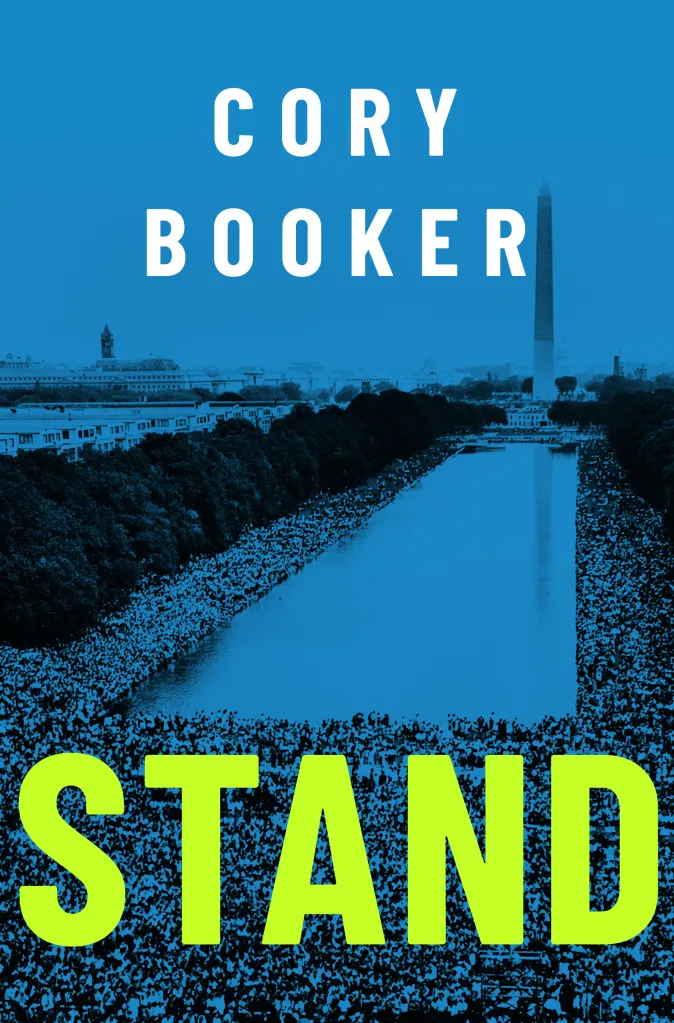
In Stand, Booker takes readers through the nation’s past and present, highlighting Americans’ actions that embody the country’s core virtues and calling on the public to stand up.
Throughout the book, Booker weaves together historical events, personal reflections, and his experiences to demonstrate shared ideals that can guide the country forward.
Booker argues that the 10 virtues that will allow the nation to “prevail” are agency, vulnerability, patriotism, truth, humility, community, creativity, perseverance, grace, and vision.
Each chapter delves into why Booker believes these attributes are needed at this moment, using history to provide instruction on adapting the virtues to today’s “crisis.”
The Washington Examiner obtained an early copy of Stand ahead of the release date.
Vulnerability on the Senate floor
Booker explores the theme that leadership is “standing up,” drawing inspiration from his historic 25-hour speech on the Senate floor.
Booker’s speech eclipsed the previous record for longest Senate speech held by the late Sen. Strom Thurmond (R-SC), who used his speech to delay passage of the Civil Rights Act of 1957.
In the memoir, Booker reveals that the idea to give the record-breaking speech came after a man confronted him in a supermarket in his hometown of Newark, New Jersey, questioning why Booker wasn’t showing up like he did when he challenged Newark’s machine politics as mayor.
DEMOCRATIC PRESIDENTIAL CONTENDERS EYE TAX CUTS TO WOO GOP VOTERS
“I stepped out in faith, out of my comfort zone, beyond my perceived physical limits, and, exposed and vulnerable, I found I didn’t stand alone,” Booker wrote about the experience.
Following his speech, Booker received correspondence praising him, but he said the “most powerful” was a letter from Thurmond’s biracial granddaughter, Wanda Williams-Bailey.
“Filibustering was a brilliant strategic move, especially in contrast to Strom Thurmond’s historical use of it 68 years ago to obstruct civil rights for Black Americans,” Williams-Baily wrote. “As an African American Senator, your filibuster became a rally cry for unity and compassion in a political landscape often marred by hatred and division.”
John McCain’s patriotic impact on Booker
Booker discusses his concerns about Americans “walking away” from patriotism as some have “wielded” it as a “weapon,” pointing to the flag being turned into an actual weapon during the Jan. 6, 2021, insurrection.
Booker accuses President Donald Trump of turning “false patriotism” into a presidential loyalty test. The senator challenges the definition of patriotism, arguing that true patriotism means loving your country enough to challenge it and calls on Americans to reclaim it.
“I believe we must reassert our pride in the bold ideals of America and our devotion to making those ideals real,” Booker writes.
Throughout the patriotism chapter, Booker defines patriotism while also recalling moments that best exemplify it, including his relationship with the late Sen. John McCain (R-AZ).
McCain encouraged Booker to be a “statesman,” not a politician, challenging him to practice a patriotism rooted in principle rather than party.
Booker pointed to McCain’s deciding “no” vote on repealing the Affordable Care Act as an example of McCain’s lesson.
“John McCain demonstrated to all of us that real patriotism isn’t always loud, but it is always loyal. Loyal to ideals, loyal to country, loyal to people – even, and especially, those with whom you disagree,” Booker wrote.
“Patriotism is about standing for something bigger than yourself. Standing even when it’s hard. Standing even when you stand alone.”
Ketanji Brown Jackson demonstrating perseverance
Booker used the confirmation of Justice Ketanji Brown Jackson to illustrate perseverance, highlighting that even when life is hard or uncertain, one should keep going.
Jackson, who became the first black woman Supreme Court justice, faced what Booker dubbed an “ugly” confirmation hearing in 2022.
Booker said behind closed doors, Republicans found Brown to be impressive despite a few of them using her hearing as “hours of indignities.”
“Ketanji Brown Jackson – on the highest platform, aiming for the highest court – met us where we are, in our common humanity. Her one-word message was a testimony and a charge to all. Persevere,” Booker wrote.
When it was Booker’s time to question Jackson, he chose to praise her, closing his remarks with, “Don’t worry, my sister, don’t worry. God has got you.”
Booker recalled that despite the contentious hearing, Sen. John Kennedy (R-LA) approached Booker after grabbing his hand and saying he found Booker’s words “moving.”
Ahead of voting, then-Vice President Kamala Harris called for Booker and Sen. Raphael Warnock (D-GA) to join her, suggesting they each write a letter to a little girl they knew expressing what Jackson’s nomination meant to them.
Warnock publicly released his, and Booker admitted he never got around to writing his letter; he finally did in the book.
“As Justice Jackson showed in her journey to the bench, your character, and the character of our country, will not be defined by what happens to you but by how you choose to respond,” Booker wrote. “So I urge you – respond with grit. Respond with grace. Most of all, respond with love.”
BOOKS BY POLITICIANS TO LOOK OUT FOR IN 2026 AHEAD OF MIDTERM ELECTIONS
In addition to discussing politics, Booker opens up about his father’s Parkinson’s diagnosis and his own struggle with mental health after witnessing a fatal shooting in Newark to illustrate these virtues in practice.
Stand was released on March 24.