
As antisemitic violence surges across the United States, from attempted synagogue attacks to killings in major cities, a growing number of Jewish Americans say they feel politically homeless, caught between parties they no longer trust to protect them.
That sense of unease has been sharpened by a string of violent incidents, including last week’s attempted attack in West Bloomfield, Michigan, where a man drove his vehicle into a synagogue that houses a preschool, armed with, authorities believe, the intent to carry out a mass-casualty attack targeting children before security personnel stopped him just in time.
“We are at the highest threat level in the history of the Jewish community,” said Eric Fingerhut, president of the Jewish Federations of North America, in an interview with the Washington Examiner.
Fingerhut said his organization had warned federal officials just a day before the Michigan attack that the risk of violence was escalating, describing the incident as coming within inches of becoming something far worse.
The Michigan attack is part of a broader surge in anti-Jewish violence that has unfolded in the wake of Hamas’s Oct. 7 assault on Israel and the war that followed. Over the past year, Israeli Embassy staffers were gunned down in Washington, D.C.; a Molotov cocktail attack injured a dozen people at a pro-hostage rally in Boulder, Colorado; and deadly attacks have struck Jewish communities abroad, from a synagogue in Manchester, England, to the Hanukkah massacre at Bondi Beach in Australia.
The impact of that violence is reflected in new data: 91% of American Jews say they feel less safe in the United States, according to the American Jewish Committee’s 2025 State of Antisemitism report. For Jewish leaders, the threat is no longer theoretical.
But beyond security, Fingerhut said the political environment itself is contributing to the danger.
“The rhetoric on the extremes of both sides has absolutely contributed to this wave of incitement and this threat level,” he said. “We’ve seen it on the far right and the far left … and that was a point we made very clearly to leaders in both parties.”
What is needed now, Fingerhut added, is a stronger, more coordinated pushback before rhetoric escalates into violence.
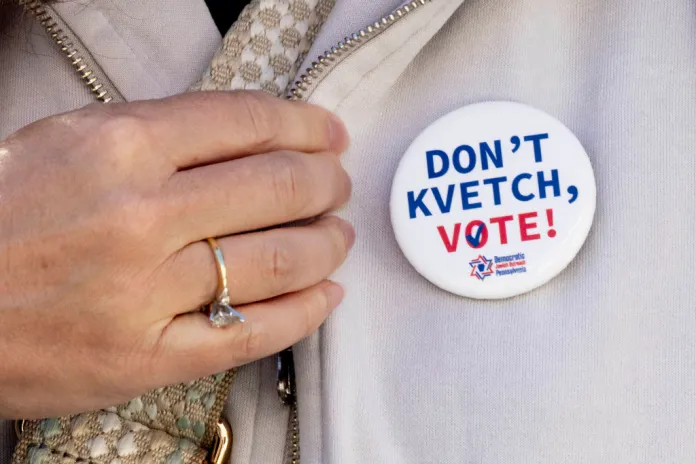
That sense of being caught in the middle is echoed by Jewish Americans themselves. In interviews with more than a dozen Jewish voters across the country, spanning a range of political ideologies, ages, and backgrounds, many described feeling increasingly disconnected from both parties.
For many, that breakdown is especially visible within the Democratic Party, where divisions over Israel and antisemitism have deepened in the wake of the Oct. 7 attacks and the prolonged war in Gaza. Images of suffering in Gaza have pushed concern for Palestinian civilians to the forefront, while also straining long-standing pro-Israel consensus within the party.
Those tensions have spilled into public view. A recent clash between the centrist group Third Way and Rep. Ro Khanna (D-IL) highlighted the divide, with moderates arguing Democrats have not taken a strong enough stance against antisemitism and progressives countering that such accusations are sometimes used to shut down criticism of Israel.
For Eric Bernstein, a 25-year-old in the Washington area who leans left, that dynamic has left him feeling disconnected from both sides, even as he still identifies more closely with Democrats.
“I definitely identify with the idea of being politically homeless,” Bernstein said. “No one in America, regardless of party, really understands what’s going on.”
What frustrates him most, he said, is the pressure to reduce complex realities into rigid political camps.
“You’re either pro-Palestine or pro-Israel,” Bernstein said. “And in reality, neither of these people are leaving … the idea that you can only support one side just infuriates me.”
Despite that frustration, he said he would not consider voting Republican, even as he acknowledged he may choose not to vote at all.
Drew Grossman, a 37-year-old in Chicago and a lifelong Democrat, said he does not feel politically homeless, but described the past year as “at times frustrating, at times heartbreaking” as antisemitism surfaces in spaces where he once felt comfortable.
“I do think there’s an antisemitism problem,” said Grossman. “But I think a bigger, more widespread issue is this apathy toward the suffering and fear of Jews.”
That tension has played out in his own community. Leaving a polling place Tuesday, he said a congressional candidate handed him a flyer with “anti-Zionist rhetoric,” a message he said felt disconnected from the concerns he hears from Jewish voters.
“I’m not big on litmus tests,” Grossman said. “But if that’s the level of nuance you’re bringing, I’m not really interested.”
Still, Grossman said the moment has made him more aware, not less committed.
“I still feel like my home is on the Left,” he said. “But it’s definitely changed how I think about things.”
For Michael Baer, a 59-year-old from Scottsdale, Arizona, the idea of being politically caught in the middle did not feel abstract. It felt personal.
“At first I was thinking, wow, you’re writing an article about me,” he said. “That’s me.”
Baer, who describes himself as socially liberal and fiscally conservative, said he has long felt comfortable navigating both parties, supporting Democrats on issues such as LGBT rights while aligning with Republicans on others. But he said the past two years, particularly since Oct. 7, have made it harder to maintain the balance.
“I want to be who I am,” said Baer. “But I feel like I’m being forced to choose.”
What has unsettled him most, he said, is what he sees as a shift within the Democratic Party on Israel, an issue that he said was once broadly bipartisan but now feels increasingly politicized.
“I’m afraid that whoever I support could get pulled in a direction I’m not comfortable with,” Baer said.
At the same time, he said, Republicans have moved in ways that leave him equally uneasy, particularly on issues like immigration and civil liberties.
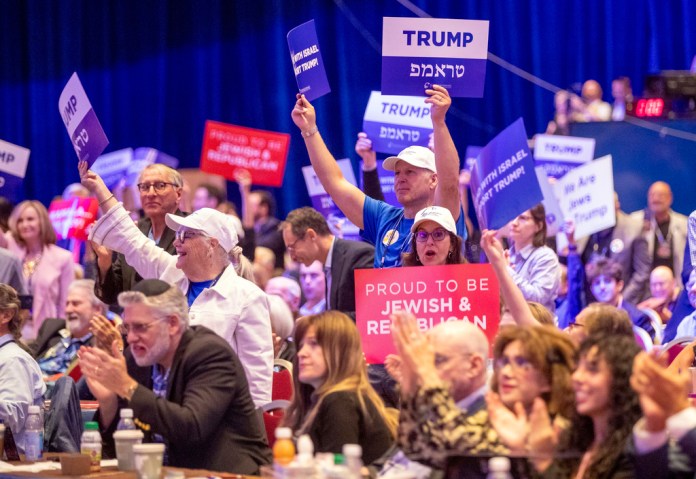
The result, Baer said, is a political landscape that rewards simplicity over nuance.
“It’s very, very frustrating to be somebody who can understand both sides of an argument and not fall victim to the easy sound bites coming out of both extremes,” he said.
For some, that frustration has already led to a breaking point. A former Democratic activist in the Washington, D.C., area, who asked not to be named, said his views have remained largely the same over the years, but his relationship with the party has changed dramatically.
“I don’t think my substantive views have really changed much,” said the activist. “The party has.”
He described reaching that point after the Oct. 7 attacks, pointing to what he saw as a failure by Democratic leaders to respond forcefully to antisemitism, particularly on college campuses.
“As an American Jew, I was infuriated,” the activist said.
But concerns about antisemitism are not limited to the Left. In recent weeks, far-right media figure Tucker Carlson drew backlash after promoting a conspiracy theory suggesting the war with Iran was part of a Jewish effort to destroy Islamic holy sites in Jerusalem and rebuild the ancient Temple, a claim swiftly condemned by Jewish leaders as a dangerous and long-standing antisemitic narrative.
The rhetoric has also drawn criticism within Republican ranks. Sen. Mitch McConnell (R-KY) recently accused Joe Kent of promoting “virulent” antisemitism after Kent resigned as director of the National Counterterrorism Center and suggested U.S. strikes on Iran were driven by pressure from Israel. McConnell called the claim baseless and warned that isolationists and antisemites have no place in government.
For Sarah Moosazadeh, a Washington, D.C.-based Jewish Iranian American who generally aligns more with Republicans, the divide feels personal. Born in Tehran and brought to the United States as a child after her family fled the Islamic regime, she said that experience shaped why conservative politics long felt like a more natural fit.
“We came into this country, we assimilated, we worked hard,” she said. “And over the years, we found out that the party or group that most aligned with our values and our ideology was the Republican Party.”
But that sense of belonging has frayed. “I feel like a minority within a minority,” Moosazadeh said.
And while Moosazadeh remains critical of the left, she said the right has also made her uneasy, pointing to what she described as antisemitic voices featured at this year’s Conservative Political Action Conference taking place in Dallas, Texas, next week.
“It’s hypocritical. Again, it’s on both sides,” said Moosazadeh.
Ari Baylor, a 42-year-old from Rockville, Maryland, said his political shift has been gradual, but no less disorienting.
“I can safely say that I do not completely align with either,” Baylor said.
Baylor, who grew up in Israel and now works in sales and fitness, said he once leaned more conservative but has since stepped back from fully identifying with either party, even as he continues to agree more often with the right on issues related to Israel.
“I used to lean more right-wing,” Baylor said. “But they have their own issues as well.”
Still, he said his frustration today is largely directed at the Left, particularly when it comes to what he sees as a failure to clearly confront antisemitism.
“I’m baffled at how many Jews are still aligning more with the Left,” Baylor said.
For many Jewish Americans, rising violence and deepening political divides have forced a hard reassessment of where they stand.
“I think a lot of Jewish people feel the exact same way,” Bernstein said. “We’re all reevaluating whether these politicians actually represent what’s best for us.”
‘THIS ISN’T THE AMERICA WE THOUGHT WE KNEW’: JEWS CALL FOR ACTION AGAINST HATE
As the conflict between Israel, Iran, and an increasingly involved U.S. spills across the region, and the next election cycle begins to take shape, the sense of being caught between competing forces is only becoming more pronounced.
For many Jewish voters, the question is no longer which party they prefer — but whether either one still deserves their vote.