
The man accused of planting pipe bombs near the Republican and Democratic national committee headquarters on the eve of the Jan. 6 riot is asking a federal judge to dismiss the case against him, arguing that President Donald Trump’s sweeping pardon for Capitol riot defendants applies to his alleged conduct.
Attorneys for Brian Cole Jr. filed a 23-page motion Monday evening contending that the charges are “inextricably and demonstrably tethered” to the events of Jan. 6, 2021, and therefore fall within the scope of Trump’s clemency.
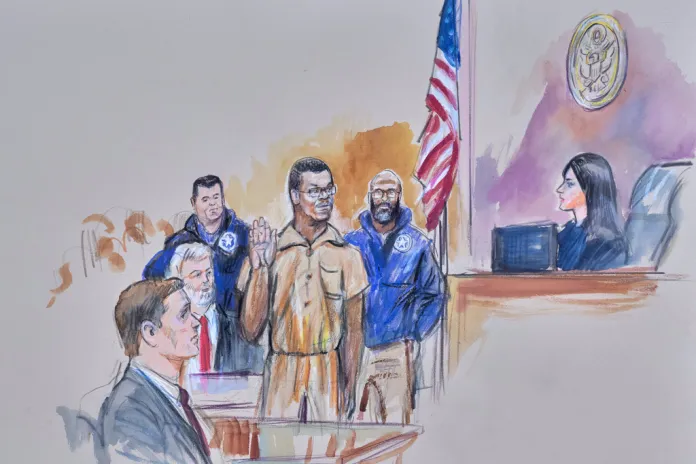
“The Pardon—like it or not—applies to Mr. Cole, based on the ordinary and plain meaning of the Pardon’s language as applied to the relevant facts in this case,” the attorneys, Mario Williams and John Shoreman, wrote in a motion to U.S. District Judge Amir Ali, an appointee of former President Joe Biden. “Wherefore, for the reasons stated above, Mr. Cole requests that this Motion be granted and the charges against him dismissed, in their entirety.”
CHRIS WRIGHT ADMITS AMERICANS WILL FEEL HIGH OIL PRICES FOR ‘A FEW MORE WEEKS’
Cole was charged late last year with interstate transportation of explosives and attempted use of explosives after investigators identified him as a suspect nearly five years after the devices were planted. The bombs, discovered on Jan. 6 near the RNC and DNC headquarters, did not detonate, though the FBI has said they were viable.
The motion tees up a key legal question about the scope of Trump’s Jan. 6 pardons that defense lawyers hope will be their client’s saving grace. Cole has pleaded not guilty to charges of interstate transportation of explosives and attempted use of explosives, charges that carry a maximum sentence of 30 years in prison if convicted.
Trump’s January proclamation last year granted clemency to individuals convicted of offenses “related to events that occurred at or near the United States Capitol on January 6, 2021,” and directed the Justice Department to dismiss pending cases tied to those events. The proclamation covered roughly 1,500 Jan. 6 defendants charged under the Biden administration, ranging from trespassing cases to more serious assault convictions.
Cole’s attorneys argue that the phrase “related to” is broad enough to include conduct that occurred on Jan. 5 but was tied to the same political event, pointing to allegations that Cole traveled to Washington for an election protest and that the devices were discovered during the Capitol certification proceedings on Jan. 6. 
They also emphasize that Trump’s clemency order specifically named a limited group of high-profile defendants whose sentences were commuted, while extending a broader, categorical pardon to “all other individuals” convicted of Jan. 6-related offenses, a distinction the defense argues shows the president’s intent to extend the pardon beyond just those explicitly listed.
Legal experts say the argument may carry weight, though it is far from settled, and will attract strong counter-arguments from prosecutors.
“It’s not a frivolous argument that they are making,” Case Western Reserve University law professor Mike Benza said, noting the unusually broad wording of the pardon. At the same time, he said the outcome will depend heavily on how courts interpret the language, a dispute that could ultimately reach higher courts.
IN FOCUS: HOW THE WAR POWERS ACT NORMALIZED PRESIDENTIAL USES OF FORCE
A central issue is whether Cole’s alleged conduct is defined as occurring before Jan. 6 or as part of a continuing act that extended into that day. Benza said crimes involving explosives or planning can span a period of time, allowing defense attorneys to argue the conduct was not complete until Jan. 6, when the devices were discovered and neutralized.
Prosecutors, however, already have and are likely to further emphasize the opposite — that the key acts, including transporting materials and planting the devices, occurred well before Jan. 6 and therefore fall outside the pardon’s scope.
Benza also pointed to the charges themselves as significant. By focusing on transportation and attempted use of explosives, rather than broader terrorism-related counts, prosecutors may be trying to “distance the charges from January 6” and avoid triggering the clemency order.
Another potential hurdle for Cole is the wording of the pardon, which applies to individuals “convicted” of Jan. 6-related offenses. Cole has not been convicted, and his indictment was not pending at the time the pardon was issued, factors the government is expected to emphasize.
Still, Cole’s attorneys argue precedent cuts in their favor, citing the case of Jan. 6 rioter David Dempsey, who received a full pardon despite violently assaulting police officers and previously being sentenced to 20 years in prison.
DC PIPE BOMBER DEFENDANT BRIAN COLE JR. SEEKS TO APPEAL FOR PRETRIAL RELEASE
“The case of January 6, 2021 rioter, David Dempsey, further strengthens Mr. Cole’s position,” they wrote. 
The DOJ has not yet filed its response to the motion.