
Multiple high-ranking leaders of the Islamic Republic of Iran, including the president, walked about the streets of Tehran for a pro-Palestinian rally before explosions erupted at the event.
President Masoud Pezeshkian, Foreign Minister Abbas Araghchi, and Supreme National Security Council Secretary Ali Larijani were among the half-dozen officials who poked their heads out for the al-Quds Day march on Friday before the festivities were interrupted by attacks.
Larijani blamed the explosion on the United States, telling state media: “[President Donald] Trump doesn’t understand that the Iranian nation is a mature, strong, and determined one. As American pressure grows, the nation’s determination will strengthen. The Zionist regime’s attacks towards the march is a sign of its hopelessness.”
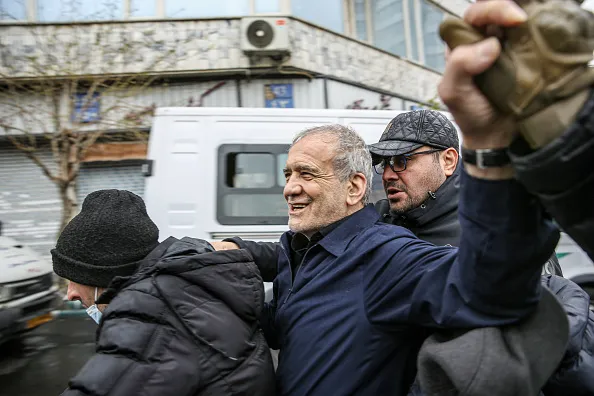
The origin of the explosion and the casualties of the attack are not yet known, but no high-ranking officials have been reported as harmed.
Chief of Police Ahmad-Reza Radan, who was present for the march, considered the attack and Iranian bystanders’ responses a testament to the regime supporters’ commitment.
“The people came today to tell the enemy — we are not afraid of you. The people responded to the sound of the explosion with shouts of ‘Allahu Akbar.’ Before the eyes of the frustrated enemy, the nation will not leave the site, and victory nears.”
Notably absent from the march was Ayatollah Mojtaba Khamenei, who was elected to the position to replace his assassinated father, Ayatollah Ali Khamenei.
The new ayatollah has not appeared in public or produced proof of life since his ascension. Iranian officials have acknowledged that he sustained injuries in a strike but assert that he remains in good health.
He issued his first address as supreme leader on Thursday, read by a state media newscaster.
“Iran has plenty of cameras and plenty of voice recorders. Why a written statement? I think you know why? His father’s dead, he’s scared, he’s injured, he’s on the run, and he lacks legitimacy. It’s a mess for them,” U.S. Secretary of War Pete Hegseth speculated on Friday morning.
The Friday explosions occurred on the 14th day of “Operation Epic Fury,” the U.S. campaign to overthrow the Islamic Republic. Simultaneously, Israel is coordinating strikes with the U.S. military as part of its own “Operation Roaring Lion.”
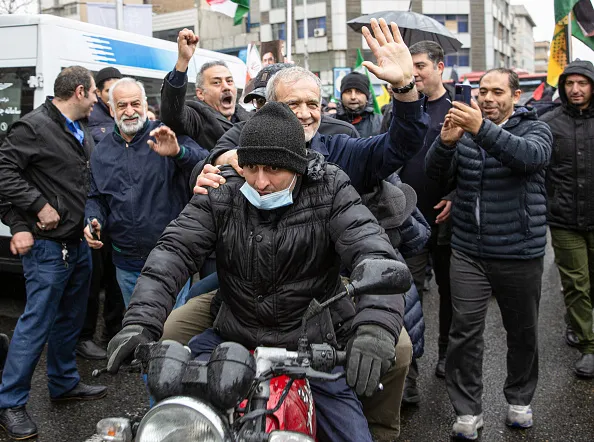
The ultimate goal of the U.S.-Israeli campaign remains somewhat vague.
The White House has at various times attempted to define what a win condition would look like, but ultimately maintains that the conflict will continue until Trump “determines that the goals of Operation Epic Fury, including for Iran to no longer pose a military threat, have been fully realized.”
Crown Prince Reza Pahlavi — the son of the last shah of Iran — is waiting patiently on the sidelines for the regime to collapse.
“On the very first day after the fall of the Islamic Republic, Crown Prince Reza Pahlavi will announce that the constitution of the regime will be completely dissolved,” Leila Bahmany, a legal adviser to the crown prince’s Iran Prosperity Project, said in an interview posted to social media on Friday.
PENTAGON DECLINES TO SHARE US CASUALTY COUNT IN MIDDLE EAST
Pahlavi continues to issue directives to would-be defectors within the Iranian government, pleading with them to abandon their posts and cease working for the regime.
Trump has maintained that while the crown prince seems “very nice,” he is not convinced the would-be shah has sufficient support within the country to form an effective government.