
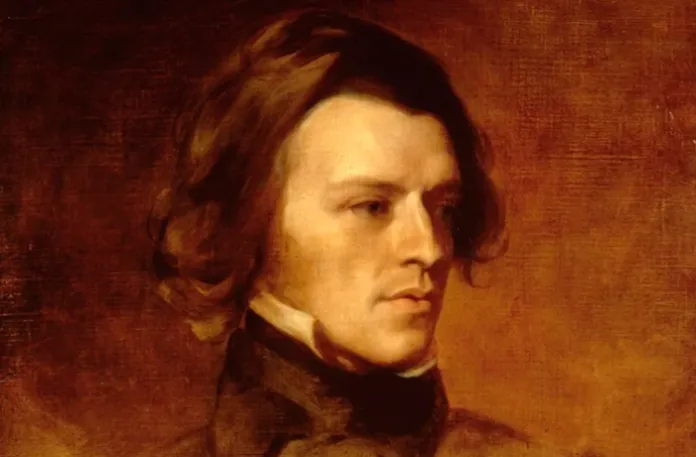
Even Alfred, Lord Tennyson was young once. You wouldn’t know it from the photos, thanks to which he is “enshrined in the national memory” as a “Victorian bard,” face swallowed by “a tremendous beard,” ever after “doomed to look ancient, patriarchal, and prophetic.” Richard Holmes’s purpose in his new study of Tennyson’s formative years, therefore, is to rediscover Tennyson before the beard.
Before, that is, he became: Lord Tennyson; Poet Laureate; the voice of his age; the intimate and confidant of Queen Victoria; so famous he could not attend a funeral without attracting a crowd; crowds which flocked to his house and stared through his windows as his family sat down to dinner, gawking made all the more alarming by the fact that he lived on the Isle of Wight. Which is to say that Holmes’s subject is Tennyson before he was Tennyson.
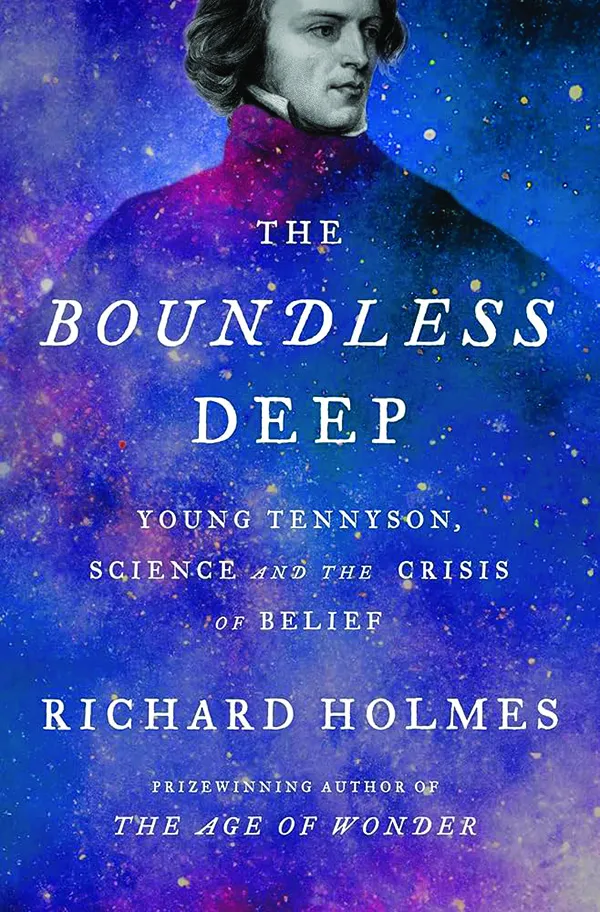
To find him, Holmes deploys the lens of science, examining Tennyson’s abiding connection to the natural world and how the radical transformations wrought upon man’s understanding of it in the first half of the 19th century influenced and were manifest in his poetry. The result is The Boundless Deep: Young Tennyson, Science, and the Crisis of Belief, an informative and engaging book, though also a somewhat dissatisfying one.
Tennyson’s passion for science is evident from even a cursory perusal of his oeuvre.
From “The Palace of Art,” first published in 1832, to 1842’s “The Two Voices” and “Locksley Hall,” through “Vastness” four decades later, to cite but four examples, scientific allusions are strewn across his poems like the fossils he and his contemporaries were equally fascinated and disturbed by.
These were not throwaway references. Tennyson’s interest in science wasn’t superficial. He was steeped in it, so much so, contends Holmes, that it shaped the outlook expressed in his poesy. Not any abstract notion of science, but specifically that of the 1820s-40s. “Tennyson was driven by the emergence – or eruption – of three new and fundamentally transformative ideas from science: that of biological evolution, a godless universe, and planetary extinction.”
These concerns, which exercised Tennyson throughout his career, were foreshadowed from the outset. In one of his earliest poems, 1830’s “The Kraken,” he ruminates on the “Huge sponges of millennial growth and height” which “swell” above that mighty mythological sea creature’s head as it “sleepeth” in the “abysmal sea” where “hath he lain for ages.” Tennyson was a 20-year-old Cambridge student when he composed these lines, yet they convey an atmosphere of impossible antiquity and world-weariness. Holmes opens his biography with a discussion of this “first modern science fiction poem” and reverts to it throughout because, he argues, it prefigured so much of what followed, both in Tennyson’s work and the era as a whole. “The Kraken theme becomes a universal expression of certain Victorian fascinations and fears,” “a monstrous idea” presaging such frightening theories as extinction or a world bereft of a creator. Yet, it also represents “some dark hidden shape in his mind or personality … or perhaps even his soul,” waiting like the beast itself to break the surface. Which, periodically, it would.
As it does in the book, but also only periodically. Which is its chief shortcoming. Despite the emphasis on Tennyson’s scientific predilections, The Boundless Deep is structured like a standard biography. Thus we follow his life from his birth in 1809 to the mid-1850s (with some peeks beyond), encountering along the way his years at Cambridge, his friendships with Arthur Hallam and Edward FitzGerald (author of The Rubaiyat of Omar Khayyam), his courtships of several women and protracted engagement to his wife, Emily Sellwood, his long grief and mourning over Hallam’s death, his peregrinations and the ups and downs of his literary career before he finally made it, the sojourns of the Tennyson men (including Alfred himself) in sanitoriums of one kind or another, and so forth.
This young(er) Tennyson comes across as something of a couch-surfing chimney, perpetually enveloped in a fugue of melancholy and smoke. Perhaps if he’d been of Goethe’s generation or German, he might have taken Werther’s way out. But for Tennyson, that seems never to have been a real option, as his meditation on suicide, “The Two Voices,” demonstrates. Tennyson possessed some unshakeable grip on life that simply would not be loosened even at his most despairing.
And despair he did: “Black Tennyson whose talents were / For an articulate despair,” in Auden’s words that Holmes quotes. Never more so than in In Memoriam A.H.H., his long-gestating elegy for Hallam published in 1850, 17 years after Hallam’s death. If any of his poems embody the “eternal background soundtrack of extinction,” which runs through them, it’s his masterwork.
The evolution sequence of In Memoriam, which occurs about a third of the way through, contains arguably Tennyson’s greatest verses, ones in which Holmes observes, “he lit upon phrases that have been burned into the English language ever since.” The chapter on the evolutionary cantos is Holmes’s best precisely because it is the most on point with the book’s overall theme, and he does an excellent job tracing their genesis and elucidating how they “were directly inspired by his scientific reading.”
The idea that Earth is billions of years old and the universe billions older, that “types” (as Tennyson called species) go extinct and this is part of the natural order, and that this fate may befall man too as part of the natural order, that nature may be, in his immortal lament from “In Memoriam,” “red in tooth and claw,” are to us such pedestrian truths as to no longer deserve comment. They have been “seal’d within the iron hills” of our mental landscape. Yet in Tennyson’s day, these were new and not just troubling but terrifying notions. He was not alone in experiencing such existential dread. His achievement is all the more remarkable for having anticipated Darwin by over a decade.
The period from 1800 to 1850 was a great age of science, the one when it started to look like what we think of as “science.” Holmes excels in situating Tennyson against this background, contextualizing him. Science was in the air, and Tennyson breathed it in. It was the time of pioneering works of scientific popularization, many of which he read. Tennyson associated with, or was acquainted with, numerous scientific luminaries, such as the astronomer Sir John Herschel, the geologist Sir Charles Lyell, the mathematician Mary Somerville, not to mention Charles Babbage, the father of computers. He even crossed paths with William Thomson, the future Lord Kelvin. Perhaps it should have been no surprise that Tennyson took a keen interest in science. After all, his tutor at Trinity College was none other than William Whewell, the great polymath who later coined the term “scientist.” “Scientific leaders … regarded him as a champion of Science,” Hallam Tennyson wrote of his father. Kindred spirits know each other.
It’s because the book, at its best, is so good that one can’t help feeling a bit let down when it strays into more conventional territory, and that instead of adopting a straightforward chronological approach, it would’ve been better served by a more thematic one. Say, Tennyson on geology and on astronomy, just as we do with Tennyson on evolution.
What isn’t in question is that Alfred, Lord Tennyson is one of the greatest poets in the English language. People remain familiar with his words, unlike those of many of his peers about whom the same could be said, even if they aren’t with his name. For he contributed some of the most instantly recognizable phrases in the English lexicon. So whether you’ve never read Tennyson before or Holmes’s book encourages you to revisit him, it will have you reaching for his poetry.
Varad Mehta is a writer and historian. He lives in the Philadelphia area. Find him on X @VaradMehta.