
British Prime Minister Keir Starmer was made aware of disgraced former ambassador Peter Mandelson’s “particularly close relationship” with convicted sex offender Jeffrey Epstein prior to his appointment in Washington.
Documents and emails pertaining to Mandelson’s appointment to the position were released by the British government on Wednesday evening, following Starmer’s appearance at Parliament for Prime Minister’s Questions.
In the advice given to Starmer in the vetting process, it was noted that a JPMorgan report from 2019 found convicted sex offender Jeffrey Epstein appeared to “maintain a particularly close relationship with Prince Andrew the Duke of York and Lord Peter Mandelson, a senior member of the British government.”
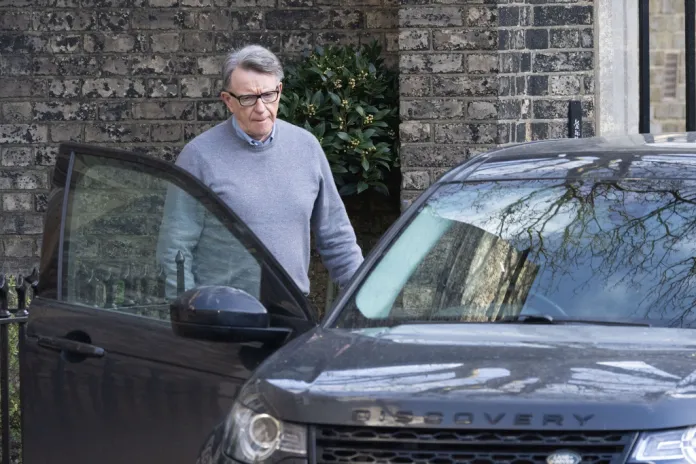
“After Epstein was first convicted of procuring an underage girl in 2008, their relationship continued across 2009-2011, beginning when Lord Mandelson was business minister and continuing after the end of the Labour government,” the December 2024 document reads. “Mandelson reportedly stayed in Epstein’s house while he was in jail in June 2009.”
Advice given to the prime minister conveyed that these ties to Epstein presented a “general reputational risk,” alongside similar reputational risks posed by his “previous departures from the New Labour Government, both relating to financial matters.”
The prime minister has previously characterized himself as largely unaware of how close Mandelson was to Epstein, saying the Labour grandee “portrayed Epstein as someone he barely knew.”
A letter in the files notes a meeting in September 2025, following the initial revelations that Mandelson was closer to Epstein than previously known, in which Starmer expressed concern that the leaked emails “revealed a depth and extent of a relationship with Epstein which [the prime minister] had not been aware of previously when he made the decision to appoint Mandelson.”
With this in mind, Starmer “proposed to ask Mandelson to resign.” Mandelson was dismissed as ambassador on Sept. 11.
Following the dismissal, national security adviser Jonathan Powell is documented as telling investigators that he felt Mandelson’s appointment was “weirdly rushed” due to “concerns” about the ambassador’s “reputation.” Powell raised those concerns to Morgan McSweeney, the former chief of staff to Starmer who is believed to have pushed for Mandelson’s appointment and left 10 Downing Street earlier this year amid fallout for his role in the debacle.
According to the documents, Mandelson demanded a severance payment of about $733,000 after his firing — roughly the salary he would have made as ambassador over the course of a four-year term in the position.
The British government eventually whittled him down to about a $100,000 settlement — infuriating critics who rebuked the idea of any amount of money being given to the disgraced ambassador.
Chief Secretary to the Prime Minister Darren Jones delivered a statement in Parliament immediately following the release of the Mandelson files, in which he attempted to defend the payout as the lesser of two evils.
“Peter Mandelson initially requested a sum that was substantially larger than the final payment, not just two or even three times, but more than six times the final amount,” Jones told members of Parliament, explaining that in light of having “lost the confidence of the prime minister,” the British government “obviously found that to be inappropriate and unacceptable.”

“The settlement that was agreed was to avoid even higher further costs involving a drawn-out legal claim at the employment tribunal, given Peter Mandelson’s employment as a civil servant rather than a minister, the House will know that ministers can be dismissed without recourse to the Employment Tribunal,” Jones argued.
Alex Burghart, shadow secretary for Northern Ireland, spoke against Starmer amid Jones’s appearance in Parliament, saying “the prime minister knew all he needed to know” before hiring Mandelson for the job and therefore is at fault.
“It was on him,” Burghart said. “It’s on him now. He let his party down, he let his country down, and I very much doubt that either will trust again.”
Mandelson’s attorney, in a statement following his arrest due to concerns that he was going to flee the country, said that “Peter Mandelson’s overriding priority is to cooperate with the police investigation, as he has done throughout this process, and to clear his name.”
Large portions of the Mandelson files have not yet been released at the request of the Metropolitan Police, who cited the ongoing investigation into the former ambassador.
Those released do offer a glimpse into former Prime Minister Tony Blair’s meeting with Epstein in 2002.
“The Cabinet Office holds official records that are likely to be released by the National Archives early next year, which relate to a Tony Blair meeting with Epstein that was facilitated by Mandelson,” documents from the newly released files read.
UK CONSERVATIVES FIGHT FOR GOP TIES WHILE SQUEEZED BY THE POPULIST RIGHT
Mandelson sent an email to Blair’s chief of staff in 2002 stating, “I mentioned to TB that Jeffrey is in London next week and he said he would like to meet him.”
“He is safe (whatever that means) and [former U.S. President Bill] Clinton is now doing a lot of traveling with him,” Mandelson wrote, calling Epstein “someone who has his finger on the pulse of many worldwide markets and currencies” and who is “young and vibrant.”