
I may be one of the few people remaining on the planet to both maintain a landline telephone and to decline to avail myself of the alleged benefits of a smartphone. And there is nothing in the new invigorating, imaginative science-fiction comedy Good Luck, Have Fun, Don’t Die that leads me to reconsider my choices.
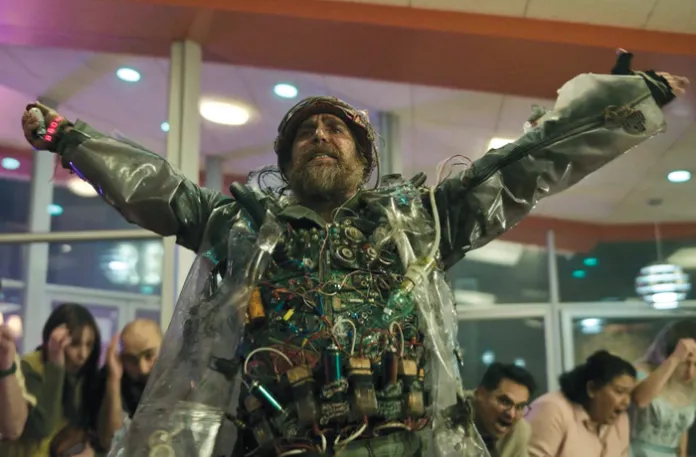
The savvy, witty movie from director Gore Verbinski stakes out an explicitly anti-AI and, more broadly, anti-digital-age position that is refreshing, even fortifying, in a time when rapid, dehumanizing technological advancement is taken as a glum given. Sam Rockwell stars as a wily, cynical time-traveling refugee from the future. Never named, the man is the bearer of bad news to America in the 2020s: In the years to come, he asserts, the public will have become so thoroughly immersed in virtual reality, and will have so completely abdicated their civilizational responsibilities to AI, that the world will be on the verge of collapse.
In the opening scene, Rockwell’s character teleports to a present-day diner, where he holds court with all the mad-scientist oddness of Doc Brown. As if to prove his point, the diner’s patrons are seen scrolling their phones, recoiling from another’s touch, and expressing general indifference to the digital apocalypse foretold by the time traveler.
In addition to Back to the Future, the movie liberally incorporates elements from The Terminator, They Live, and Groundhog Day. But because it marshals them to tell the timeliest of tales, it never feels like a retread or homage. In fact, the only thing old-fashioned about the movie is the sturdily constructed, fluidly realized direction by Verbinski. A quarter-century or more ago, Verbinski was responsible for such eminently craftsmanlike entertainments as Mouse Hunt (1997), The Mexican (2001), and The Ring (2002) before progressing to the Pirates of the Caribbean franchise, whose best entries he helmed. Good Luck, Have Fun, Don’t Die proves that he has not lost his touch, but he directs with the urgency of someone who is himself imperiled by AI’s march: creative, original, relatively well-financed movies such as this one are certain to be among the first to evaporate if too many people become too entranced by fake videos on the order of the recent AI clip featuring the likenesses of Tom Cruise and Brad Pitt clobbering each other — the sort of pointless but hypnotic simulacrum this movie warns against.
Indeed, Good Luck, Have Fun, Don’t Die is that rare modern movie that entertains and edifies in equal measure. That’s largely because its assessment of the digital revolution’s impact on people’s spiritual condition comes with a shock of recognition. Nothing that Rockwell’s character asserts, in his dire report from the future, sounds terribly uncanny or even implausible. “It all started with morning phone time,” he says, before noting how texting, calling, or watching videos evolved from an occasional activity to a way of life. “Pop quiz,” he asks, while slurping a milkshake at the diner. “Anybody know a phone number?” Of course, no one has a number committed to memory — why bother when they can look it up on their smartphone? From such small “conveniences,” the movie is telling us, a society can destroy itself.
Even so, our hero has been down this path before. He has, he says, journeyed back in time on more than a hundred prior occasions to round up comrades to put a halt to AI (using technology developed in the future but needed in the present). This software is shown to be housed on a flash drive, which is not confidence-inspiring. Even less reassuring is the band of random misfits Rockwell’s character cajoles into participating in his plan. This includes married, harried teachers Mark (Michael Pena) and Janet (Zazie Beetz), whose recent experience helps explain their willingness to go along with such a loony plot. Upon trying to engage his class in a discussion of Anna Karenina, Mark encounters the usual Gen Z indifference (“Is it YA?” one girl asks). More alarmingly, when he tries to power down an inattentive student’s smartphone, he triggers some sort of mass reaction among the horde of high-schoolers. The image of a mob of blank-faced adolescents wielding handheld devices is one of the most frightening in cinema since Night of the Living Dead.
Other characters have had their own disheartening experiences with digital delusions that are just a step (or two or three) removed from our own reality. For example, Susan (Juno Temple) mourns the loss of her son to such an extent that she consents to have the boy cloned — a not-unimaginable future when we consider the chatbot simulations of today. Of course, Susan finds that the clone is a soulless substitute apt to spout advertisements for soft drinks.
And then there is Ingrid (Haley Lu Richardson), who, in a replay of the condition that bedeviled Julianne Moore in Todd Haynes’s Safe, is afflicted by nosebleeds whenever she finds herself in proximity to digital devices or too much Wi-Fi. She commits herself to a Luddite lifestyle by performing as a princess at children’s birthday parties until her clientele themselves start to routinely use smartphones. Among a memorable supporting cast, Richardson stands out for credibly inhabiting her off-the-grid character, who listens to vinyl and cassette tapes, owns a camera that shoots film, and so on.
The stories of Mark, Janet, Susan, and Ingrid are sketched in punchy flashbacks that are entertaining on their own without halting the forward momentum of the plot. Although Rockwell’s character has a futuristic mission — to hobble the humanity-destroying potential of AI — he goes about it with appealingly low-tech techniques, including ducking into alleyways and avoiding gunfire from assorted bad guys. During these stretches, Good Luck, Have Fun, Don’t Die becomes a kind of companionable action comedy — fun, exciting, unpretentious. The third act departs from this mode by leaning heavily into visual effects and increasingly over-the-top imagery, but the fundamental premise is so compelling that we do not mind the excesses in its execution.
Anyone worried about the consequences of our digital addictions or acquiescence to the AI avalanche will find a sympathetic filmmaker in Verbinski, who has worked mighty spottily over the last 15 years or so.
Is Good Luck, Have Fun, Don’t Die his last movie made on this scale? If that turns out to be the case, he has outdone himself. So has the always-engaging Rockwell, who munches on all the scenery in sight.
By the film’s head-spinningly Twilight Zone-esque ending, whose details are too good to reveal here, I was reassured once more that I had done the right thing by sticking to my landline and avoiding smartphones. Now, how do I stop watching YouTube videos when I am supposed to be writing?
Peter Tonguette is the film critic for the Washington Examiner magazine.