
Every four years, the world holds a curling tournament that most people refer to as “the Winter Olympics.” Yes, the ice dancers will dance, the ski jumpers will jump, and the double lugers will inexplicably stack on top of each other to hurtle down a track at 80 miles an hour. But in my house, nearly every day of the 25th Winter Games will be spent watching men and women sweeping ice to make way for 40-pound granite rocks.
For a quiet and reserved sport, curling seems to provoke fierce reactions. Its detractors place it among the most absurd of the Olympic events, such as racewalking or the brief experiment with ski ballet at the 1988 and 1992 Games. To be sure, it’s true that it can look remarkably like televised darts. And the competitors are not as physically impressive as the cross-country skiers. The sport does not require the bravery of skeleton sledding.
The Wall Street Journal captured the amateur spirit of curling and had one of the best X posts of the year in its profile of Rich Ruohonen, an alternate on the U.S. men’s team: “A personal-injury attorney in his 50s is on the cusp of becoming the oldest American Winter Olympian in history. All he needs is for one of his teammates to slip and fall.”
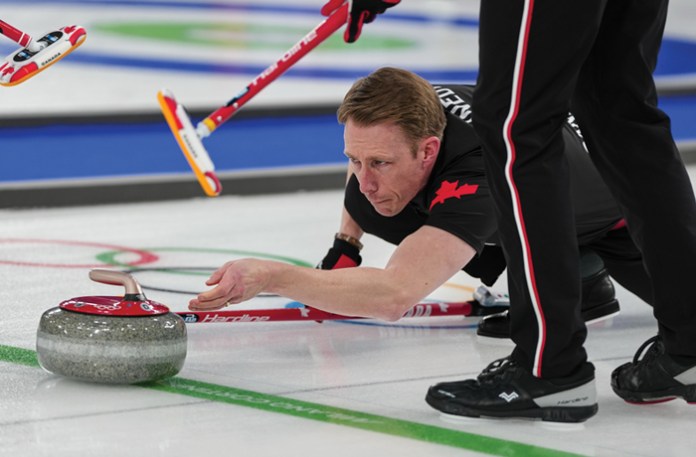
Other curlers have similar backgrounds. Korey Dropkin, who won silver for Team USA in the mixed doubles, is a realtor in Duluth, Minnesota. Aidan Oldenburg, another American curler, is an environmental scientist and “experienced juggler” who works “on permitting for wind and solar projects nationwide.” I don’t imagine that Nike and Adidas are lining up on their doorsteps with endorsement deals.
Nonetheless, the people who think curling is barely a sport are badly misunderstanding it, and missing out on one of the great athletic spectacles of the Olympic cycle. Fans of curling, who I suspect tend toward the bookish end of the sports-watching spectrum alongside baseball fans and people who appreciate special teams play in the NFL, know that whatever Dropkin, Oldenburg, Ruohonen, and their teammates do for their day jobs, these men and women are master tacticians. Curling is frequently called “chess on ice,” which is a bad metaphor, but it speaks to the level of strategy involved.
The most important and confusing element of the rules for anyone that I’ve introduced to curling is the scoring. This is not shuffleboard, and the concentric rings at the end of the sheet, the “house,” are not an accuracy or scoring target like archery or darts, but a visual guide to reckon distance from the center point—the “button.” The closest analogy for scoring in curling might be bocce or pétanque: whichever team finishes each end with the rock closest to the button scores as many points as they have rocks closer than the other team’s closest rock.
Got it? Good.
The strategy element comes from a mix of gameplay and physics. The spin throwers give to the rocks makes them curl, hence the name, over the pebbled ice sheet, while the broom-sweeping melts a thin layer of water to make the rocks fly faster and straighter as needed. A good skip and his teammates can softly curl a rock around a blocking stone onto the button, or ram it at the opponent’s position for a takeout. A well-executed curling shot is something like a cross between watching a billiards pro pocket multiple balls with a single cue strike and a golfer using backspin to place the ball on the green just so.
The nature of curling usually precludes much of the drama that attends other Olympic sports. No curler is going to explode her knee and require a helivac from an Alpine mountainside, and Jamaica does not field a curling team worthy of a feel-good biopic — yet. Some of that lack of drama is a deliberate part of curling culture. The quadrennial influx of fans, myself included, has prompted the moderators on Reddit’s curling forum to halt discussion of inappropriate cheering during matches. In a gentleman’s sport such as curling, the done thing is to cheer good shots from either team, and never to cheer misses.
The gentlemen’s etiquette extends to the ice, where players largely police themselves with no involvement from the officials, except to measure when distances are too close to eyeball. During a USA-Italy round-robin match in the mixed doubles, Dropkin accidentally and illegally kicked his own blocking stone off the center line. Conceding the error, he offered to let the Italians remove or re-place the “burnt” rock, a possibly enormous advantage. The Italians let him keep it. No hard feelings.
It’s been incredible to watch, then, as curling of all sports, and Canada and Sweden of all countries, have become the center of one of the great controversies of the Milan Olympics.
“I haven’t done it once. You can f*** off,” Team Canada’s Marc Kennedy said to Oskar Eriksson of Team Sweden during a match on Feb. 13. “C’mon Oskar, f*** off.”
In the world of curling, this wasn’t some heated-but-normal discourtesy like a hockey fight or charging the mound. This is like Pedro Martinez throwing down with a 72-year-old Don Zimmer, or Myles Garrett using Mason Rudolph’s helmet as a weapon. This never happens.
Sweden had gone to the umpires, itself a rare occurrence, to complain about two problems. One is that you have to release the rock before it crosses the front plane of the “hog line,” the boundary where the stone enters play, and the second is that players have to throw rocks by the handle and never touch the granite at all.
Replays showed that Eriksson was right on both counts. Kennedy clearly touched the granite after the stone crossed the hog line. Canada should have admitted the fault, and the rock should have been removed, as it was a day later when the Canadian women’s team did the same thing.
VANCE AMPLIFIES US OLYMPIANS ARE NOT AT GAMES TO ‘POP OFF’ ON POLITICAL TAKES
Still, it would be hyperbolic to call this “cheating.” For one thing, the rules anticipate hog-line violations. And finger-touching hanky-panky can certainly affect a shot, but Kennedy’s error does not withstand the comparison that many have made to Diego Maradona’s “Hand of God” goal in the 1986 FIFA World Cup.
Something important would be lost if any of this became the norm in curling. It’s good that there is still a sport where players settle disputes with a handshake, where Minnesota nice slip-and-fall attorneys in their 50s can dream of Olympic gold. But maybe a finger’s worth of Olympic controversy and a Canadian level of outrage about hog lines will make the world understand just what a serious sporting business it is to sweep the ice with brooms.
Andrew Bernard is a correspondent for the Jewish News Syndicate.