
Nuclear energy is trending in the right direction, and it’s thanks to an unlikely suspect that has been blowing up for the last four years. Artificial intelligence has been everywhere as of late; you’ve seen it on social media and you’ve most likely used it in the past four years.
As it continues to expand its horizons, its evolution demands a single necessity — the consistent production of massive amounts of energy. Nuclear is the answer to the high maintenance nature that it possesses. It just so happens that nuclear is setting new records in electric generation.
The International Energy Agency report showed that the growth is being driven by “some of the most dynamic segments of global economies, such as AI, data centers, and evolving technological innovations.” Demand is rapidly growing, as consumption has also reached record heights.
AI is powered by massive amounts of electricity from sources such as natural gas, renewables (solar and wind), and nuclear, fueling huge data centers filled with specialized hardware that process immense data sets using complex algorithms (machine learning and deep learning) to find patterns, learn, and make predictions, requiring constant power and cooling. This requires large amounts of energy consumption.
2024 US Primary Energy Consumption
Primary energy consumption includes all energy used in the United States, measured in British thermal units. In 2024, total consumption was 94.2 quadrillion BTUs.
This graph illustrates the energy mix in 2024, highlighting a continued reliance on fossil fuels, which account for nearly 74% of the total. These data confirm that the U.S. economy remains heavily dependent on liquid fuels. While this is well known among those living in the U.S., a shift in baseload power is underway.
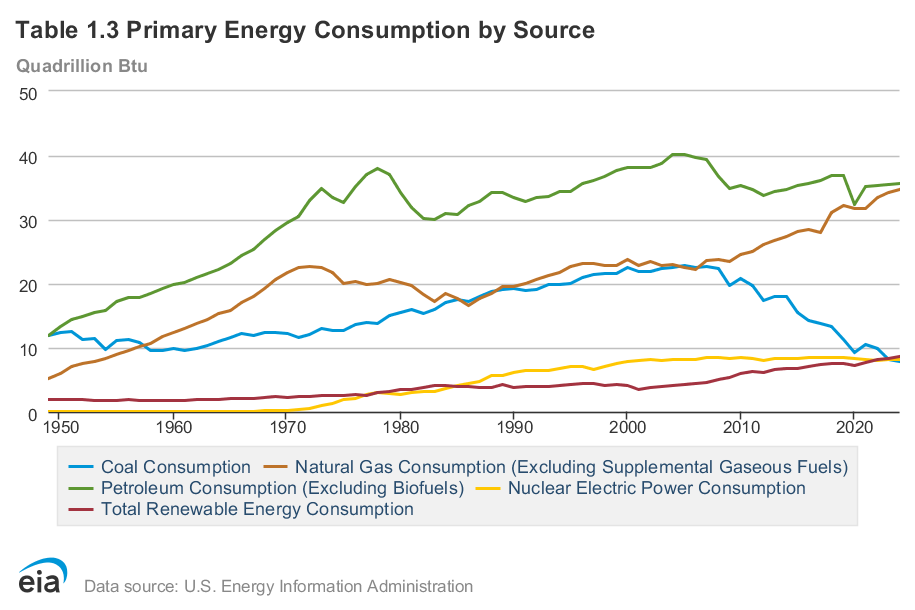
For the first time in modern history, the U.S. consumed more energy from nuclear reactors (~8.7%) than from coal plants (~8.4%). This is a result of the steady decline and retirement of aging coal factories across the country, showing the preference for cleaner, more efficient energy alternatives. While there seems to be significant public focus on the current energy transition, the raw data show that zero-carbon courses still only represent a relatively small portion of the total primary energy mix.
We are seeing a narrow focus being placed on nuclear energy since President Donald Trump entered office in 2025, a year in which he signed four different executive orders on nuclear energy. The four executive orders include:
- Ordering the Reform of the Nuclear Regulatory Commission: This order directs the NRC to speed up the licensing process for new reactors, targeting a decision within 18 months.
- Reinvigorating the Nuclear Industrial Base: This order focuses on strengthening the nuclear supply chain, increasing fuel production, and restarting closed or completing suspended nuclear power plants.
- Reforming Nuclear Reactor Testing at the Department of Energy: This directive mandates that the DOE expedite the testing of advanced reactor technologies.
- Deploying Advanced Nuclear Reactor Technologies for National Security: This order calls for the deployment of advanced reactors at military bases and other critical infrastructure.
These developments followed reports from the DOE confirming that nuclear power maintained the highest capacity factor of any energy source. In practical terms, nuclear plants produced maximum power more than 92% of the time throughout the year — a rate nearly twice that of natural gas and coal units, and three times that of wind and solar plants.
Nuclear power plants are also much more reliable because they require much less maintenance, and they are designed to run for a longer period of time, usually anywhere from a year and a half to two years. The report also highlights that a typical nuclear reactor produces 1 gigawatt of electricity. That doesn’t mean you can simply replace it with 1 gigawatt of coal or a renewable plant. The department continues to explain that you would actually need two coal or three to four renewable plants (each of 1 GW size) to generate the same amount of electricity into the grid.
TRUMP SHOULD REFORM, NOT ABANDON, THE WORLD TRADE ORGANIZATION
There’s no question about AI. It’s here to stay and likely will grow at a rapid pace. In order to keep up with the demanding use of power that it takes to run an AI data center, nuclear power is clearly the answer. Whether you agree with the uses of AI or not, it’s not going anywhere.
It is time for the DOE to focus narrowly on how it can maximize efficiency when it comes to nuclear power plants. We can’t afford to overlook our most reliable asset. The department must continue to increase the function of these plants — because in the race for technological supremacy, we must either go nuclear or go home.