
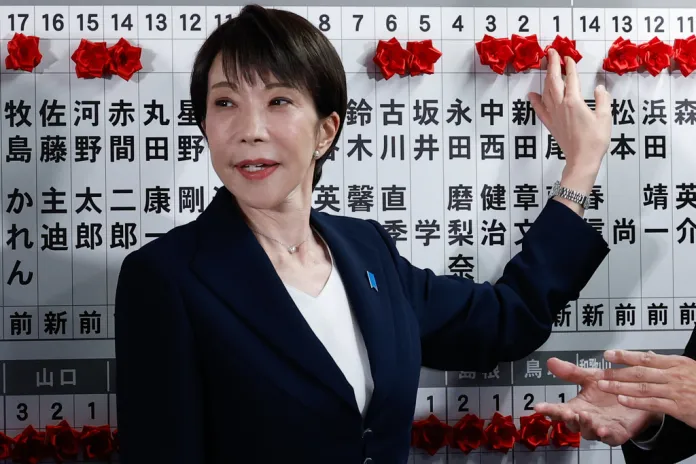
The comprehensive electoral victory of Prime Minister Sanae Takaichi over the weekend secured the Liberal Democratic Party a two-thirds majority in the Japanese Diet, a broad and inarguable mandate for her proposed nationalist revival.
Following her victory, Takaichi was not coy about her policy ambitions — stating firmly on Monday that her goal is to rewrite the Japanese constitution to remilitarize the islands.
“We will work toward constitutional revision while looking ahead to the nation’s future,” the prime minister said. “I am determined to create an environment where a national referendum on constitutional amendment can take place as soon as possible.”
The Chinese Communist Party, already frustrated by Takaichi’s refusals to kowtow on Taiwanese sovereignty, is openly alarmed by the prospect of the Japanese right-wing finally fulfilling a decadeslong campaign to break out of their pacifist handcuffs.
“Various signs indicate that Japan’s right-wing forces are deliberately attempting to challenge the post-war international order from multiple aspects, including military, public opinion and law,” Senior Col. Jiang Bin, spokesman for China’s Ministry of National Defense, said on Tuesday.
He added: “The international community should remain highly vigilant and resolutely take measures to curb this situation, and join hands to safeguard the fruits of victory of World War II and regional peace and stability.”
Takaichi’s cemented position is a major concern for China, which has been outraged with the prime minister for months after she acknowledged a hypothetical invasion of Taiwan as a national security threat that could warrant a military response from Tokyo.
Members of the Beijing elite called Takaichi an “evil witch” and a diplomat stationed in Japan even threatened to “cut off” her “filthy head” following her comments. That ire only grew as Takaichi repeatedly refused to walk back her position.
Takaichi offered an olive branch to the CCP on Monday — suggesting she is open to a mutually respectful dialogue — but Beijing balked.
“No one would accept dialogue when one side talks about dialogue while engaging in confrontation with the other,” Chinese Foreign Ministry spokesman Lin Jian said.
Remilitarization has been a long-term goal of the Liberal Democratic Party for decades, and a signature proposal of the late Shinzo Abe — one of the most successful prime ministers in Japanese history.
Japan was comprehensively demilitarized following World War II when the United States wrote a new constitution for the defeated empire which expressly forfeited their right to declare. A modest Self-Defense Force was formed following reconstruction, and that quasi-military force has become a key ally of the U.S. and other Western powers operating in the Pacific ever since.
The LDP walked away from the Sunday election with 316 seats out of the 465 up for grabs in the House, securing a two-thirds majority, meaning the Liberal Democratic Party can easily push the proposal through the lower chamber of the Japanese Diet.
However, Takaichi’s party does not have even a simple majority in the House of Councillors, the upper chamber.
Left-wing and centrist politicians have long refused negotiations to join onto proposals to remilitarize, characterizing Japanese pacifism as a national virtue. But following the most humiliating defeat in modern history, opposition figures may be forced into deep introspection on where they are willing to bend.
Yoshihiko Noda, coleader of the opposition Centrist Reform Alliance, told reporters that his role in the “devastating defeat” over the weekend is a “responsibility worthy of 10,000 deaths.” Noda and his coleader, Tetsuo Saito, are expected to resign in the following days.
If Takaichi cannot secure enough opposition figures in the House of Councillors to join the constitutional rewrite campaign, she will be forced to wait until the next upper house election in 2028.
CHINESE MILITARY LAUNCHES ‘JUSTICE MISSION’ AROUND TAIWAN AS REGIONAL TENSIONS MOUNT
As Takaichi and the LBP lead a charge to rediscover Japan’s military self-confidence, they can count on one very important ally to have their back.
U.S. President Donald Trump called it an “honor” to have endorsed the prime minister and praised her for seizing the opportunity for a snap election.
“She is a highly respected and very popular leader,” Trump wrote. “Sanae’s bold and wise decision to call for an election paid off big time.”
Takaichi thanked Trump profusely for his endorsement, writing: “Our Alliance and friendship with the United States of America are built on deep trust and close, strong cooperation. The potential of our Alliance is LIMITLESS. Let us work together to ensure that our Alliance continues to bring peace and prosperity to our two nations — and beyond.”