
President Donald Trump sparked a constitutional debate this week after floating the idea that Republicans could consider “nationalizing the voting,” arguing that some states cannot be trusted to fairly oversee the midterm elections.
“Amazing that the Republicans aren’t tougher on it,” Trump said. “The Republicans should say, ‘We want to take over. We should take over the voting in at least 15 places.’ The Republicans ought to nationalize the voting.”
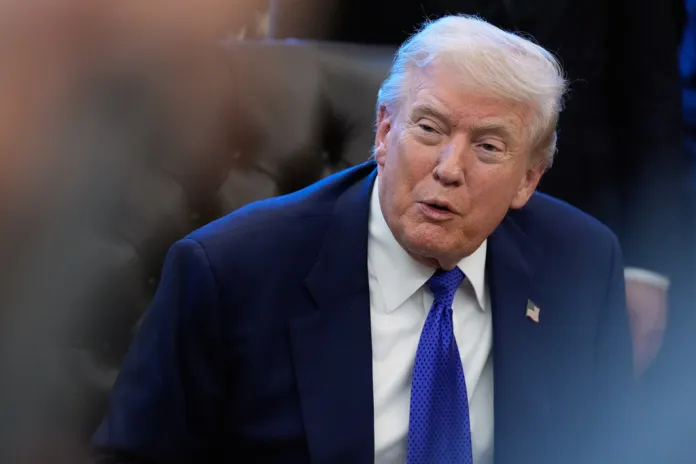
His comments were made Monday on former FBI Deputy Director Dan Bongino‘s Rumble podcast, and they reignited a long-running question that has divided lawmakers and legal scholars for decades.
The White House later framed Trump’s comments as part of a broader push for election security legislation rather than a call for federal control of election administration.
A White House spokesperson pointed to the president’s support for the SAVE Act and related proposals that would establish uniform photo ID standards for voting, prohibit no-excuse mail-in voting, and restrict ballot harvesting.
The legal case against nationalizing elections
Constitutional and election experts have been sounding off about whether nationalizing the election process is even legal, and what ramifications could arise from such a drastic change.
At the center of the debate is Article I, Section 4 of the Constitution — the Elections Clause — which gives states primary authority to regulate the “time, place, and manner” of congressional elections, while allowing Congress to alter those rules by statute. The clause does not grant any similar authority to the president to act on his own, and it leaves other aspects of elections outside federal reach altogether.
Hans von Spakovsky, a senior legal fellow at Advancing American Freedom, told the Washington Examiner that any proposals to nationalize elections would quickly collide with those constitutional limits.
“The Constitution gives Congress certain powers over federal elections, but even there it’s split,” von Spakovsky said. “The qualifications to be a voter are given entirely to the states.”
He pointed to the 26th Amendment as proof that Congress cannot change voter eligibility by ordinary legislation.
“If Congress wanted to pass a law saying you can start voting when you’re 16, that would be unconstitutional,” von Spakovsky said. “That’s why during the Vietnam War, when they lowered the voting age from 21 to 18, Congress couldn’t do it. They had to pass a constitutional amendment.”
Von Spakovsky added that federal authority is even more limited when it comes to presidential elections, where Congress can set the date electors meet but otherwise has little control, and none at all over state elections aside from prohibitions on discrimination imposed by the Reconstruction Amendments.
As a cautionary example, von Spakovsky pointed to Democrats’ 2021 push for HR 1, the For the People Act, which was backed by then-Speaker Nancy Pelosi (D-CA).
“All you’ve got to do is look at HR 1,” he said. “It basically would have nationalized elections. It would have outlawed voter ID laws. It would have required every state to allow absentee ballots to come in after Election Day. It was one bad mandate after another.”
Republicans blocked HR 1, arguing that the Elections Clause was not a blank check for Congress to override state control. But legal scholars note that Congress still retains significant authority if it chooses to exercise it.
The legal case for nationalizing elections
South Texas College of Law Houston professor Josh Blackman contrasted von Spakovsky’s view, telling the Washington Examiner that Congress “probably would have the power” to impose nationwide rules for federal elections under the Elections Clause, but warned that doing so would carry serious long-term consequences.
“The reason why you wouldn’t want it is federalism,” Blackman said. “Some states might have very vigorous voter integrity laws. Other states might have none.”
Blackman warned that once election rules are centralized, they can be reversed just as easily when political power changes hands.
“Conservatives might like it when they are the ones setting the nationwide standard,” he said. “But they might not like it if President Gavin Newsom decides to limit all requirements of voter ID in two or three years.”
That concern was echoed by Sean Trende of RealClearPolitics, who told the Washington Examiner that nationalizing election rules would almost certainly lead to instability.
“That’s exactly what would happen,” Trende said. “If Republicans did this now, Democrats would repeal it the next time they had unified control and replace it with the exact opposite.”
“You’re going to see national photo ID one cycle, then a ban on photo ID the next,” he added. “Forty days of early voting nationally, then same-day registration nationally. It’s just going to be a big, destabilized mess.”
Trende warned that such reversals would leave voters uncertain about the rules governing their ability to vote.
“Some people assume they’re going to have same-day registration because that’s what they’ve had the last three election cycles,” he said. “They show up and they can’t register because the law changed. That’s really going to be bad.”
Rather than sweeping federal legislation, von Spakovsky argued that some of the most contentious election disputes could be resolved through narrower legal channels consistent with federalism. He pointed to a pending Supreme Court case involving Mississippi’s mail-in ballot deadline as a potential vehicle for addressing concerns over ballots received after Election Day.
“The biggest complaint that a lot of folks have had is states allowing absentee ballots to come in after Election Day,” von Spakovsky said. “That issue is probably going to get decided by the Supreme Court.”
“You don’t need to take any action on it,” he added. “The Court is going to decide whether that violates the federal laws that set the national Election Day.”
The executive branch already pursued other lawful means of election oversight through existing statutory mechanisms rather than direct control.
TRUMP RAISES NATIONALIZED VOTING IDEA IN BONGINO’S RETURN PODCAST DEBUT
The Justice Department has sued roughly two dozen states seeking compliance with requirements under the Help America Vote Act, the National Voter Registration Act, and the Civil Rights Act, particularly provisions governing voter roll maintenance and access to election records.
Federal agencies have also expanded cooperation with states that choose to work with immigration databases to identify non-citizens on voter rolls.