
A crowded debate featuring six Democrats and one Republican on Tuesday night signaled a shift in California’s gubernatorial race, as candidates more aggressively trained their fire on term-limited Gov. Gavin Newsom (D-CA) and one another.
Several contenders attacked the outgoing governor, who is eyeing a 2028 presidential run, over the state’s $24 billion homelessness spending, arguing that it has failed to tackle the root causes of the crisis. Democrats also leaned into proposals to tax billionaires, implement rent control, and freeze utility rates, as they attempted to channel voter frustration over the soaring cost of living.
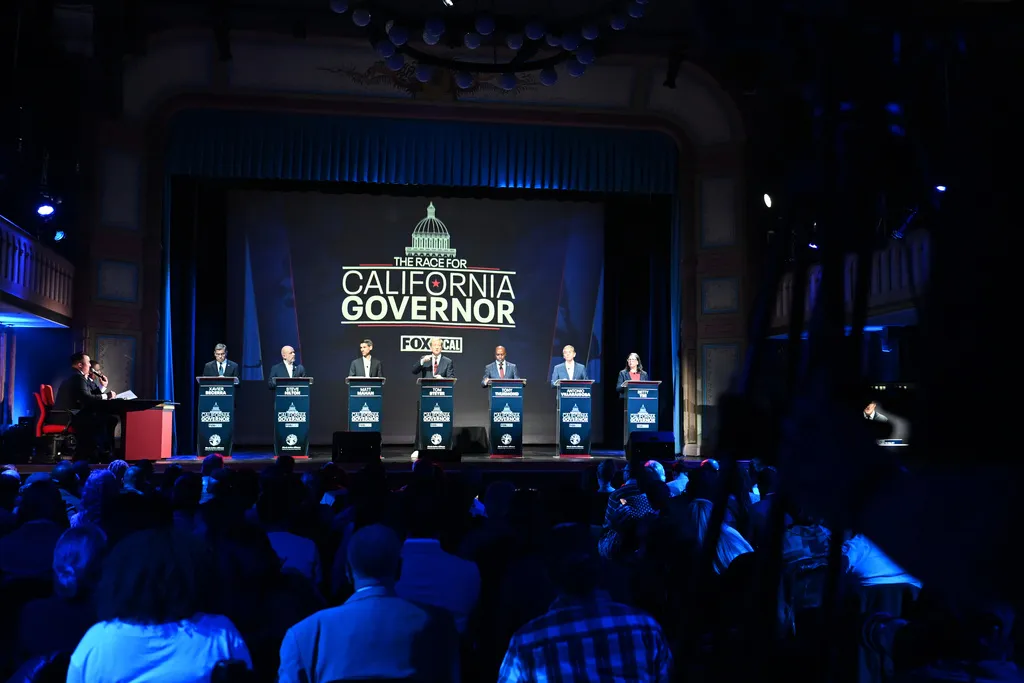
With the primary election less than four months away, the debate underscored how Democrats are now willing to challenge Newsom head-on as the race intensifies. In the past, they had mostly tiptoed around the governor, offering tepid policy contrasts on homelessness, crime, and affordability without naming names.
The debate also featured Republican Steve Hilton, a former Fox News host, who came out swinging against his GOP rival, Riverside Sheriff Chad Bianco, who was a no-show. Hilton also landed a few verbal jabs on newcomer San Jose Mayor Matt Mahan, a Democrat, who announced last week that he would throw his hat into the ring.
The California jungle primary is June 2. The top two candidates, regardless of party affiliation, will advance to the general election on Nov. 3.
The latest Emerson College poll, released in December 2025, has Hilton, Republican Riverside County Sheriff Chad Bianco, Rep. Eric Swalwell (D-CA), and former Democratic Rep. Kate Porter nearly in a four-way tie at the top, with the other candidates polling below 10% each and with 31% of voters still undecided.
Here are four takeaways from the night’s debate.
Homelessness
Former Los Angeles Mayor Antonio Villaraigosa, who lost a gubernatorial bid to Newsom in 2018, cited the state’s homelessness spending as a case study in government failure.
“We spent $24 billion at the state, along with billions more from the counties and the cities throughout the state, and homelessness went on,” he said. “We cannot be afraid to look in the mirror.”
During Newsom’s final State of the State address last month, he claimed that the number of unsheltered people on his watch had declined but blamed local officials for dragging their feet on other issues tied to the problem. The state experienced a 9% drop in unsheltered homelessness last year, but the number of people living on the streets or in their cars is still significantly higher than when Newsom took office in 2019.
The state’s homeless population grew dramatically in the second half of the 2010s. The last time California recorded an annual decline in homelessness was 2014, when it fell by 2%. The last major decline seen in the state was in 2009, when the count of unsheltered homeless people dropped by 18%.
Newsom has touted the most recent decline as proof that his methods are working.
Mahan, who made a name for himself by criticizing the governor on homelessness, found himself in the hot seat with Hilton, who mocked a recent interview in which Mahan praised Newsom’s progress in reducing homelessness at the state level, an about-face from earlier comments.
“He just said in an interview that the thing he most admires about Gavin Newsom is his record on homelessness,” Hilton said as he stood at a podium next to Mahan. “You’ve got to be kidding me.”
Mahan hit back, informing viewers that Hilton recently visited San Jose and asked him what the city was doing right to lower homelessness rates so he could replicate it.
“l’ll just note that Steve, you came to San Jose just a week ago to see what’s working,” Mahan said. “… But what’s wrong with our politics is when we denigrate ideas because of who had them.”
Mahan said Newsom is “focused on the right issues” but that the new governor would have to build on them, including the “Care Court plan to treat people with addiction or mental issues.”
As of early 2026, San Jose has experienced a 10% drop in its unsheltered homeless population since 2023, with about 60% of the area’s 6,503 homeless residents in shelters.
Affordability
California is in the middle of a deepening affordability crisis. The state has some of the highest gas and electricity costs in the country. Rent, housing costs, and other day-to-day financial struggles have created a tough environment for most residents.
Former Health and Human Services Secretary Xavier Becerra said he would stabilize rents and freeze utility and home insurance costs “until we find out why they’re increasing.”
Climate activist Tom Steyer leaned into rent control during the debate, while he and former state Controller Betty Yee argued that loosening zoning and permitting rules is key to boosting housing supply, especially near public transit.
Steyer and Mahan found common ground in promoting tech-driven solutions, such as prefabricated construction, to speed development and lower housing costs, highlighting an emerging cross-faction push for housing reform. The state’s Superintendent of Public Instruction, Tony Thurmond, said he would raise taxes on billionaires and create tax credits for struggling families, while Villaraigosa and Hilton said they would lower gas prices by cutting regulations on California’s oil refineries.
Hilton also blamed the state’s high cost of living on Democrats, arguing that they have been in power for more than 16 years and that whatever issues Californians are facing are the Democrats’ fault.
Billionaire tax debate
The fight over a proposed 5% wealth tax on billionaires has been gaining traction in the state and took center stage during the debate.
The healthcare workers’ union pushing the measure claims that it is necessary to offset cuts from President Donald Trump’s tax bill and argues that hospital closures and job losses could be on the horizon if the state does not receive a massive infusion of cash.
Newsom has vowed to use his political power to stop the wealth tax on billionaires, even if that means going against his own party and angering unions in the process. He has claimed that even the introduction of a wealth tax has driven billionaires to relocate and take their sizable tax dollars with them.
The proposal itself calls for California residents with more than $1 billion in assets to pay a one-time tax equal to 5% of their assets. For example, someone with $1 billion in assets would be required to pay $50 million in taxes over five years.
Steyer, himself a billionaire, is among a group of Democrats who have supported the measure in recent weeks.
“I’m the billionaire who’s going to take on the billionaires,” he said, before taking Mahan to task for opposing it.
Who skipped?
There were four no-shows at the debate.
Swalwell, a seven-term representative and a manager during Trump’s second impeachment trial in 2021, was slated to attend but was in Washington, voting “against the ICE budget.”
Porter’s team cited a scheduling conflict but did not say what it was. Porter came under fire last year for her behavior during a CBS News Sacramento interview when asked what she would say to the 40% of Californians who voted for Trump. Porter said she would not need them and appeared visibly agitated before threatening to walk out of the interview. The prickly exchange went viral and prompted bipartisan criticism and questioning of her temperament.
Bianco also passed on Tuesday night, citing a scheduling conflict. Hilton blasted Bianco for skipping the debate and also faulted him for taking a knee with protesters during the 2020 racial unrest.
A ‘NEW WORLD ORDER’ IS HERE, AND IT’S HERE TO STAY
“Chad Bianco has got more baggage than LAX,” Hilton quipped.
Ian Calderon, a Democrat and former state Assembly member from the San Gabriel Valley, also did not attend the debate. There was no excuse given.