
EXCLUSIVE – Every year, Nigel Farage claims his populist movement is about to destroy the Conservative Party and remake British politics. The thing is, he might be right this time.
“This is the biggest set of elections between now and the next general election, and it could be a very, very pivotal moment,” Farage told the Washington Examiner in an exclusive interview, referring to upcoming local elections.
Farage, the architect of Brexit turned leader of Reform U.K., has seen his support surge while Prime Minister Keir Starmer and his Labour Party suffer historically unprecedented levels of disapproval. Meanwhile, the usual benefactors of Labour’s demise, the Conservative Party, are being picked off one by one by Reform as it looks to supplant them as the true party of the British right.
Farage is not interested in coming to the Conservatives’ rescue, charging that they were “elected as conservatives [and] governed as liberals” for the 14 years prior to Starmer’s 2024 win. The arch-Eurosceptic blames the Conservatives, or Tories, for failing to deliver on the Brexit victory he delivered, and would rather burn their party down.
“All the promises, all the hopes of what Brexit might be able to do — none of it delivered at all,” Farage ruminated, reflecting on the British public’s “feeling of genuine anger that the Conservative Party did not represent their voters.”
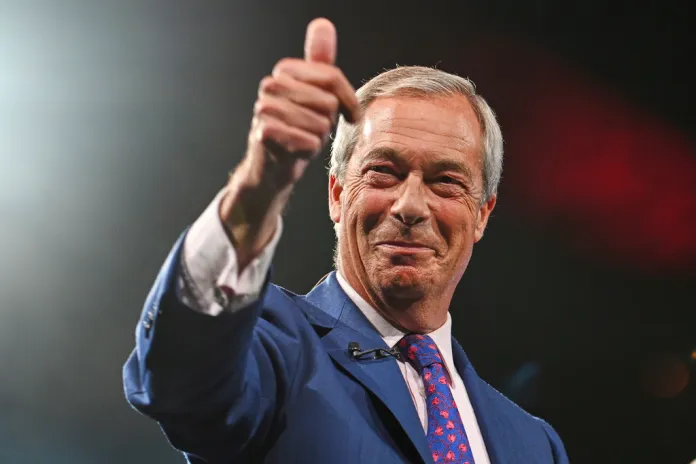
“I’ve been around for decades. People know me. They voted for me in the past in the millions,” Farage told the Washington Examiner. “I’m saying to people — look, you know what? It’s about time I was in charge.”
It’s not just typical Farage bluster. Reform’s rise and the Tories’ fall have been reflected in British public polling data for months.
Reform currently leads by a comfortable 28%, with Labour in a distant second at 19%. The Conservatives are in a close third with 18%, followed by the Greens and Liberal Democrats with 15% and 13% respectively.
Kemi Badenoch, the current Conservative leader, has presented herself as a cool-headed and confident steward of the world’s oldest extant political party, but morale is low.
Following nearly a decade and a half in power, the Tories suffered a historic collapse in the July 2024 general election. The party lost two-thirds of its seats in parliament, a rejection not seen since its founding in 1834.
Recurring points of frustration cited in public polls include a failure to address illegal immigration, political infighting, and a lack of adherence to traditional conservative social values.
Since then, the Tories have attempted a hard pivot toward populist policies similar to U.S. President Donald Trump, promising to get serious about migrants, social disintegration, and the nation’s languishing economy.
Unfortunately for them, Reform U.K. appears to have beaten them to the punch with a bombastic campaign centered on immigration, complete with mock-up departure boards for remigration.
James Johnson, co-founder of the polling firm JL Partners and former chief pollster at 10 Downing Street under former prime minister Theresa May, told the Washington Examiner that his team warned of the Tories’ implosion in a late 2023 report titled “Implosion in Blue.”
“We really sort of singled out the rise of Reform as being the key reason,” Johnson explained. “A lot of people weren’t really taking them seriously, and that really got borne out in reality because obviously the following year we had that election where, you know, the Conservatives did very badly — mostly because of the rise of Reform.”
Tory politicians see the writing on the wall. Former Home Secretary Suella Braverman became the most recent defector this week when she appeared onstage with Farage at a Veterans for Reform rally in London.

She was characterized as the perfect candidate to switch from Conservative to Reform, having been seen as farther to the right than previous Tory administrations on social issues like immigration.
“[Braverman] obviously thought long and hard about it, but, like many Tory MPs, she’s come to the conclusion that the Conservatives are disintegrating,” Farage told the Financial Times after stepping offstage at the event.
Former finance minister Nadhim Zahawi joined Reform on Jan. 12, calling the party’s surge a “glorious revolution.” It was a marked turn for Zahawi, who in 2015 compared Farage to a Nazi officer.
Just days later, Badenoch announced she was sacking Shadow Justice Secretary Robert Jenrick and suspending his party membership after being “presented with clear, irrefutable evidence that he was plotting in secret to defect in a way designed to be as damaging as possible to his Shadow Cabinet colleagues and the wider Conservative Party.”
Her intel was proven correct when Jenrick appeared onstage with Farage later that day and declared that “both Labour and the Conservatives broke Britain. Both parties are committed to a set of ideas that have failed Britain.”
Andrew Rosindell, an MP since 2001 who said he had been a Tory since age 14, defected on Jan. 19. He claimed the Tories were “irreparably bound to the mistakes of previous governments.”
May 7th deadline day
The deadline for Tories contemplating defection to Reform is already set for May 7, the day local elections are held across England, as well as elections in Scotland and Wales. Local elections are often used as a protest vote against the government or establishment.
Farage senses blood in the water.
“I’m not sure Starmer will survive the summer. I think the Conservative Party may well cease to be a national party after May the seventh,” he said. “They just disappear in the North and disappear in Scotland completely. They’ll be down to a handful in Wales.”
If any defection-curious politicians believe the Reform leader’s forecast, they only have a few more months to act because Reform is not interested in courting doubters.
“Any Conservative MP who still clings to the hope that their party can recover and waits until May 8 to try to leave the sinking ship does not understand how rapidly things are changing out in the country,” Farage wrote in a column earlier this month announcing the deadline. “Trying to use Reform as a lifeboat to save their own political skins will not wash. We have no interest in rescuing political failures.”
Johnson told the Washington Examiner that while defectors have helped Reform build out and present itself as a truly viable third-party, at its heart, the movement remains a one-man band.
“It’s easy to get carried away with the other personalities because they’re in the news more recently, but Reform is Farage, Farage is Reform,” said Johnson. “He is the one that has built this appeal. Most voters didn’t really know what Reform was — and then Farage came on back onto the scene.”
Sergeant Major Farage
Farage has been a preeminent face of right-wing British politics since at least the 2010s, when he served as a representative to the European Parliament and led the opposition to the bloated European bureaucracy that would ultimately manifest itself in Brexit.
His addresses to the supranational body, usually mixing righteous indignation with cheeky banter, frequently went viral in the U.K. and abroad.
As he was delivering his final speech ahead of Britain’s formal withdrawal from the EU in January 2020, Farage referred to the moment as the “summit of his own political ambitions.” But another line in his speech foreshadowed his crusade against his own nation’s establishment.
“There’s a historic battle going on now across the West — in Europe, America, and elsewhere,” he warned his fellow European bureaucrats. “It is globalism against populism. And you may loathe populism, but I tell you a funny thing — it’s becoming very popular.”
For the first few years following his stint in the European Parliament, Farage left what he called “frontline politics” and pursued a slew of side projects. His lucrative pursuits ranged from founding a brand of artisan gins to recording paid video messages on the Cameo platform. All the while, he kept one toe in the political sphere with frequent columns and media appearances.

But it was his appearance on the 2023 season of I’m a Celebrity… Get Me Out of Here! — a popular British reality TV show — that supercharged his brand.
Johnson told the Washington Examiner that this dabble into reality TV, alongside actors, athletes, and influencers, sold Farage as a politician better than any speech or debate.
“In the focus groups, that was a key moment when a lot of the public who assumed that Farage was just another politician, or quite elitist or quite smarmy, actually then started saying, ‘Oh, he’s quite approachable. He’s quite down to Earth,” Johnson explained.
He continued: “And the words that they used the most […] is ‘Sergeant Major.’ He’s this sergeant major character, you know, no nonsense type.”
In this sergeant major’s war against the Conservatives, there are to be no truces. He and his deputies have repeatedly affirmed that no pacts or alliances will be made with the Tories, even if that threatens the ability to form a right-wing government.
Conservatives, for their part, have been just as outspoken against the idea.
“Under Kemi Badenoch’s leadership, the Conservatives will not be considering any deals or pacts,” a party spokesperson said in December. “Only the Conservatives have the team, the plan, and the backbone to deliver.”
Lord Dan Hannan, a Conservative life peer in the House of Lords, is no fan of the Reform movement.
He believes Farage’s campaign has enjoyed temporary but unsustainable popularity by banging the war drums on immigration, while failing to prepare a team to handle a slew of unprecedented problems created by Labour that only experienced civil servants will be able to solve.
“Obviously, Reform has exploited its position on [immigration] because they have clean hands. But unemployment is going up in a way that we haven’t really had for 30 years,” Hannan told the Washington Examiner. “It’s kind of new for us. Everyone knows kids who have left university with good degrees and can’t find work.”
In Hannan’s mind, the question voters will be asking themselves at the voting booth: Who do you want as Chancellor of the Exchequer, an untried guy who says all the right stuff about immigration? Or somebody with a bit of business experience?”
But Hannan is not among those Tories who see Reform U.K. as barbarians beneath the dignity of negotiation.
In his mind, reconciling the two parties is a political necessity.
“I’m still of the view that there needs to be a coming together… That it is just not viable under our electoral system — any more than under [America’s] — to have two rival parties on the right,” Hannan told the Washington Examiner. “It’s a complete disaster for both of them.”
Labour may suffer from grim levels of disapproval, but third parties such as the Greens and Lib Dems could scoop up enough voters to patch together an alliance if Reform and the Tories truly refuse to work together.
Farage and other Reform leaders have floated the rumor that a senior Labour figure is poised to be the next defector, but that individual has yet to materialize.
“Didn’t happen yet. It will,” Farage said when asked about the supposed turncoat. “We are talking to a number of people who held senior positions in the Labour Party, and yes, they will come.”